

Saved Bookmarks
This section includes 7 InterviewSolutions, each offering curated multiple-choice questions to sharpen your Current Affairs knowledge and support exam preparation. Choose a topic below to get started.
| 1. |
If y =-x-15 and (5y)/(2)-37=-x/2, then what is the value of 2x + 6y ? |
|
Answer» SOLUTION :You're asked for the value of an expression rather than the value of one of the variables, so try COMBINATION. Start by rearranging the TWO equation so that variables and constants are aligned: `x+y=-15` `x/2 + (5y)/(2) =37` Clear the FRACTIONS in the second equation and then add the equations: `2 ((x)/(2)+ (5y)/(2) =37)to x + 5y =74` `x +y=-15` ` (+x + 5y =74)/(2X + 6y=59)` This is precisely what the question asks for, so you're done. Grid in 59. |
|
| 2. |
By using the properties of definite integrals, evaluate the integrals int_(-5)^(5)abs(x+2)dx |
|
Answer» |
|
| 3. |
Using elementry transformation, find the inverse of the matrices. A = [(2,-6),(1,-2)] |
| Answer» SOLUTION :`A^(-1) = [(-1,3),(-1/2,1)]` | |
| 4. |
The solution of the differential equation x(dy)/(dx) = y - x tan((y)/(x)) is (Here, k is an arbitrary constant) |
|
Answer» `X = y SIN^(-1)((k)/(x))` |
|
| 5. |
A matrixwhich is not a square matrix is called a ….. Matrix. |
|
Answer» |
|
| 6. |
Area of the region bounded by the curve y^(2) = 4x, y -axis and the line y = 3 is |
|
Answer» 2 |
|
| 7. |
Find the locus of the vertices of equilateral triangle circumscribing the ellipse x^(2)/a^(2)+y^(2)/b^(2)=1. |
|
Answer» |
|
| 8. |
Let f(x) be a continuous function such that f(a-x)+f(x)=0 for x in [0, a]. Then int_(0)^(a)(dx)/(1+e^(f(x))) is equal to |
| Answer» ANSWER :2 | |
| 9. |
Find the circumcentre of the triangle whose vertices are (1,3) (0,-2) and (-3,1). |
|
Answer» |
|
| 10. |
If f(x+ay,x -ay) = axythen f(x,y) = ...... |
|
Answer» XY |
|
| 11. |
Let the foci of the hyperbola (X^(2))/(A^(2))-(y^(2))/(B^(2))=1 be the vertices of the ellipse (x^(2))/(a^(2))+(y^(2))/(b^(2))=1 and the foci of the ellipse be the vertices of the hyperbola. Let the eccentricities of the ellipse and hyperbola be e_(E) and e_(H), respectively. Then match the following lists. |
|
Answer» `A=ae_(E) and a=Ae_(H)` `"or"e_(E)e_(H)=1` `therefore""e_(E)+e_(H)gt2""("Using "e_(E)+e_(H)gtsqrt(e_(E)e_(H)))` `B^(2)=A^(2)(e_(H)^(2)-1)=a^(2)(1-e_(E)^(2))=b^(2)` `"or"(b)/(B)=1` Also, the angle between the asymptotes is `2TAN^(-1).(B)/(A)=(2pi)/(3)` Also, `(B)/(A)=sqrt3or(b)/(ae_(E))=sqrt3ore_(E)^(2)=(1)/(4)` Solving `(X^(2))/(a^(2))+(y^(2))/(b^(2))=1 and (x^(2))/(a^(2)e_(E)^(2))-(y^(2))/(b^(2))=1 or(2X^(2))/(a^(2))-(y^(2))/(b^(2))=1` Now, solve. |
|
| 12. |
The vertex and focus of a parabola are at a distance of h and k units on positive x-axis from origin. Then equation of parabola is |
|
Answer» `x^(2) = 4 (K- h) (y-k) ` |
|
| 13. |
Find the number of ways of arranging 15 students A_1,A_2,…….,A_(15) in a row such that A_2 must be seated after A_1 and A_3must come after A_2 |
|
Answer» |
|
| 14. |
If A and Bare square matrices of same order such that AB = A and BA = B, then AB^(2)+B^(2)=:a) ABb) A+Bc) 2ABd) 2BA |
|
Answer» AB |
|
| 16. |
Which of the following differential equations has y = c_(1)e^(x) + c_(2)e^(-x) as the general solution? |
|
Answer» `(d^(2)y)/(DX^(2)) + y = 0` |
|
| 17. |
Find the solutions of the equation z^(2) + |z| = 0. |
| Answer» | |
| 18. |
A vector perpendicular to 2overset(^)i+overset(^)j+overset(^)k and coplanar with overset(^)i+2overset(^)j+overset(^)k and overset(^)i+overset(^)j+2overset(^)k is |
|
Answer» `5(OVERSET(^)j-bark)` |
|
| 19. |
int_0^(pi/2)sin^11thetad theta |
| Answer» SOLUTION :`int_0^(pi/2)sin^11thetad theta=10/11 CDOT 8/9 cdot 6/7 cdot 4/5 cdot 2/3=(3840)/4455` | |
| 20. |
int (1-tanx)/(1+tan x)dx= |
|
Answer» |
|
| 21. |
An equation of the plane passing through the point (1,-1,2) and parallel to the plane 3x+4y-5z=0 is |
|
Answer» `3x+4y-5z+11=0` |
|
| 22. |
If y= a sin x + b cos x then, y^(2) + (y_(1))^(2)= ……. (a^(2) + b^(2) ne 0) |
|
Answer» `a COS X - B sin x` |
|
| 23. |
Solution of the differential equation x=1+xy^((dy)/(dx) + ((xy)^(2))/(2!) ((dy)/(dx))^(2) + ((xy)^(3))/(3!) ((dy)/(dx))^(3) +……. is |
|
Answer» `y log_(e)X +C` `RARR logx = xy (dy)/(dx) rArr ydy (log x)/x dx` On INTEGRATION, we get `y^(2)2 = (log_(e)x)^(2)/2 + C` `y^(2) = (log_(e)x)^(2) + C` Hence, `y = +- sqrt((log_(e)x)^(2) + 2C)` |
|
| 25. |
.........Was a spiritual leader than a politician. |
|
Answer» NEHRU ji |
|
| 26. |
Two squares are chosen at random from the small squares on a chess board. What is the chance that the two squares have exactly one common corner. |
|
Answer» |
|
| 27. |
Now that Max has the plan for the building, he heads to the Team Rocket building with Officer Jenny. The entrance however, is password protected. A hint has been provided. The Combat Potential of this family of Charmanders are controlled by their Health and Attack, which are each labelled by one of 8 distinct prime numbers. Each pokemon has a characteristic pair of Health(H) and Attack(A), receiving one from each parent, and have neither H nor A values in common with their siblings. Each pokemon's CP is precisely the product ofits A and H values,never crossing 120, and in each of the six (adjacent) pairs, the female (circles) have higher CP than males (squares). The password is the sum of CP in the boxes labelled 1,2 and 3. What is the password? |
|
Answer» 299 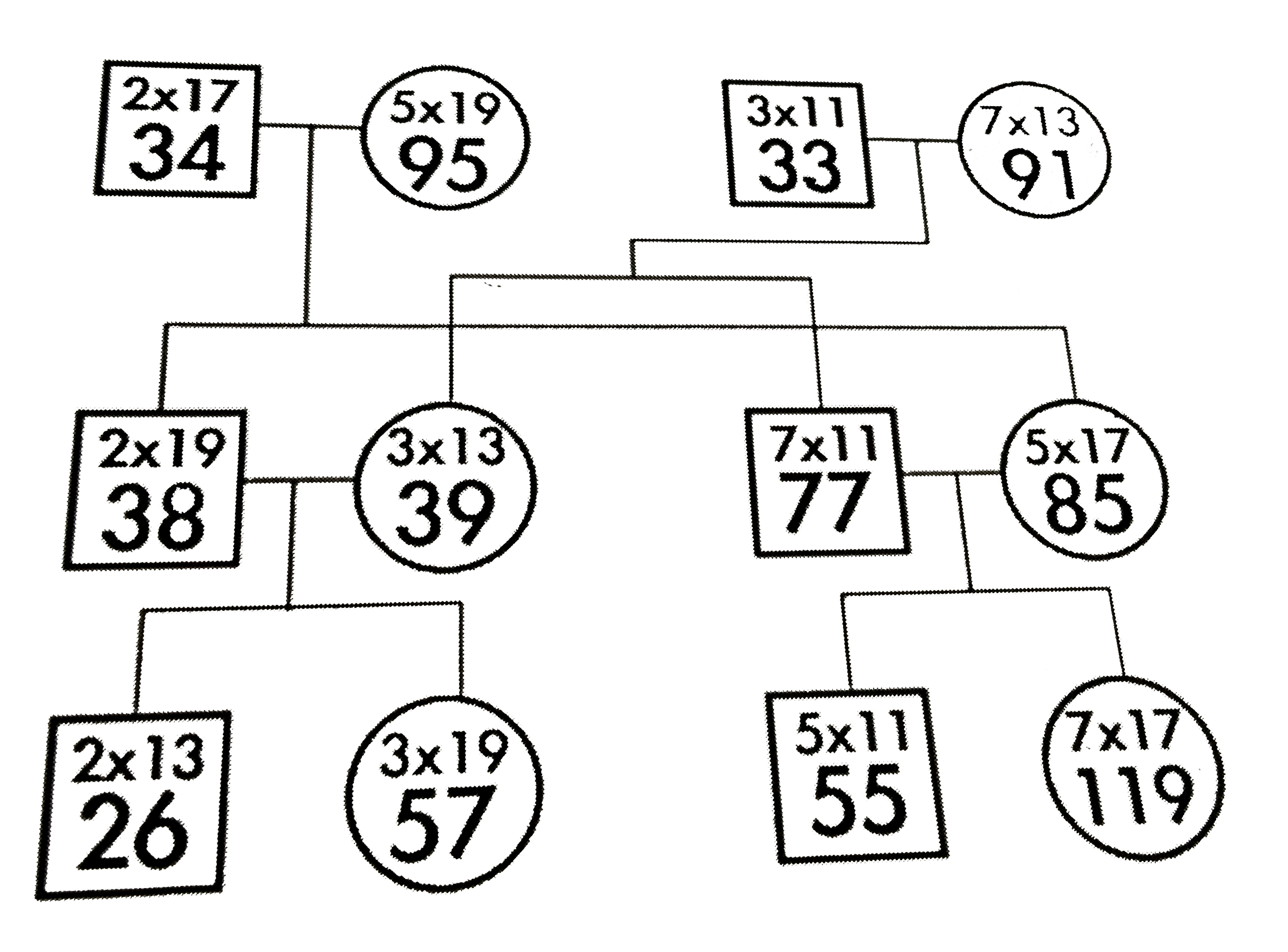 By eliminating some of the NUMBERS because the PRODUCT of the PRIMES will EXCEED the given LIMIT, we can arrive at this solution. |
|
| 28. |
Find the number of ways of selecting 3 - number subset of the set {1, 2, 3, 4 ....... 30} so that the number form a G.P. with common ratio as integer. |
|
Answer» |
|
| 29. |
Prove that the function L(x), defined in theinterval (0, infty) bythe integral L(x) = int_(1)^(x) (dt)/(t) isan inverse of the function e^(x) |
|
Answer» |
|
| 30. |
If int cosec 2x dx = f|g(x)| + C then |
|
Answer» RANGE of g (x) = `[0, oo)` |
|
| 31. |
Consider the fourteen lines in the plane given by y=x+r,y=-x+r, where r in{0, 1, 2, 3, 4, 5, 6). The number of squares formed by these lines, whose sides are of length sqrt(2), is |
|
Answer» 9 |
|
| 32. |
Solution of the differential equation (dy)/(dx)=(6x^(2)-5xy-2y^(2))/(6x^(2)-8xy+y^(2)) is |
|
Answer» `(y-2x)^(12)=C(y-x)(y-3x)^(9)` |
|
| 33. |
The noncommon rays of 2 adjacent angles form a straight angle. The measure of one angle is 4 times the measure of the other angle . What is themeasure of the smaller angle ? |
| Answer» ANSWER :A | |
| 34. |
An equilateral triangle is inscribed in the circle x^(2)+y^(2)=a^(2). The length of the side of the triangle is |
| Answer» ANSWER :B | |
| 35. |
IF""^(n)C_(r-1):""^(n)C_(r)= 2 : 3then( n , r)= |
|
Answer» `(34,14)` |
|
| 36. |
On Z, a relation R is defined as follows: a,b in Z, aRb if 7|(a-b), then which of the following is not true? |
|
Answer» R is reflexive |
|
| 37. |
Two tangents on a parabola are x-y=0 and x+y=0. S(2,3) is the focus of the parabola. If P and Q are ends of the focal chord of the parabola, then (1)/(SP)+(1)/(SQ)= |
|
Answer» `2sqrt(13)//3`  We know that foot of perpendicular from the focus upon a tangent lies on the tangent at the VERTEX of the parabola. Now, if the foot of perpendicular of (2,3) on the line x-y=0 is `(x_(1),y_(1))` , then `(x_(1)-2)/(1)=(y_(1)-3)/(-1)=(-(2-3))/(2)` `orx_(1)=(5)/(2)andy_(1)=(5)/(2)` If the foot of perpendicular of (2,3) on the line x+y=0 is `(x_(2),y_(2))`, then `(x_(2)-2)/(1)=(y_(2)-3)/(1)=-(2+3)/(2)` `orx_(2)=-(1)/(2)andy_(2)=(1)/(2)` Now, the tangent at the vertex passes through the points `(5//2,5//2)and(-1//2,1//2)`. Then, its equation is `y-(1)/(2)=(2)/(3)(x+(1)/(2))` `or4x-6y+5=0` The length of latus rectum of the parabola is `4xx` (DISTANCE of locus from tangent at vertex) `=4xx|(8-18+5)/(sqrt(52))|=(10)/(sqrt(13))` Also, the distance between the focus and the tangent at vertex is `5//sqrt(13)` We know that `(1)/(SP)+(1)/(SQ)=(1)/(a)` where a is `1//4`th of the length of latus rectum. Therefore, `(1)/(SP)+(1)/(SQ)=(2sqrt(13))/(5)` |
|
| 38. |
The points of intersection of the circle x^(2) + y^(2) = a^(2) and the line x + y = a is |
|
Answer» (a, 0) and (0, a) |
|
| 40. |
Let f(x) = {{:( x^(3) + x^(2) - 10 x ,, -1 le x lt 0) , (sin x ,, 0 le x lt x//2) , (1 + cos x ,, pi //2 le x le pi ):} then f(x) has |
|
Answer» LOCAL maximum at `X = pi/2` |
|
| 41. |
Let A=(-3, 4) and B=(2, -1) be two fixed points. A point C moves such that tan((1)/(2)angleABC):tan((1)/(2)angleBAC)=3:1 Thus, locus of C is a hyperbola, distance between whose foci is |
|
Answer» `5` |
|
| 42. |
Using the methodof chords , find approximate values of the real roots of the following with an accuracy up to 0.01the positiveroots of the following equations: (a) (x-1)^(2)-2 sin x = 0 (b)e^(x) - 2(1-x)^(2) = 0 |
|
Answer» (B) `0.21` |
|
| 43. |
Discuss the continuity of the function f given by f(x)= |x|" at "x=0. |
|
Answer» |
|
| 44. |
Show that the following four points in each jof the following are concyclic and find the equation of the circle on which they lie.(9,1),(7,9),(-2,12) , (6,10) |
|
Answer» |
|
| 45. |
Find least non negative integer r such that 1237"(mod 4)"+985"(mod 4)" -= r"(mod 4)" |
|
Answer» SOLUTION :1237(MOD 4) +985 (mod 4) R (mod 4) ` "Now" 1237 -= 1"mod" 4` `985 -= 1 "mod" 4` `implies1237("mod" 4) +985("mod" 4) `=(1+1)"mod" 4` `=2"mod"4` `impliesr=2` |
|
| 46. |
The volume of the tetrahedron whose co-terminous edges are overline(a), overline(b), overline(c), where overline(a), overline(b), overline(c) are non-coplanar units vectors each inclined with other at an angle of 30^(@) is |
|
Answer» `(3sqrt(3)-5)/(12)`CU. UNITS |
|
| 48. |
Find the values of a and b such that the function defined by f(x) = {(5,if, x le2),(ax + b,if, 2 lt x lt 10),(21,if,xge10):} is continuous function. |
|
Answer» |
|
| 49. |
If OAB is a tetrahedronwith edges and hatp, hatq, hatr are unit vectors along bisectors of vec(OA), vec(OB):vec(OB), vec(OC):vec(OC), vec(OA) respectively and hata=(vec(OA))/(|vec(OA)|), vecb=(vec(OB))/(|vec(OB)|), vec c= (vec(OC))/(|vec(OC)|), then : |
|
Answer» `([hata HATB hatc])/([hatp hatq HATR])=(3sqrt(3))/(2)` |
|