

Saved Bookmarks
This section includes 7 InterviewSolutions, each offering curated multiple-choice questions to sharpen your Current Affairs knowledge and support exam preparation. Choose a topic below to get started.
| 1. |
The system of equations lambdax + (lambda+ 1) y+ (lambda- 1)z=0,(lambda+1)x+lambday+(lambda+z)z=0,(lambda-1)x+(lambda+2)y+lambdaz=bas a non-trivial solutions for |
|
Answer» exactly three REAL value of `lambda` |
|
| 2. |
Consider the function f (x)={{:(max (x, (1)/(x))",", If x ne0),(min (x, (1)/(x)),),(1"," , if x=0):}, then lim _(xto 0^(-)) {f(x)} + lim _(xto 1 ^(-)) {f (x)}+ lim _(x to 1 ^(-)) [f (x)]= (where {.} denotes fraction part function and [.] denotes greatest integer function) |
|
Answer» 0 |
|
| 3. |
Let a_(n)=3^(n)+5^(n), ninN and let A=((a_(n),a_(n+1),a_(n+2)),(a_(n+1),a_(n+2),a_(n+3)),(a_(n+2),a_(n+3),a_(n+4)))Then |
|
Answer» 0 is a root of the EQUATION DET (A-xl) =0 |
|
| 4. |
If int(x^((1)/(3))+(tanx)^((1)/(3)))dx=(3)/(4)x^((4)/(3))-lambdalog(l+t^(2))+(1)/(sqrt(3))tan^(-1)(2t^(2)-1)/(sqrt(3))+C,t=tan^((1)/(3))x then lambda is equal to |
|
Answer» |
|
| 5. |
Coefficient of x^3y^4z^2 in (2x-3y+4z)^9 is |
|
Answer» `(9!)/(4!4!)2^(3)3^(4)4^2` |
|
| 6. |
Integrate the following functions. int(cosx)/(cos(x-2))dx |
|
Answer» |
|
| 7. |
The vertex or the parabola y = ax^(2)+bx+c is |
|
Answer» `((b)/(2A),(b^(2)-4ac)/(4A))` |
|
| 8. |
Principal value of cos^-1 (-frac{1}{2}) is : |
|
Answer» `-2π/3` |
|
| 9. |
The solution of the differential equation (dy)/(dx)= (x)/(1 + x^(2)) is |
|
Answer» `y=(1)/(2) LOG |2+X^(2)| +c` |
|
| 10. |
Solve the following linear programming problem graphically: Maximize : z=x+9y Subject to: x+3yle60 x+yge10 xley xge0 yge0 |
|
Answer» |
|
| 11. |
If the coefficients of x^2 and x^4 in the expansion of (x^(1/3) + (2)/(x^(1/3)) )^18 , (x lt 0) are m and n respectively then m/n is equal to |
|
Answer» 27 |
|
| 12. |
Find (dy)/(dx) ofy=e^xlogx |
| Answer» SOLUTION :`d/dx(e^xlogx)=e^xxx1/X+logxxxe^x=e^x[1/x+logx]=(e^x(1+xlogx))/x` | |
| 14. |
Evaluate Lt_(x to 0)(log(1 + 5x))/(x) |
| Answer» | |
| 15. |
Find the number of solution to the equation sin x = x^(2) + 2x + 1. |
|
Answer» Solution :Let F(x) = sin x and `g(x) = x^(2) + 2x + 1 = (x + 1)^(2)` Graphs of y = sin x and `y = (x + 1)^(2)` are as shown in the following figure. 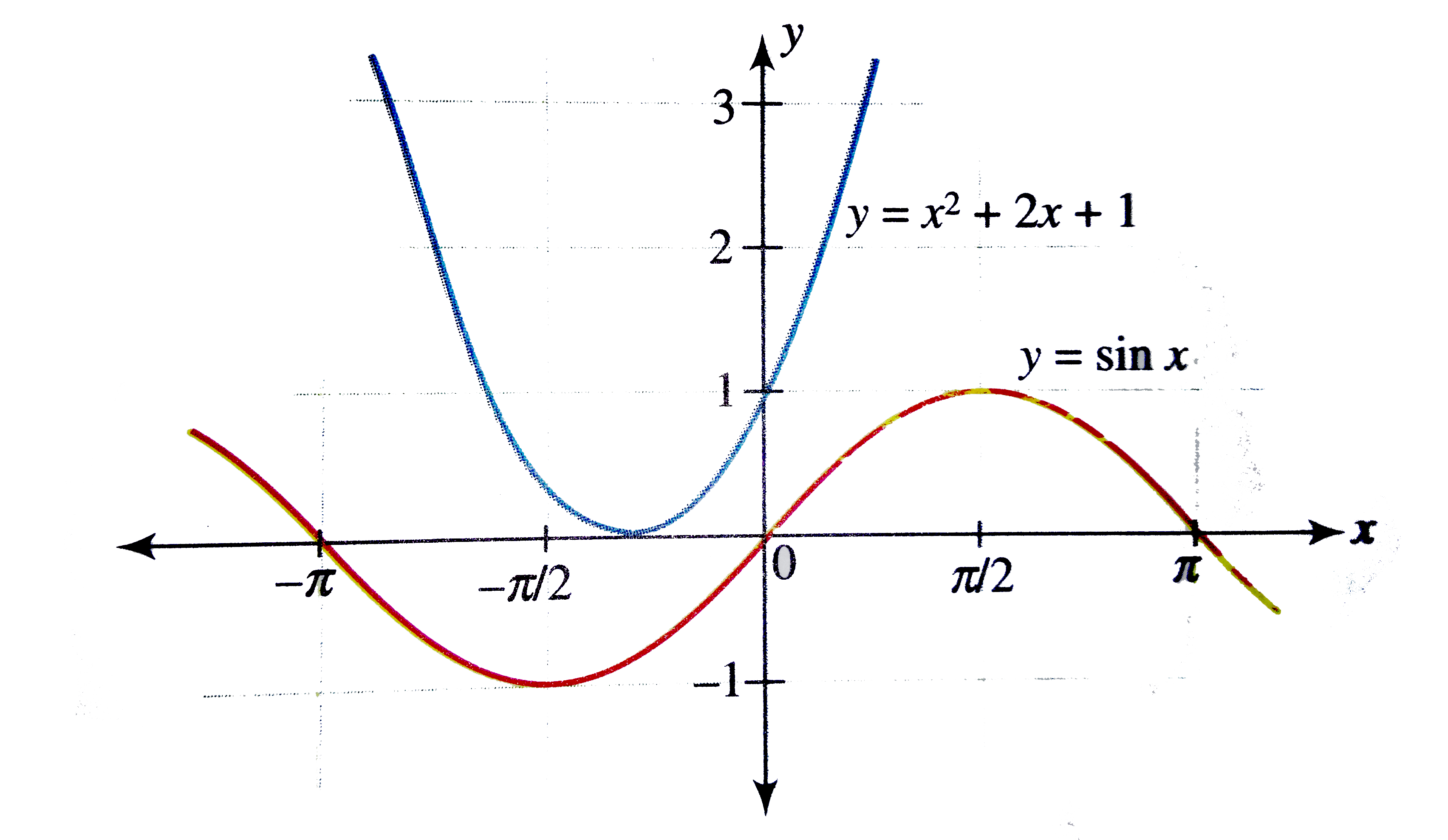 Since the curvey `y = (x + 1)^(2)` MEETS the y - axis at (0, 1), it never INTERSECTS y = sin x. HENCE no solution. |
|
| 16. |
Let L_(1) -= ax+by+a root3 (b) = 0 and L_(2) -= bx - ay + broot3 (a) = 0be two straightlines . The equatins of the bisectors of the angle formed by the foci whose equations are lambda_(1)L_(1)-lambda_(2)L_(2)=0 and lambda _(1) l_(1) + lambda_(2) = 0 , lambda_(1) and lambda_(2) being non - zero real numbers,are given by |
|
Answer» `L_(1)=0` |
|
| 17. |
If |{:(a,a+x^(2),a+x^(2)+x^(4)),(2a,3a+2x^(2),4a+3x^(3)+2x^(4)),(3a,6a+3x^(2),10a+6x^(2)+3x^(4)):}| =a_(0)+a_(1)x+a_(2)x^(2)+a_(3)x^(3)+a_(4)x^(4)+a_(5)x^(5)+a_(6)x^(6)+a_(7)x^(7) and f(x) =+a_(0)x^(2)+a_(3)x+a_(6) then |
|
Answer» `f(X)gt=0,forallin R if algt0` |
|
| 18. |
The value of the |(log_a(x/y),log_a(y/z),log_a(z/x)),(log_a^2(y/z),log_a^2(z/x),log_a^2(x/y)),(log_a^3(z/x),log_a^3(x/y),log_a^3(y/z))| |
| Answer» ANSWER :C | |
| 19. |
If a,b,c are non-coplanar vector and lambda is a real number then [lambda (a + b) lambda^(2) b lambda c] - [a b + c b] for |
|
Answer» EXACTLY ONE value of `lambda` |
|
| 20. |
For positive l, m and n, if the points x=ny+mz, y=lz+nx, z=mx+ly intersect in a straight line, when Q. The equation of the straight line is (x)/(a)=(y)/(b)=(z)/(c) , where the ordered traid (a, b, c) is |
|
Answer» `SQRT(1-L^2), sqrt(1-m^2), sqrt(1-N^2)` |
|
| 21. |
Evaluate int (x^(2))/(sqrt(1+x^(2)) ( sqrt(1 + x^(2)) - 1) )" dx " ( x ne 0 ) |
|
Answer» |
|
| 24. |
There are two vectors vecA and vecB then component of vecA in the direction of vecB is : |
|
Answer» `(vecA.HATB)hatB` |
|
| 25. |
Find the number of divisors of lfloor20 |
|
Answer» |
|
| 26. |
Sum to n terms of the series (1)/(1.2.3)+(3)/(2.3.4)+(5)/(3.4.5)+(7)/(4.5.6)+…. is |
|
Answer» `(n(n+1))/(2(n+2)(n+3))` |
|
| 27. |
For x in R, tanx+1/2tan""(1)/(2^(2))tan""(x)/(2^(2))+...+(1)/(2^(n-1))tan""((x)/(2^(n-1))) is equal to |
|
Answer» `2cot2x-(1)/(2^(n-1))COS""((X)/(2^(n-1)))` |
|
| 28. |
If A=[[1,2],[-2,3]]B=[[3,2],[1,4]],C=[[2,2],[1,3]]Calculate CB. |
|
Answer» SOLUTION :`CB=[[2,2],[1,3]][[3,2],[1,4]]` `=[[2.3+2.1""2.2+2.4],[1.3+3.1" "1.2+3.4]]=[[8,12],[6,14]]` |
|
| 29. |
(i) int sin mx dx (ii) int 2x sin (x^2+1) dx (iii) int x sqrt(1+2x^2) dx. |
|
Answer» |
|
| 30. |
A circle of radius r is concentric with theellipse (x^(2))/(a^(2))+(y^(2))/(b^(2)) = 1 Prove that slope of the common tangent of the above curves is sqrt((r^(2)-b^(2))/(a^(2)-r^(2))) |
|
Answer» |
|
| 31. |
Are the following sets relation ? phi x C from A to B .Determinethe domain range and inverse of each of the relations mentioned above. |
| Answer» Solution :`phi` XX C` from A to B is a RELATION. | |
| 32. |
Let Q be the set of rational numbers and R be a relation on Q defined by R{":"x,y inQ,x^2+y^2=5} is |
|
Answer» An EQUIVALENCE RELATION |
|
| 33. |
A model for the number of questions on an assignment when the assignment is worth p points, is q=p^2/50. According to this model , what is the number of questions, q for an assignment worth 80 points ? |
|
Answer» 128 |
|
| 34. |
If truth value of p is T, q is F, then truth values of ( p rarr q ) and ( q rarr p ) vee (~ p )are respectively |
|
Answer» F, F |
|
| 35. |
If a fair coin is tossed 6 times. Find the probability of (i) at least five heads and (ii) exactly 5 heads. |
|
Answer» (II) `63/64` (III) `3/32` |
|
| 36. |
If the two regression coefficients are - 0.4 and -1.6, then the coefficient of correlations is |
|
Answer» 0 |
|
| 37. |
Find the points on the curve x^(2)y^(2)+xy=2 at which the slope of the tangent is -1. |
|
Answer» |
|
| 38. |
If f(x) =X^(3) + ax^(2) +bx +c has extreme values at x=-1 and x=3 . Finda,b,c. |
|
Answer» Solution :Extreme values basically mean maximum or minimum values SINCE F(x) isdifferentiable function so `f(-1) =0 =f'(3)` `f'(x) =3x^(2) +2ax +b` ` f'(3) =27 +6a +b=0` `f'(-1) =3 -2A +b =0` `rArr "" a=-3 ,b =- 9, c in R` |
|
| 39. |
20 persons are sitting along a round circle. In how many ways 4 persons can be selected such that exactly 3 of them are consecutive |
|
Answer» |
|
| 40. |
20 persons are sitting along a round circle. In how many ways 4 persons can be selected such that exactly 2 of them are consecutive. |
|
Answer» |
|
| 41. |
Find the maximum and minimum values in the following functions :x^(5)-5x^(4)+5x^(3)-10 |
|
Answer» Minimum value `-37` at x = 3 |
|
| 42. |
Solve the following linear programming problem graphically: Maximize : z=3x+5y Subject to: x+yge2 x+3yge3 xge0 yge0 |
|
Answer» |
|
| 43. |
A conical tent of given capacity will require the least amount of canvas when the height is …… times the radius of the tent |
| Answer» ANSWER :D | |
| 44. |
Method of integration by parts : int log(x+1)dx=.... |
|
Answer» `(x+1)LOG(x+1)-x+c` |
|
| 45. |
Find the area of the triangle with vertices A(1, 1, 2), B(2, 3, 5) and C(1, 5, 5). |
|
Answer» |
|
| 46. |
Let f(x) be a differentiable non-decreasing function such that int_(0)^(x)(f(t))^(3)dt=(1)/(x^(2))(int_(0)^(x)f(x)dt)^(3)AAx inR-{0} andf(1)="1. If "int_(0)^(x)f(t)dt=g(x)" then "(xg'(x))/(g(x)) is |
|
Answer» always equal to 1 `THEREFORE""int_(0)^(x)(f(t))^(3)dt=(1)/(x^(3))(g(x))^(3)` Differentiating w.r.t. x, `therefore""(f(x))^(3)=(1)/(x^(2))3(g(x))^(2)g'(x)-(2)/(x^(3))(g(x))^(3)` `rArr""((xg'(x))/(g(x)))^(3)-3((x.g'(x))/(g(x)))+2=0` `rArr""(xg'(x))/(g(x))=1or -2` If `(xg'(x))/(g(x))=1` `rArr""XF(x)=int_(0)^(x)f(t)dt` `rArr""xf'(x)+f(x)=f(x)` `rArr""f(x)=1` `"or"xf'(x)+f(x)=-2f(x)` `""(f'(x))/(f(x))=(-3)/(x)` `logf(x)=-3LOG x+logc` `rArr""f(x)=c//x^(3)` `rArr""f(1)=1 rArr f(x)=1//x^(3)" (decreasing function)"` |
|
| 47. |
squareABCD is a parallelogram. The position vectors of the points A, B and Care respectively 4hati+5hatj-10hatk,2hati-3hatj+4hatk and -hati+2hatj+hatk. Find the vector equation of the line BD. |
|
Answer» |
|
| 48. |
The set of points (x,y) in the plnae satisfying x ^(2//5)+ |y| =1 form a curve enclosing a region of area p/q square units, when p and q are relatively prime positive intergers. Find p-q. |
|
Answer» |
|
| 49. |
Show that 3C_0-8C_1 + 13C_2 - 18C_3 + ..... + (n+1)^(th) term = 0 |
|
Answer» Solution :`3C_0-8C_1 + 13C_2 - 18C_3 + ..... + (N+1)^TH` term = `3C_0 - (5+3)C_1 + (10+3)C_2 - (15+3)C_3` + .... = `3(C_0 - C_1 + C_2 ....) + 5(-C_1 + 2C_2 - 3C_3 ....) But `(1+X)^n` = `C_0 - C_1x + C_2x^2 - C_3x^3 + ... + (-1)^n x^nC_n ....(1) putting x = 1 we get `C_0 - C_1 + C_2 .... + (-1) "^nC_n` = 0 and differentiating (1) we get `n(1-x)^(n-1) (-1) = `-C_1 + 2C_2 x - 3C_3x^2 + .... putting x = 1 we get `-C_1 + 2C_2 - 3C_3 + .... = 0 THEREFORE `3C_0 - 8C_1 + 13C_2 ..... (n+1)` terms = 0 |
|
| 50. |
Find all points of discontinuityof f, where f is defined by f(x)={{:((x)/(|x|)," if "x lt0),(-1," if "x ge 0):} |
|
Answer» |
|