

Saved Bookmarks
This section includes 7 InterviewSolutions, each offering curated multiple-choice questions to sharpen your Current Affairs knowledge and support exam preparation. Choose a topic below to get started.
| 1. |
If I = ((1,0),(0,1)), J = ((0,1),(-1,0)) and B = ((cos theta , sin theta),(-sin theta, cos theta)) then B equals |
|
Answer» `(COS THETA ) I +(SIN theta) J` |
|
| 2. |
Multiply (sqrt(-1)+sqrt(-1))(a-bsqrt(-1)) |
|
Answer» SOLUTION : `(SQRT(-1)+sqrt(-1))(a-bsqrt(-1))` `=(i+i)(a-bi)=2I(a-bi)` `=2ai-2bi^2=2ai+2b` |
|
| 3. |
Let x^3 + ax + 10 = 0 and x^3 + bx^2 + 50 = 0 have two roots in common. Let P be the product of these common roots. Find the numerical value of P^3, not involving a, b. |
|
Answer» |
|
| 4. |
Prove that .^(n)C_(0) +5 xx .^(n)C_(1) + 9 xx .^(n)C_(2) + "…." + (4n+1) xx .^(n)C_(n) = (2m+1) 2^(n). |
|
Answer» Solution :`S = .^(n)C_(0) + 5 XX .^(n)C_(1)+9xx.^(n)C_(2)+"....."(4n-3)xx.^(n)C_(n-1)+(4n+1)xx.^(n)C_(n)"......"(1)` `:. S = (4n+1).^(n)C_(n)+(4n-3).^(n)C_(n-1)+"...."+5.^(n)C_(1)+.^(n)C_(n)"....."(2)` ADDING (1) and(2), we get `2S = (4n+2)(.^(n)C_(0)+.^(n)C_(1)+"....."+.^(n)C_(n-1)+.^(n)C_(n))` `= (4n+2)2^(n)` `RARR S = (2n+1)2^(n)` |
|
| 5. |
Statement-I : ((costheta+isintheta)^5(cos3theta-isin3theta)^6)/((cos2theta+isin2theta)^3(cos4theta-isin4theta)^5)=1Statement-II :((cos2theta+isin2theta)^3(cos3theta-isin3theta)^4)/((cos3theta+isin3theta)^2(cos4theta+isin4theta)^(-3))=1 |
|
Answer» Only I is true |
|
| 6. |
Consider vectors veca,vecb,vecc,vecp=(vecb.vecc)veca-(vecc.veca)vecb,vecq=(veca.vecc)vecb-(veca.vecb)vecc,vecr=(vecb.veca)vecc-(vecb.vecc)veca, then |
|
Answer» <P>`vecp.vecc=0` So, `vecp, vecq, vecr` can form a triangle `vecp.ecc=(vecb.vecc)(veca.vecc)-(vecc.veca)(vecb.vecc)=0` `:.vecp_|_vecc` `impliesvecq-\-veca` and `vecr_|_vecb` |
|
| 7. |
If the remainder of the polynomial f(x) when divided by x+1 and x-1 are 7, 3 then the remainder of f(x) when devided by x^(2)-1 is |
|
Answer» 3x+5 |
|
| 8. |
If two dice are rolled then the probability of getting exactly one six on the dice or sum 8 is |
|
Answer» `(13)/(36)` |
|
| 9. |
Find the equation of normals of the following curves at thegiven points: (i)Curvey^(2)=4 ax" at point "(at^(2), 2at). (ii) Curve y= e^(x)" at point "(0, 1) (iii) Curve y = x^(3)" at point "(1, 1). (iv) Curve 2y = 3 - x^(2)" at point "(1, 1). (v) Curve 16x^(2)-9y^(2) = 432 at point (6, 4). |
|
Answer» (iii)`x+3y=4""(iv)x=y` (V)`3x+8y=50` |
|
| 10. |
If f(x)={(sin(x^(2)-3x),xle0 .^x+5x^(2),xgt0 |
|
Answer» f(x) has a LOCAL minima `f(x)^(+))rarr(0^(+))` `f(0^(+))=underset(xrarr0)lim sin (x^(2)-3x)=underset(hrarr0)limsin (H^(2)+3h)rarr0^(+)` Thus `f(x^(+)) and f(0^(-))gtf(x)` Hence x =0 is point of manima |
|
| 11. |
Find the point of extream of the function f(x) =(12)/(x^(x)).Draw the graph of the function and hence find therange of function .Also detrmine which is bigger,(1)/(pi)^(1/e) or (1)/(e )^((1)/(pi))? |
|
Answer» Solution :`f(x)=(1/x)^(x)` `f(x) =(1/x)^(x)(log_(e)(1))/(x)-1` `f(x) 0 rarr log_(e)(1)/(x)=1 rArr x=(1)/(c )` Sign scheme of f(x) is as follows:  From the sing scheme `x=(1)/(c )` is point of MAXIMA. Also `UNDERSET(xrarr0)lim(1/x)^(x)=e^(xrarr0^(limxlog))(1/x)=e^(xrarr0^(-lixxlogx))=e(0)=1` and `underset(xrarr00)lim (1/x^(x))=0` so, GRAPH of the function isas SHOWN in the following  From the graph range of the function is `0,f(1//e) or 0,e^(1)` Now `pigte` `f(pi)ltf(e)` `(1)/(pi^(pi))lt(1)/(e^(e))` `(1)/(pi^(1/e)) lt (1/e^(1))/(pi)` |
|
| 12. |
Let tangentsat P and Q to curve y^(2)-4x-2y+5=0intersectat T. If S(2, 1) is a point such that (SP)(SQ)=16, then the length ST is equal to : |
|
Answer» 3 |
|
| 13. |
Draw the graph of f(x) = (sin x)/(sqrt(1 + tan^(2)x))- (cos x)/(sqrt(1 + cot^(2)x)). Then find the range of f(x). |
|
Answer» SOLUTION :`f(x) = (SIN x)/(|sec x|) - (cos x)/(|"cosec "x|)` `= sin x *| cos x| - cos x * |sin x|` `= {{:(0",", x in (0", "pi//2)),(-sin 2x, x in (pi//2, pi)),(0",", x in (pi, 3pi//2)),(sin 2x",", x in (3pi//2, 2pi)):}` Clearly the domain of f(x) is `R - {(NPI)/(2), nin Z}` and the PERIOD of f(x) is `2pi`. So the range of f(x) is (-1, 1). 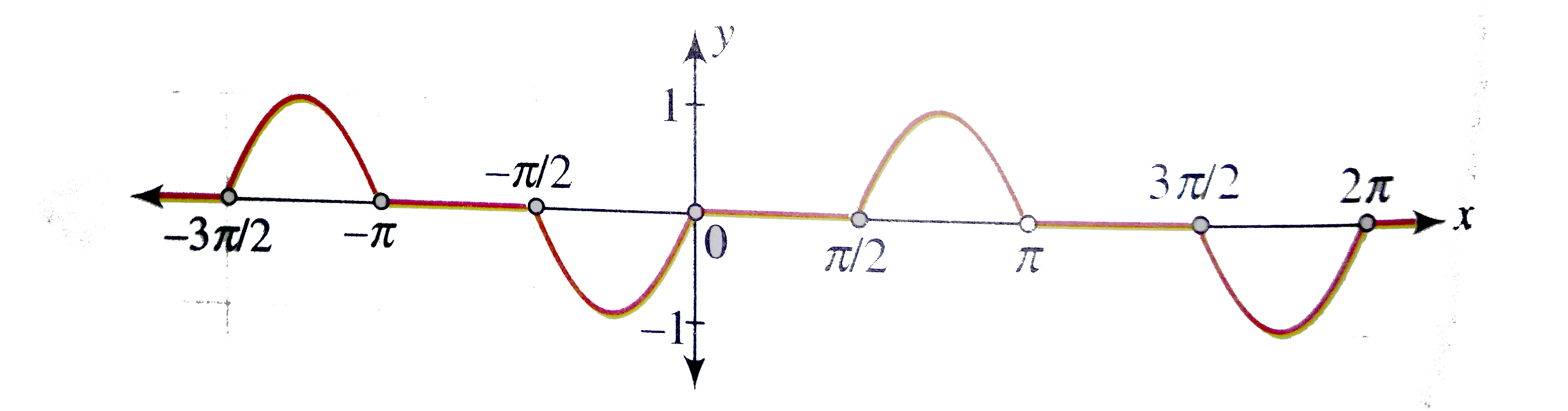
|
|
| 14. |
Out of 7 consonants and 4 vowels,the number of words (not necessarily meaningful)that can be made,each consisting of 3 consonants and 2 vowels,is |
|
Answer» 24800 |
|
| 15. |
A=[{:(1,4),(3,2),(2,5):}]andB=[{:(-1,2),(0,5),(3,1):}]then find the matrix X. where A+B-X=0.0 is a zero matrix. |
|
Answer» |
|
| 16. |
A card is selected at random from a pack of 52 cards. Let A be the event that the card is a face card and B be the event that the card is a heart card show that A and B are independent. |
|
Answer» |
|
| 17. |
Evalute the following integrals int ("sec x cos ecx")/(log (tan x))dx |
|
Answer» |
|
| 18. |
Locus of point of intersection of tangents to the circle x^(2)+y^(2)=a^(2) which makes complimentary angle with X axis is |
|
Answer» `X^(2)-y^(2)=0` |
|
| 19. |
Match the following {:(I.,"A = (2, 3, 4), B = (3, 4, 2), C = (4, 2, 3)",(a),Delta "is isosceles"),(II.,"A = (2, - 1, 1, 1), B = (1, -3, -5), C = (3, -4, -4)",(b),Delta "ABC is equilateral"),(III.,"A = (1, 1, 1), B = (1, 2, 3), C = (2, -1, 1)",(c),"A, B, C are collnear"),(IV.,"A = (1, 2, 3), B = (3, 4, 7), C = (-3,-2,-5)",(d),Delta "ABC is right angled"):} |
| Answer» Answer :D | |
| 20. |
If |{:(a,b,ax+b),(b,c,bx+c),(ax+b,bx+c,0):}|'=0 then "a,b,c are in" ..(''whereax^2+2bx-c ne' 0) |
|
Answer» A.P |
|
| 21. |
Evaluation of definite integrals by subsitiution and properties of its : int_(-a)^(a)sqrt((a-x)/(a+x))dx=kpi then k =…….. |
|
Answer» `-a` |
|
| 22. |
Integrate the function (x+3)/(x^(2)-2x-5) |
|
Answer» |
|
| 23. |
If the number of subsets with 8 elements from the set A={a_(1),a_(2),a_(3),.........a_(n)},nge8 is five times the number of such subsets containg a_(4), then |
|
Answer» 32 |
|
| 24. |
A die is tossed thrice. Find the probability of getting an odd number tieast once. |
|
Answer» |
|
| 25. |
"cos"pi/7+"cos"(2pi)/7+"cos"(3pi)/7+"cos"(4pi)/7+"cos"(5pi)/7+"cos"(6pi)/7 = |
|
Answer» 0 |
|
| 26. |
Obtain the inverse of the following matrix using elementary operations A=[(0,1,2),(1,2,3),(3,1,1)] |
|
Answer» |
|
| 27. |
|x|gt|y|. Which of the following must be true? Indicate ul("all") that apply. A. xy is positive B. x+y gt0 C. x^(2)gty^(2) |
|
Answer» |
|
| 28. |
Choose the correct answer int dx/(x^2+2x+2) |
|
Answer» `xtan^-1(X+1)+x` |
|
| 29. |
Find the non-trivial solutions, if any, for the system of homogeneous equations 2x+5y+6z=0,x-3y-8z=0,3x+4y-4z=0 |
|
Answer» |
|
| 30. |
Plane ax+by+cz=1 intersect axes in A,B,C respectively. If G((1)/(6),-(1)/(3),1) is the centroid of triangleABC, then a+b+3c=…………. |
| Answer» Answer :C | |
| 31. |
The sum of first n terms of the series 1_(2) + 2.2^(2) + 3^(2) + 2.4^(2) + 5^(2) + 2.6^(2) + ...... is (n(n + 1)^(2))/4 when n is even. When n odd the sum is |
|
Answer» `(n(n + 1)^(2))/4` |
|
| 32. |
Let C_(1):y=x^(2)sin3x,C_(2):y=x^(2)and C_(3):y=-y^(2), then |
|
Answer» `C_(1)` touches `C_(2)` at infinite points |
|
| 33. |
int ((x -1))/(2x^(2) + 5x + 2)dx = |
|
Answer» log `|(X + 2)/(2x + 1)|+ C` |
|
| 34. |
theta=tan^(-1)(2 tan^(2)theta)-tan^(-1)((1//3)tan theta), if tan theta is equal to |
| Answer» Answer :A | |
| 35. |
For any natural n ,expressed in base 10, let S(n) denote the sum of all digits of n. Find all natural numbers n such that n = 2S(n)^2 ? |
|
Answer» |
|
| 36. |
If A+B+C=0, then prove that sin 2A + sin 2B+ sin 2C=-4sin A sin B sin C . |
|
Answer» `SIN A sin B sin C ` |
|
| 37. |
The plane containing the two lines (x-3)/(1) = (y-2)/(4) = (z-1)/(5) and (x-2)/(1) = (y+3)/(-4) = (z+1)/(5) is 11x+my + nz = 28 where ............. |
|
Answer» m= -1, N=3 |
|
| 39. |
Let the function f be defined by f(x) ={{:(cx+1",", "if", x ge 3),(dx + 3",","if", x lt 3):} If f is continuous at x = 3 then d - c = ........ |
|
Answer» `-(3)/(2)` |
|
| 40. |
The probability that A speaks truth is 4/5 , while this probability for B is 3/4 . The probability that they contradict each other when asked to speak on a fact is |
|
Answer» `(3)/(20)` |
|
| 41. |
If (2,3)is one limiting point of a coaxal system of circles whose common radical axis isthe line x + y= 1then the other limiting point is |
|
Answer» (-3,-2) |
|
| 43. |
Determine the truth of falsity of the For any object x, there is a set A such that , x in Apropositions with reasons. |
| Answer» SOLUTION :For any OBJECT X , there is a SET A such that, `x in A`. It is TRUE. | |
| 44. |
If the product of the lengths of the perpendiculars from any point on the hyperbola 16x^(2)-25y^(2)=400 to its asymptotes isrhoand the angle between the two asymptotes is theta then rho " tan " (theta)/2 = |
|
Answer» `400/41` |
|
| 45. |
A random varibale x takes values0,1,2,3…. Withprobability proportional to (x+1)(1/5)^(x) then |
|
Answer» |
|
| 46. |
A triangle has its sides in the ratio 4:5:6, then the ratio of circumradius to the inradius of the triangle is |
|
Answer» `15/7` |
|
| 47. |
If A=[{:(2,3,-1),(1,4,2):}]andB=[{:(2,3),(4,5),(2,1):}], then AB and BA are defined and equal . |
|
Answer» |
|
| 48. |
Using the properties of determinants in Exercise 1 to 6, evaluate |{:(x+4,x,x),(x,x+4,x),(x,x,x+4):}| |
|
Answer» |
|
| 49. |
Draw the graph of y=2x^(2)-1 and heance the graph of f(x)=cos^(-1)2x^(2)-1). |
|
Answer» Solution :`y=2x^(2)-1` is an UPWARD parabola having VERTEX at (0,-1). It meets the x-axis at `(+-sqrt0)` For `f(x)=cos^(-1)(2x^(2)-1)`to get defined. `-1le2x^(2)-1le1` `or""0le2x^(2)le2` `or""0lex^(2)le1` `or""-1lexle1` Hence the domain of `y=f(x) is [-1,1]` `Now f(-1)=f(1)=cos^(-1)=0" and "f(0)=cos^(-1)(-1)=pi` So the inportant points of the graph paper are as FOLLOWS. 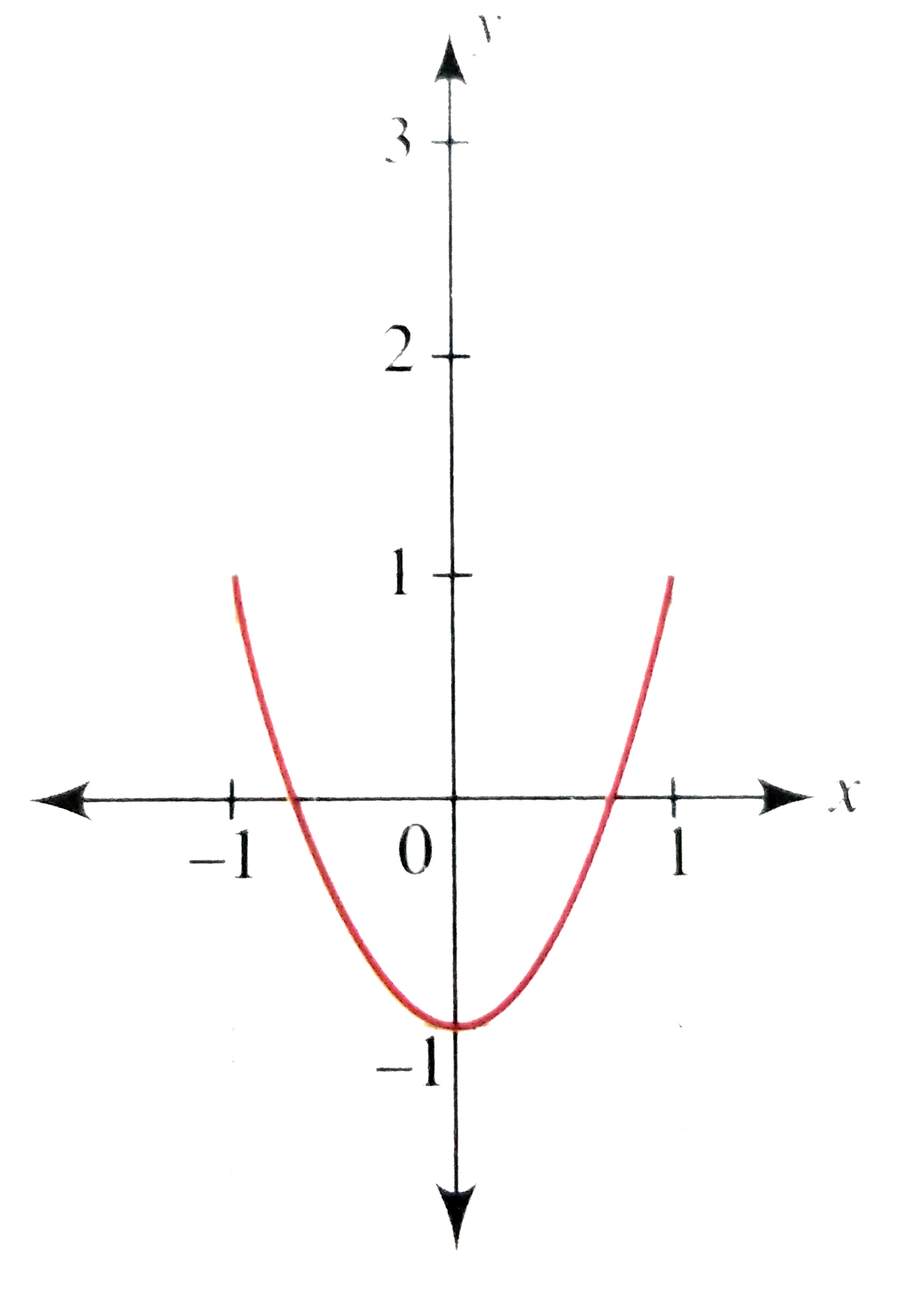 `"Now"f'(x)=(4X)/(sqrt(1-(2x^(2)-1))^(2))` Clearly f'(x) does not EXIST at x=0, heance f(x) is non-differenctiable at x=0 `" Also"f'(x)gt0 "for x in [-1,0]` `"and"f'(x)lt0 for x in (0, 1]`. Hence the graph of `y=cos^(-1)(2x^(2)-1)`can be drawn as follows. 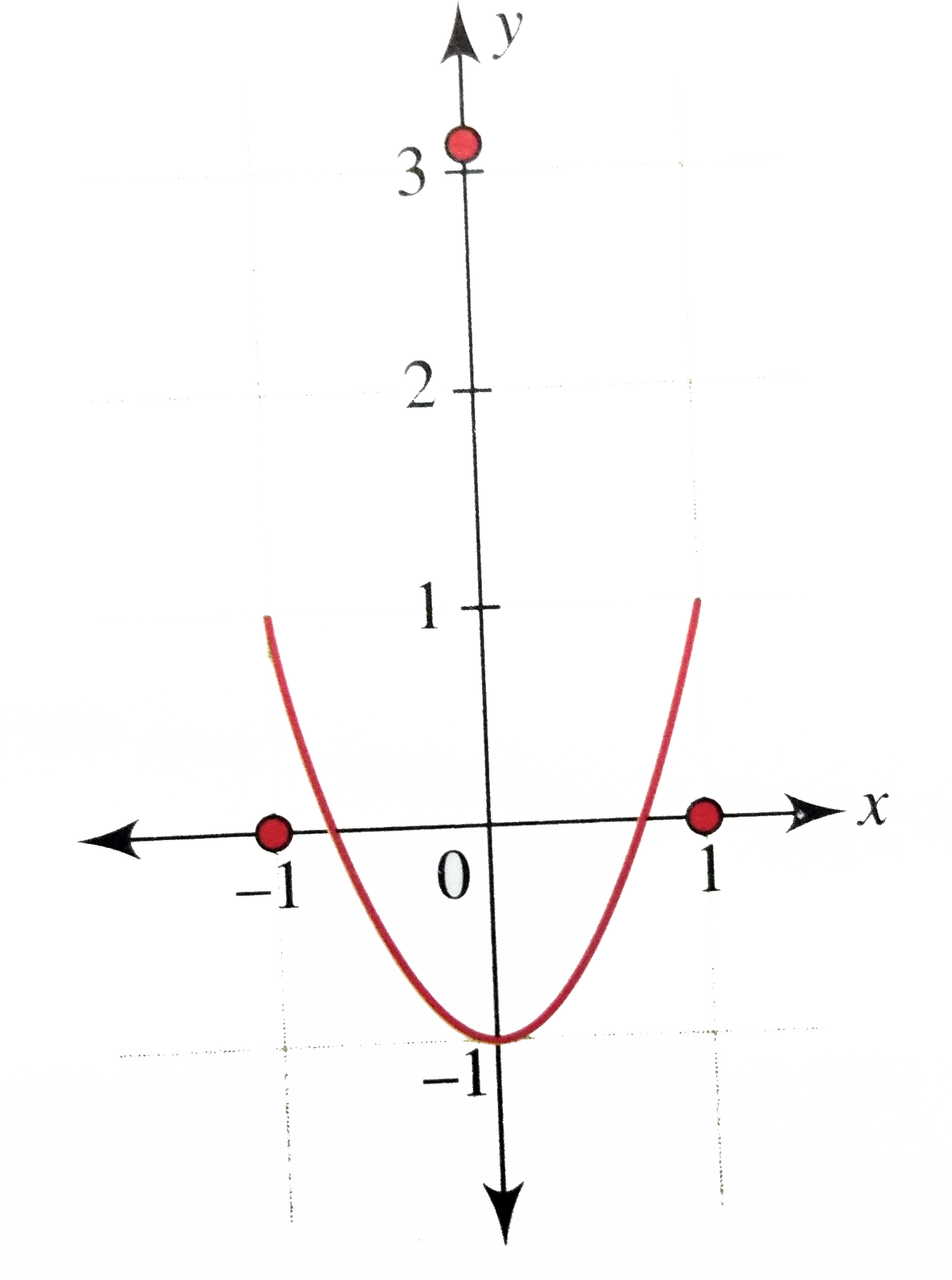 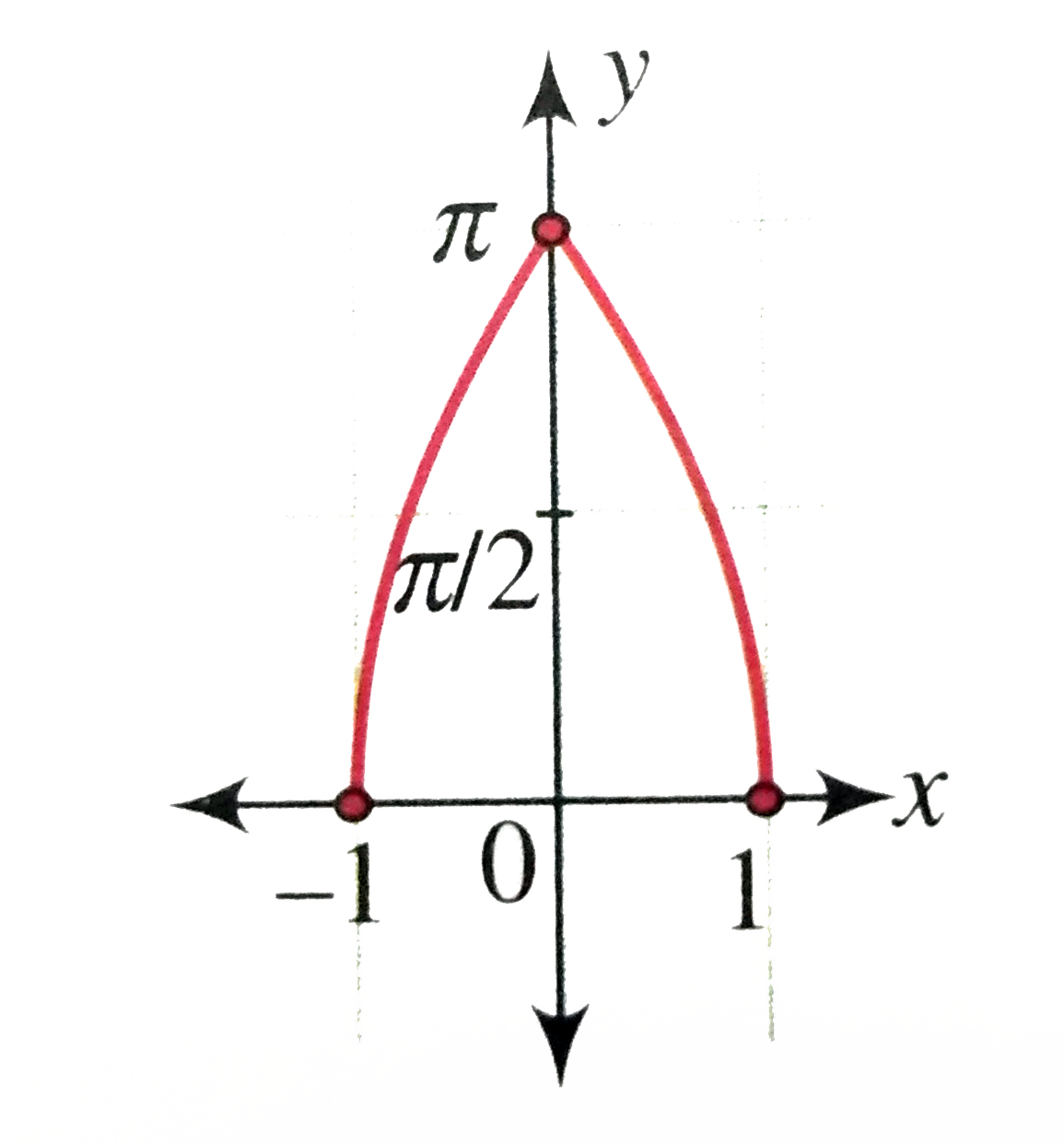
|
|
| 50. |
If f (theta ) = lim _(x to oo) sum _( r =o) ^(n theta) (2r)/(n sqrt((3 thetan-2r)(n theta +2r))) then: |
|
Answer» `f (1) =(PI)/(6)` |
|