

Saved Bookmarks
This section includes 7 InterviewSolutions, each offering curated multiple-choice questions to sharpen your Current Affairs knowledge and support exam preparation. Choose a topic below to get started.
| 1. |
If int(x+1)/(x(x^(2)-4))dx=log[(x-2)^(m//8).x^(n//4).(x+2)^(p//8)]+c, then (m, n,p)-= |
|
Answer» `(3, -1,1)` |
|
| 2. |
The solution of y^(2) dx + (3xy -1) dy = 0 is |
|
Answer» `xy^(3) = y^(2)+c` |
|
| 5. |
For three non-colliner complex numbers Z,Z_(1) and Z_(2) prove that|Z-(Z_(1)+z_(2))/(2)|^(2) + |(Z_(1) -Z_(2))/(2)|= (1)/(2) | Z - Z_(1)|^(2) +(1)/(2)|Z- Z_(2)|^(2) |
|
Answer» Solution :Consider the formed by A(Z), `B(Z_(1))` and`C(Z_(2))`. Letmidpointof BC be Dhaving complex NUMBER `(Z_(1)+Z_(2))/(2)` By Apollononiustherorem, we have `AB^(2) + AC^(2) + 2(AD^(2) + BD^(2))` `THEREFORE |Z-(Z_(1) +Z_(2))/(2)|^(2) + |(Z_(1) +Z_(2))/(2)|` `AD^(2) + BD^(2)` `=(1)/(2)AB^(2) + (1)/(2)Ac^(2)` `= (1)/(2)|Z- Z_(1)|^(2)+(1)/(2)|Z-Z_(2)|^(2)` |
|
| 6. |
Match the following for the system of linear equations A is square matrix such that (##FIITJEE_MAT_MB_07_C02_E04_003_Q01.png" width="80%"> |
|
Answer» |
|
| 7. |
Using differentials, find the approximate value of each of the up to 3 places of decimal. (32.15)^((1)/(5)) |
|
Answer» |
|
| 8. |
(1+x)^25= sum_(r = 0)^(25) C_r x^r then C_1 - C_3 + C_5 - C_7 + ……-C_25 = |
|
Answer» `2^10` |
|
| 9. |
Fill in the gaps with correct answer. 2sin67 (1^@)/2cos22 (1^@)/2 = ____. |
| Answer» SOLUTION :`1+(1)/SQRT2` | |
| 10. |
From the equations which representsthe following Pair of lines 2x - 3y + 1 = 0 , 2x + 3y + 1 = 0 |
|
Answer» SOLUTION :2x - 3y + 1 = 0 , 2x + 3y + 1 = 0 (2x - 3y +1) (2x + 3y +1) = 0 or, `(2x +1)^2 - 9y^2` = 0 `4x^2 + 1 + 4x - 9y^2 = 0` `4x^2 - 9y^2 + 4x + 1 = 0` which REPRESENTSA PAIR of lines. |
|
| 11. |
Evaluate log_(27)sqrt(54)-log_(27)sqrt(6). |
|
Answer» Solution :If you can enter base 27 into your calculator, enter the entire expression to get the answer `0.bar(3)=(1)/(3)`. Otherwise, you can use the change-of-base formula to substitute `(log54)/(log27)" for "log_(27)sqrt(54)and(logsqrt(6))/(log27)" for"log_(27)sqrt(6)`. If you your logarithms well, you use properties to see that `log_(27)sqrt(54)-log_(27)sqrt(6)=log_(27)sqrt((54)/(6))` `=log_(27^(3))` `=(1)/(3)` The GRAPHS of all exponential functions `y=b^(x)` have roughly the same shape and pass through point (0,1). If `bgt1`, the graph increases as x increases and APPROACHES the x-axis as an asymp- tote as x decreases. The amount of curvature BECOMES greater as the value of b is made greater. If `0ltblt1`, the graph increases as x decreases and approaches the x-axis as an asmptote as x increases. The amount of curvature becomes greater as the value of b is made closer to zero.  The graphs of all logarithmic functions `y=log_(b)x` have roughly the same shape and pass through point (1,0). If `bgt1`, the graph increases as x increases and approaches the y-axis as an asymptote as x approaches zero. The amount of curvature becomes greater as the value of b is made greater. If `0ltblt1`, the graph decreases as x increases as x increases and approaches the y-axis as an asymptote as x approaches zero. The amount of curvature becomes greater as the value of b is made closer to zero.  Two numbers serve as special bases of exponentil functions The number 10 is convenient as a base because integer power of ten determine place values : for instance, `10^(2)=100 and 10^(-3)=0.001`. The inverse of `10^(x)` is `log_(10)x`. By convention, the base is not written when it is 10, so the inverse of `10^(x)` is simply written as log 10. The other special base is the number `e~~2.718281828 . . . . ` This is a nontermination and nonrepeating decimal. The inverse of `e^(x)` is `log_(e)x`, which is further abbreviated ln x, the NATURAL logarithm of x. On the TI - 84 graphing calculator, the command log will evalute the logarithm with respect to any base by entering the value whose log is being sought followed by the base. Log base e (ln) can also entered the value whose log is being sought followed by the base. Log base e (ln) can also be entered directly. Exponential growth is an important application of exponential functions Exponential growth reflects a CONSTANT rate of change from one time period to the next. |
|
| 12. |
Five points are given on a circle of radius a . A rectangular hyperbola is made to pass through four of these points . Prove that tha centre of the hyperbola lies on a circle of radius a//2. |
|
Answer» |
|
| 13. |
int(dx)/((x^(2)-4)sqrt(x))=-1/(2sqrt2) f(x) + 1/(4sqrt2) log|(sqrt(x) - sqrt(2))/(sqrt(x) + sqrt(2))| +c where c is constant of intergration and f(2) = pi/4 and f(6) + f(2/3) is equal to |
|
Answer» `pi/4` `x = l^(2) :. Dx = 2tdt` `l = int (2tdt)/((t^4 - 4)t) = 2 int (dt)/((t^(2) + 2)(t^(2) - 2))` `-1/2 int (dt)/(t^2 + 2) + 1/2 int (dt)/(t^2 - 2)` `(-1)/(2SQRT2) TAN^(-1) (t/(sqrt2)) + 1/(4sqrt2) log |(t-sqrt2)/(t + sqrt2)| + C` `=(-1)/(2sqrt2) tan^(-1) sqrt(x/2) + 1/(4sqrt2) log |(sqrt(x) - sqrt(2))/(sqrt(x) + sqrt(2))|+C` `f(x) = tan^(-1) ((SQRTX)/(sqrt2))`. |
|
| 15. |
Find the area enclosed by the curves y= l nx, y= 2^(x) and the lines x=(1)/(2) and x=2. |
|
Answer» |
|
| 17. |
Let E_(1)E_(2) and F_(1)F_(2) be the chords of S passing through the point P_(@) (1, 1) and parallel to the X-axis and the Y-axis, respectively. Let G_(1)G_(2) be the chord of S passing through P_(@) and having slope -1. Let the tangents to S at E_(1)and E_(2) met at F_(3), and the tangents to S at G_(1) and G_(2) meet at G_(3). Then , the points E_(3), F_(3) and G_(3) lie on the curve Let S be the circle in the XY-plane defined by the equation x^(2)+y^(2)=4 |
|
Answer» x + y = 4 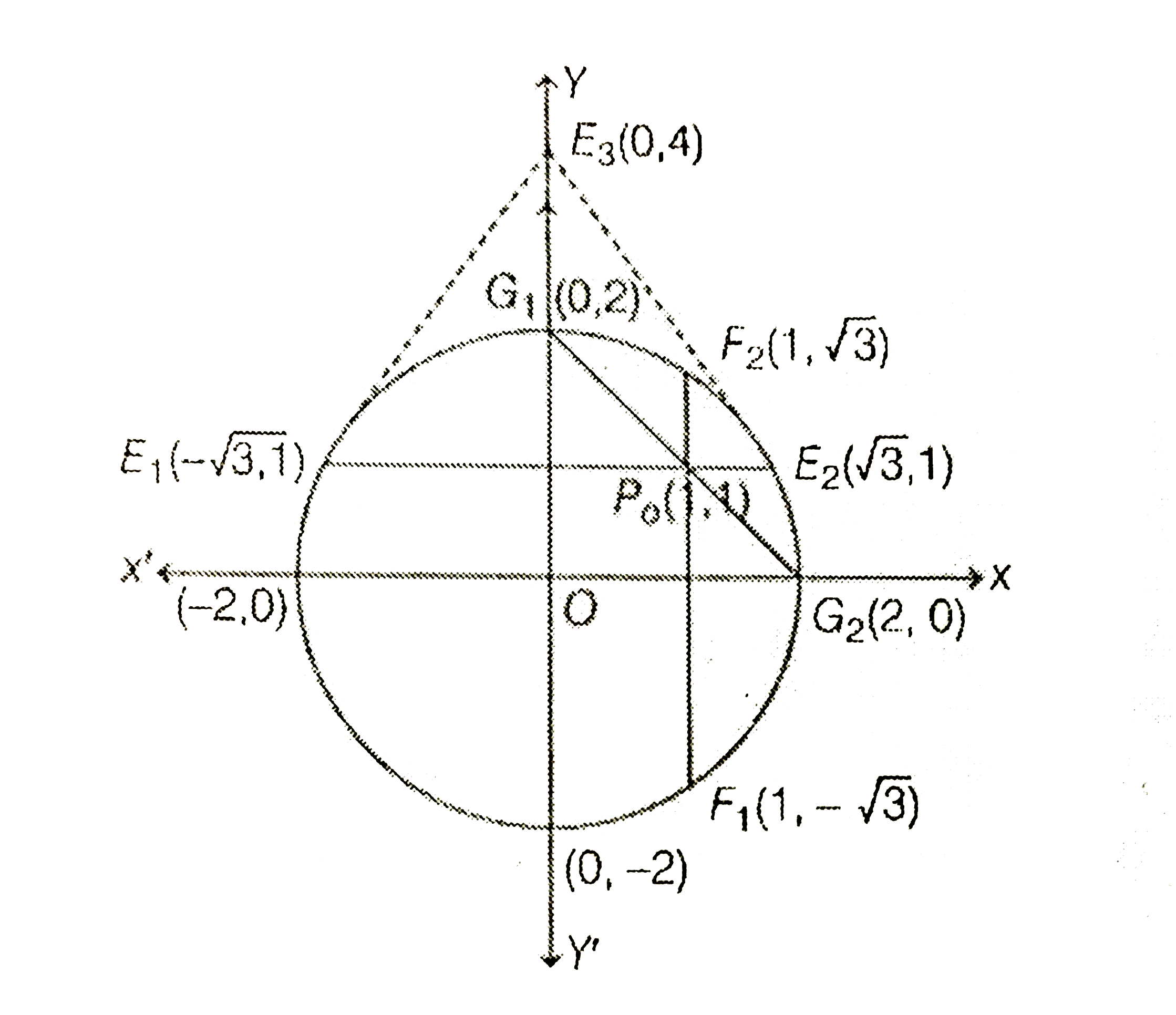 Equation of tangent at `E_(1)(-sqrt3,1)` is `-sqrt3x +y=4 and "at" E_(2)(sqrt3,1)` is `sqrt3x+y=4` Intersection point of tangent at`E_(1) and E_(2) " is " (0,4)`1. `THEREFORE` Coordinates of `E_(3)` is (0, 4) Similarly equation of tangent at`F_(1)(1, -sqrt3) and F_(2)(1,sqrt3)` are `x-sqrt3y=4 and x+sqrt3y=4`, respectively and intersection point is (4, 0), i.e., `F_(3)(4,0)` and equation of tangent at `G_(1)(0,2) and G_(2)(2,0)` are 2y =4 and 2X = 4, respectively and intersection point is (2, 2)i.e., `G_(3) (2,2)`. Point `E_(3) (0, 4) , F_(3)(4,0) and G_(3)(2, 2)` satisfies the line x + y = 4. |
|
| 18. |
The rate of change of the area of a circle with respect to its radius r at r = 6 cm is |
|
Answer» `10PI` |
|
| 19. |
A rectangle has one side on the positive side of Y - axis and one side on the positive side of X - axis. The upper right hand vertiex is on the curve y=(log x)/(x^(2)). The maximum area of the rectangle is ………. sq. unit. |
|
Answer» `(1)/(e )` |
|
| 20. |
If y= log (x+ sqrt(x^(2) + a^(2))) then (dy)/(dx)= ……… |
|
Answer» `SQRT(X^(2) + a^(2))` |
|
| 21. |
Compute the following: [[a^2+b^2, b^2+c^2],[a^2+c^2, a^2+b^2]]+[[2ab, 2bc],[-2ac, -2ab]] |
| Answer» SOLUTION :GIVEN SUM=`[[a^2+b^2+2ab, b^2+c^2+2bc],[a^2+c^2-2ac, a^2+b^2-2ab]]=[[(a+b)^2, (b+c)^2],[(a-c)^2, (a-b)^2]]` | |
| 22. |
If the circles of same radii and with centres (2,3),(5,6) cut orthogonally then radius is |
|
Answer» 3 |
|
| 23. |
Integrate the rational functions ((x^(2)+1)(x^(2)+2))/((x^(2)+3)(x^(2)+4)) |
|
Answer» |
|
| 24. |
The minimum value (x-6)^(2) + (x + 3)^(2) + (x-8)^(2) + (x + 4)^(2) + (x-3)^(2) is |
|
Answer» 114 |
|
| 25. |
Which one of the following is homogeneous function ? |
|
Answer» `f(x,y) = x-y/x^2 +y^2` |
|
| 26. |
Which of the following pair(s) of curves is/are ortogonal? |
|
Answer» `y^(2)=4AX,y=e^(-x//2a)` |
|
| 27. |
Equation of the curve passing through the point (4,3) and having slope = y/2 at a point (x,y) on it is |
|
Answer» `LOG((y)/(3)) = (x)/(2) -2` |
|
| 28. |
solvethe followingequations 4x^3 + 16 x^2 -9x -36 =0giventhatthesumof tworootsiszero. |
|
Answer» |
|
| 29. |
{:(Column -I,Column -II),((A)"if" 4^(x)-3^(x-(1)/(2))=3^(x+(1)/(2))-2^(2x-1)"then 2x equals",(P)1),((B)"The number of solutions of" log_(7)log_(5)(sqrt(x+5)+sqrt(x))=0 is,(Q)2),((C)"The number of values of x such that the middle term of",(R)3),(log_(2)2 log_(3)(2^(x)-5)log_(3)(2^(x)-(7)/(2))"is the average of the other two is",),((D)"if" alphabeta "are the roots of the equation",(S)4),(x^(2)-(3+2^(sqrt(log_(2)3)-3sqrt(log_(3)2)))x-2(3log_(3)^(2)-2^(log_(2)^(3)))=0,),("then" 2(alpha+beta)-alpha beta"equals",):} |
|
Answer» |
|
| 30. |
Let alpha and beta be the roots of quadratic equation ax^(2)+bx+c=0. Match the following columns and choose the correct answer. {:(" Column I"," Column II"),("(A)"alpha+beta,(1)" "(ac^(2))^(1//3)+(a^(2)c)^(1//3)+b=0),("(B)"alpha=2beta,(2)" "2b^(2)=9ac),("(C)"alpha=3beta,(3)" "b^(2)=6ac),("(C)"alpha=beta^(2),(4)" " 3b^(2)=16ac),(,(5)" "b^(2)=4ac),(,(6)" "(ac^(2))^(1//3)+(a^(2)c)^(1//3)=b):} |
|
Answer» `{:("(A)","(B)","(C)","(D)"),(5,2,4,6):}` |
|
| 31. |
Let the function f : R rarr R be defined by f(x) = cos x , AA x in R. Show that f is nether one - one nor onto . |
|
Answer» |
|
| 32. |
A tangent to the elise (x ^(2))/(4)+ (y ^(2))/(1) =1 cuts the circle x ^(2) + y^(2)=4 at points A and B, C any point on the circle x ^(2) + y^(2)=4 such that A, B and C are to the same side of x-axis. Find the maximum area of the triangle ABC. |
|
Answer» |
|
| 33. |
If pair of tangents drawn to the ellipse(x^(2))/(a^(2))+(y^(2))/(b^(2))=1. From the point P(1, sqrt(3)) are perpendicular to each other , then the angle between the pair of tangents drawn from the point Q(3,2) at the curve(x^(2))/(2a^(2)+b^(2))+(y^(2))/(2a^(2)+b^(2))=1 can be |
|
Answer» `(PI)/(3)` |
|
| 35. |
For any non-zero complex number z, the minimum value of abs(z) + abs(z - 1) is |
| Answer» ANSWER :A | |
| 36. |
If sum_(i=1)^(15)x_(i)=45,A=sum_(i=1)^(15)(x_(i)-2)^(2),B=sum_(i=1)^(15)(x_(i)-3)^(2) and C=sum_(i=1)^(15)(x_(i)-5)^(2) thenStatement 1: min(A,B,C)=AStatement 2: The sum of squares of deviations is least when taken from man. |
|
Answer» STATEMENT 1: is TRUE, Statement 2 is True , Statement 2 isa correct explanation for statement 1 `implies "min" (A,B,C)=B` |
|
| 37. |
Let A(0,6,8) and B(15,20,0) are two given points and P(lambda, 0, 0) is a point on x-axis such that PA+PB is minimum If image of origin along plane mirror passing through P.A,B is (alpha, beta, lambda) then |
|
Answer» `9(ALPHA+BETA)=20` `PA+PB= sqrt(alpha^(2)+100)+sqrt((alpha-15)^(2)+400)` is same as finding minimum value of P'A' + P'B' where `P'(alpha,0),A'(0,10)` and are `B'(15,-20)` which is possible only when P', A', B' are collinear. ` implies alpha=5` `therefore`Equation of plane passing through `P(5,0,0),A(0,6,8)` and `B(15,20,0)` is `2x-y+2z=10` ` implies d=(10)/(3)`and `(alpha,beta,lambda)=((40)/(9),(-20)/(9),(40)/(9))` |
|
| 38. |
Let A(0,6,8) and B(15,20,0) are two given points and P(lambda, 0, 0) is a point on x-axis such that PA+PB is minimum If perpendicular distance of origin from the plane passing through P,A,B is d then ([.] represent greatest integers function and {.} represent fracional part) |
|
Answer» <P>`[d]` `PA+PB= sqrt(alpha^(2)+100)+sqrt((alpha-15)^(2)+400)` is same as finding minimum value of P'A' + P'B' where `P'(alpha,0),A'(0,10)` and are `B'(15,-20)` which is possible only when P', A', B' are collinear. ` implies alpha=5` `therefore`Equation of plane passing through `P(5,0,0),A(0,6,8)` and `B(15,20,0)` is `2x-y+2z=10` ` implies d=(10)/(3)`and `(alpha,beta,lambda)=((40)/(9),(-20)/(9),(40)/(9))` |
|
| 39. |
Find all real numbers 'Y' for which there is atleast one triplet (x, y,z) of nonzero real numbers such that: x^(2)y + y^(2)z + z^(2)x = xy^(2) + yz^(2) + zx^(2) = rxyz |
|
Answer» |
|
| 42. |
Find the probability distribution of the number of successes in two tosses of a die, where a success is defined as (i) number greater than 4 (ii) six appears on at least one die |
|
Answer» |
|
| 43. |
A unit vector perpendicular to the plane determined by the points P(1, -1, 2) Q (2, 0, -1) and R (0, 2, 1) is |
|
Answer» `(2I + J + K)/(sqrt(6))` |
|
| 44. |
Choose the correct answer. Area lying in the first quadrant and bounded by the circlex^2+y^2=4 and the lines x=0 and x=2 is |
|
Answer» `PI` |
|
| 46. |
Let f(theta)=(sin^(2)theta cos theta)/((sin theta+cos theta))-(1)/(4)tan(pi/4-theta), forall theta in R-{npi-pi/4}, n in I. bb"Statement I" The largest and smallest value of f(theta) differ by 1/sqrt(2) bb"Statement II "asinx+bcosx+c in [c-sqrt(a^(2)+b^(2)),c+sqrt(a^(2)+b^(2))], forall x in R, " where " a,b,c in R. |
|
Answer» |
|
| 48. |
For kind of cake requires 200 g of flour and 25 g of fat, another kind of cake requires 100 g of flour and 50 g of fat. Find the maximum number of cakes which can be made from 5 kg of flour and 1 kg of fat, assuming that there is no shortage of the other ingredients used in making the cakes. Make it an LLP and solve it fraphically. |
|
Answer» `200x+100y,le5000implies2x+yle50""...(i)` `25x+50yle100impliesx+2yle40""...(ii)` and `x ge0,yge0.` 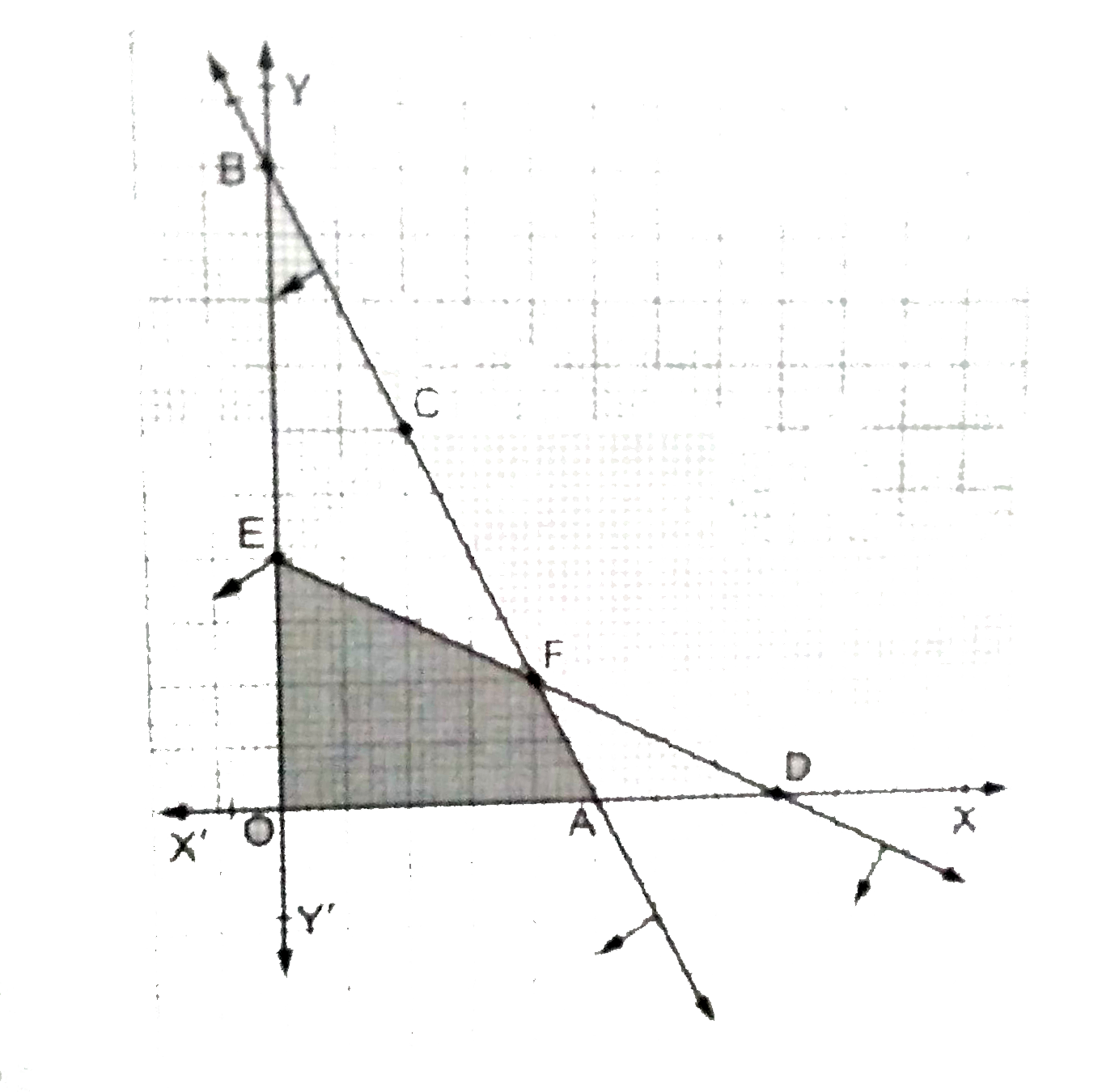 First we deaw the line `2x+y=50.` For this, we plot the points `A(25,0),B(0,50) and C(10,30).` Draw the line ACB. The region below this line represents `2x+y le50.` Now, we draw the line `x+2y=40.` For this, we plot the points `D(40,0),E(0.20)and F(20,10).` Draw the line DFE. The region below this line represents `x+2y le40.` The feasible regin CONTAINS the points `A(25,0),F(20,10) and E(0,20).` Value of z at `A(25,0)=25+0=25.` Value of z at `F(20,10)=20+10=30.` Valus of z at `E(0,20)=0+20=20.` For maximum value of z, we have x=20 and y=10. ltbr gt Maximum number of cakes REQUIRED for first and second type are 20 and 10 respectively. |
|
| 49. |
Thenumberof waysin which7distinct toyscan bedistributedamong3 childrenwheneachchildis eligibleto takeall thetoysis |
|
Answer» <P>`3^(7)` |
|