

Saved Bookmarks
This section includes 7 InterviewSolutions, each offering curated multiple-choice questions to sharpen your Current Affairs knowledge and support exam preparation. Choose a topic below to get started.
| 2. |
If p, q are true and r is a false statement, then which of the following is a true statement? |
|
Answer» `(p ^^ Q) VV R ` is F |
|
| 3. |
Let a=hatj-hatk and c=hati-hatj-hatk, the vector b satisfying axxb+c=vec0 and a.b=3, is |
|
Answer» `-hati+hatj-2hatk` `RARR a xx (a xx b) + a xx c = 0` `rArr (a.b)a - (a.a) + a xx c = 0` `rArr 3a - 2B +a xx c = 0` `rArr 2b =3a+a xx c` `rArr 2b = 3hatj - 3hatk -2hati - hatj - hatk` `rArr 2b = - hati + 2hatj - 4hatk` `:. b= - hati + hatj - 2hatk` |
|
| 4. |
Integrate the following intcosec(x+pi/4)cot(x+pi/4)dx (x=pi/4) |
|
Answer» SOLUTION :`intcosec(x+pi/4)COT(x+pi/4)DX` put `(x+pi/4)=Z` then dx=dz `intcoseczcotzdz` -cosecz+C=`-COSEC(x+pi/4)+C` |
|
| 5. |
Find a vector of magnitude 9 units and perpendicular to the vectors veca=4hati-hatj+hatk and vecb= -2hati+hatj-2hatk. |
|
Answer» |
|
| 6. |
The totalcost of daily output of x tons of coal is Rs. ((1)/(10) x^(3)-3x^(2) +50x). What is theMarginal cost funvtion . |
|
Answer» |
|
| 7. |
If int(dx)/(x^(2) + 2x+2) =f(x) +c, then f(x) is equal to |
|
Answer» `TAN^(-1)(x+1)` |
|
| 8. |
Find the value of x, y and z from the following equations: (i) [(4,3),(x,5)]=[(y,z),(1,5)] (ii)[(x+y, 2 ),(5+z, xy)]=[(6,2),(5,8)] (iii) [(x+y+z),(x+z), (y+z)]=[(9),(5),(7)] |
|
Answer» (II) `x=4,y=2,z=0 or x=2, y=4, z=0` (III) `x=2,y=4,z=3` |
|
| 9. |
We say an equation f(x)=g(x) is consistent, if the curves y=f(x) and y=g(x) touch or intersect at atleast one point. If the curves y=f(x) and y=g(x) do not intersect or touch, then the equation f(x)=g(x) is said to be inconsistent i.e. has no solution. The equation sinx=x^(2)+x+1 is |
|
Answer» CONSISTENT and has infinite NUMBER of solutions |
|
| 10. |
ABCD is a parallelogram and O is the point of intersection of its diagonals. If points P, Q, R, S are the mid-points of OA, PB, QC, RD respectively, then the points Q, O, S |
|
Answer» FORMS a triangle |
|
| 11. |
The plane containing lines(x+1)/(3)=(y+3)/(5)=(z+5)/(7)" and "(x-2)/(1)=(y-4)/(4)=(z-6)/(7) passes through |
|
Answer» (0,0,0) |
|
| 12. |
Find the value of the following integral int_(0)^((pi)/(2)) cos^(6) x dx |
|
Answer» |
|
| 13. |
If f(x) = ax^(2) + bx + c is such that |f(0)| le 1, |f(1)| le 1 and |f(-1)| le 1, prove that |f(x)| le 5//4, AA x in [-1, 1] |
|
Answer» |
|
| 14. |
Find the value of tan [1/2 sin^(-1) ((2a)/(1+a^(2))) + 1/2 cos^(-1) ((1-a^(2))/(1+a^(2)))] |
|
Answer» |
|
| 15. |
If a circle of area 16pihas two of its diamters along the line 2x-3y +5=0 and x+3y -11=0then the equation of the circle is |
|
Answer» `X^(2) +y^(2) -4X +6Y -13=0` |
|
| 16. |
Find the equation of all possible curves such that length of intercept made by any tangent on x-axis is equal to the square of X-coordinate of the point of tangency. Given that the curve passes through (2,1) |
|
Answer» |
|
| 17. |
If 5 fair coins are tossed, find the probability of getting heads in majority. |
|
Answer» |
|
| 18. |
The probability of a missile hitting a target is 1/2 and two direct hits are required to destroy it. Find the least number of missles, so that the probability of the target destroyed is greater than 0.9. |
|
Answer» |
|
| 19. |
If 2(cos ( alpha-beta)+cos(beta-gamma)+cos(gamma-alpha)+3=0, prove that (d alpha)/(sin ( beta+theta)sin(gamma+theta))+(d beta)/(sin(alpha+beta)sin(beta+theta))+(d gamma)/(sin(alpha+theta)sin(beta+theta))=0, where, 'theta' is any real angle such thatalpha+theta, beta+theta, gamma+theta are not the multiple of pi. |
|
Answer» |
|
| 20. |
If a line has the direction ratios '-18,(12) ,-4', then what are its directión cosines? |
|
Answer» If a, b, c are the direction ratios of a LINE then its d.c.'s are `(a)/(sqrt(a^2+b^2+c^2), (b)/(sqrt(a^2+b^2+c^2), (c)/(sqrt(a^2+b^2+c^2)` i.e., `(-18)/22, (12)/22, (-4)/22` i.e., `(-9)/11, (6)/11, (-2)/11` |
|
| 21. |
If 2 dice are rolled then find the probability that the dice show different numbers or sum 10. |
|
Answer» |
|
| 22. |
Compute the 1/(8!)+1/(9!)+1/(10!) |
|
Answer» Solution :`1/(8!)+1/(9!)+1/(10!)` `=1/(8!)=1/(9*8!)+1/(10*9*8!)` `=(10*9+10+1)/(10*9*8!)=(101)/(3628800)` |
|
| 23. |
Express with rational denominator(3+2sqrt(-1))/(2-5sqrt(-1))+(3-2sqrt(-1))/(2+5sqrt(-1)) |
|
Answer» SOLUTION :`(3+2sqrt(-1))/(2-5sqrt(-1))+(3-2sqrt(-1))/(2+5sqrt(-1))=(3+2i)/(2-5i)+(3-2i)/(2+5i)` `((3+2i)(2+5i)+(3-2i)(2-5i))/((2-5i)(2+5i))` `(6+15i+4i+10i^2+6-15i-4i+10i^2)/(4-15i^2)` `(12-20)/(4+25)=-8/(29)` |
|
| 24. |
Twofunctions are defined as f(x)={:{(x+1,"if" x le1),(2x+1,"if" lt x le 2):} g(x)={:{(x^(2),"if" -1 le x lt 2),(x+2,"if" 2 le x le 3):} |
|
Answer» `{:{(X+1,"if" |x| le1),(2X^(2)+1,"if" lt x le SQRT(2)):}` |
|
| 25. |
Let f(x) be a differentiable and g(x) be a twice differentiable function such that |f(x)-1|le1 and f^(')(x)=g(x). If f^(2)(3)+g^(2)(3)=20 then number of value(s) of cepsilon(0,4) such that g(c)g^('')(c)gt0 is/are _________ |
|
Answer» and `g(3) epsilon [-2sqrt(5), -4]uu[4,2sqrt(5]` Also `int_(0)^(4)g(x)dx=int_(0)^(4)f^(')(x)dx(f(4)-f(0) in(-2,2))` Case I: Let `g(x) gt0` and `g^('')(x)gt0` Clearly `int_(0)^(4)g(x)dx le` Area (MDKS)`=4` Which is a contradiction THUS, there is no such `C` Similarly case II: Let `g(x)LT0` and `g^('')(x)lt0` 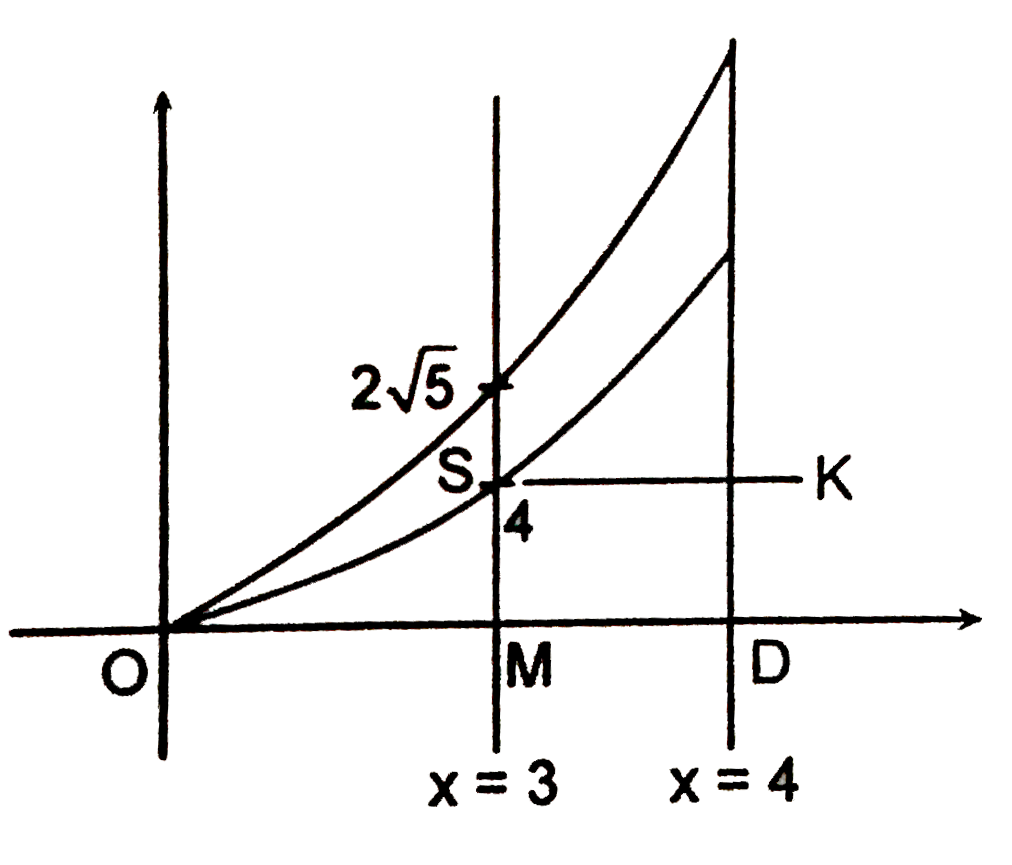
|
|
| 26. |
Evaluate int sin ^(4) x dx. |
|
Answer» `(sin^(3)"xcosx")/(4) - (3)/(8) "SINX cosx" - (3)/(8) x + c` |
|
| 27. |
Let A = { a,b,c }, absB = {1,2} Of all the relations from A to B identify which relations are many one, one many and one-one and represent these diagramatically. |
|
Answer» SOLUTION :Some MANY onerelations are {(a,1), (b.1),(c,1),(b,2)(c,2)} {(a,2),(b,2),(c,2)} |
|
| 28. |
If (7+4sqrt3)^n=I+F where I and n are +ve integers and F is +ve proper fraction, then (I+F)(1-F)= |
|
Answer» only I is true |
|
| 30. |
If N = 6 m (where m is obtained in question number 35) then : |
|
Answer» TOTAL number of divisors of N is 36 |
|
| 31. |
The order of the differential equation of the family of curves y=(a)/(c ) sin (bx)+3^(dx) where a, b, c, d are arbitrary constants is |
|
Answer» 4 |
|
| 33. |
A circle C whose radius is 1 unit, thuches the x-axis at point A. The centre Q of C lies in first quadrant. The tangent from origin O to the circle touches it at T and a point P lies on it such that Delta OAP is a right angled triangle at A and its perimeter is 8 units. If tangent OT cuts the two parallel tangents (one of them is OA) at O and R, then equation of circle circumscribing the Delta ORQ is |
|
Answer» `X ^(2) +y ^(2) - sqrt3 x - y=0` |
|
| 34. |
A circle C whose radius is 1 unit, thuches the x-axis at point A. The centre Q of C lies in first quadrant. The tangent from origin O to the circle touches it at T and a point P lies on it such that Delta OAP is a right angled triangle at A and its perimeter is 8 units. Equation of the larger circle which touches the tangents drawn from origin to the circle C and the circle C extermally is |
|
Answer» `{x -2 (2 - sqrt3)} ^(2) + (y-2) ^(2) =4` |
|
| 35. |
A right circular cone has height 9 cm and radius of the base 5 cm. it is inverted and water is poured into it. If an any instant the water level rises at the rate of(pi/A) cm /sec, where A is the area of the water surface at the instant , show that the vessel will be full in 75 seconds |
|
Answer» Solution :LET r be the radius of the water surface and h be the HEIGHT of the water at time t. area of the water surface `A = pir^(2)` sqcm. Since height of the right cicrular cone is 9 cm and radius of the base is 5 cm. ` r/h = 5/9therefore r = 5/9 h` area of water surface i.e., A` = pi (5/9 h)^2` ` A = (25 pih^(2))/(81)` The water level, i.,e, the RATE of change of h is `(DH)/(dt) ` RISES at the rate of `(pi/2)` cm/sec. ` (dh)/(dt) = pi/A = ( pi xx 81)/( 25 pih^(2))` ` (dh)/(dt) = 81/ (25h^(2))"" therefore h^(2)dh = (81)/25 dt` On integrating we get ` int h^(2) dh = (81)/25 int dt +c"" therefore h^(3)/3 81/25 .t +c` Initially ,i.e. when t = 0 , h=0 ` therefore0=0+ctherefore c=0` ` h^(3)/3 = 81/25 t` when the vessel will be full h = 9` therefore ((9)^(3))/3= 81/25 xx t` ` t = (81 xx 9 xx 25)/(3 xx 81) =75` Hence, the vessel will be full in 75 seconds `(NVT_21_MAT_XII_C16_SLV_043_S01)` |
|
| 36. |
Find the locus of the point of intersection of tangents to the ellipseat the points the sum of a b whose ordinates are constant. |
|
Answer» |
|
| 37. |
If ""^nC_2+2(""^nC_3)+"^nC_3gt^((n+2))C_3 then find n. |
|
Answer» |
|
| 38. |
There are five boggarts placed in a maze on blocks A,B,C,D and E. Every student starts on Block X, and can control the movement of other blocks. The objective is to take their wands from the centre of the maze and use it to shoot the boggarts As the maze is enchanted, there are restrictions on the movement of the blocks. Each block can be made to travel horizontally or vertically, but only directly towards another block -- as far as it can go until hitting it edge to edge. One set of move is a continuous sequence of such movements made by the same block. Each move is indicated by the block’s letter followed by the directions traveled: up (U), Down (D), left (L), and right (R). For Example, X- RUL is one move, which states that Block X first moved Right, then Up, then Left. How many times does each of the blocks,student move? (A, B, C, D, E, X) and total set of moves? |
|
Answer» 1,3,2,0,2,4 and 6 D-D, C-D, D-L, X-UL, B-LDR, D-U, X-LUR |
|
| 39. |
Consider the functions, f(x) = |x -2 | + |x - 5 |, x in RStatement-1 : f'(4) = 0 Statement-2 : f is continuous in [2, 5], differentiable in (2, 5) and F(2) =F(5) |
|
Answer» Statement 1 is true , statement 2 is true, statement 2 is not a CORRECT EXPLANATION for statement 1 |
|
| 40. |
There are 12 points in a plane of which no three points are collinearand 5 points are concyclic . The number of differentcircles that can be drawn throughatleast3 pointsof these points is |
|
Answer» 120 |
|
| 41. |
The quadratic equations x^(2)-6x+a=0" and "x^(2)-cx+6=0 have one root in common. The other roots of the first and second equations are integers in the ratio 4 : 3. Then the common root is |
| Answer» ANSWER :A | |
| 42. |
Let L:y = mx +c C_(1) :x^(2) = 4y C_(2):y^(2) = 4ax, a ne 0 be three curves in xy plane. If L is normal to C_(1) and tangent to C_(2) then the possible value of a^(2) can be |
|
Answer» 1 `x=-yt + t^(3) + 2t`…….(1) If the line TOUCHES `t in R y^(2) = 4ax`, then `t^(2) + at + 2=0` As `t in R, D ge 0` `a^(2) ge 8` |
|
| 43. |
Show that the equation ax+by+d=0 represents a plane parallel to the z-axis. Hence findthe equation of plane parallel to the z-axis and passing through the points (-4,7,6) and(2,-3,1). Also convert to vector form. |
|
Answer» |
|
| 44. |
IfP -= ((1)/(x_(p)), p ), Q = ((1)/(x_(q)),q), R = ((1)/(x_(r)), r) wherex _(k) ne 0 ,denotes thek^(th)terms of a H.P. fork in N , then : |
|
Answer» ar. `( Delta PQR)= (p^(2)Q^(2)R^(2))/(2) sqrt((p-q)^(2) + (q-r)^(2) + (r-p)^(2))` |
|
| 45. |
In the matrixA=[{:(a,1,x),(2,sqrt(3),x^(2)-y),(0,5,-(2)/(5)):}] , write : (i) The order of the matrix A (ii) The number of elements (iii)Write elements a_(23),a_(31),a_(12) |
|
Answer» (II) `=9` (III) `=1` |
|
| 46. |
The sum of the series S= overset(n)underset(r=1)Sigma log ((a^(r+1))/(b^(r-1))) is |
|
Answer» `(n)/(2)LOG((a^(n-1))/(b^(n)))` |
|
| 47. |
A person standing on the bank of a river observes that the angle of the top of a tree on the opposite hank of the river is 60^(@) and when he retires 40 metres away from the tree the angle of elevation becomes 30^(@). The breadth of the river is: |
| Answer» ANSWER :A | |
| 48. |
Urn A contains 1 white, 2 blackand 3 red balls, urn B contains 2 white, 1 black and 1 red balls, and urn C contains 4 white , 5 blackand 3 red balls. One urn is chosen at random and two balls are drawn. These happen to be one white and one red. What is the probability that they come from urn A? |
|
Answer» SOLUTION :Let `E_1,E_2,E_3` be the EVENTS that the balls are drawn from urn A, urn B and urn C respectively, and let E be the event that the balls drawn are one WHITE and one RED. Then, `P(E_1)=P(E_2)=P(E_3)=1/3`. `P(E//E_1)`= probability that the balls drawn are one white and one red, giventhat the balls are from urn A `=(.^1C_1xx.^3 C_1)/(.^6C_2)=3/15=1/5`. `P(E//E_2)`= probability that the drawn are one white and one red,given that the balls are from urn B `=(.^2C_1xx.^1C_1)/(.^4C_2)=2/6=1/3` `P(E//E_3)`= probability that the balls drawn are one white and one red, given that the balls are from urn C `=(.^4C_1xx.^3C_1)/(.^12C_2)=12/66=2/11` Probability that the balls drawn are from urn A, it being given that the balls drawn are one white and one red `=P(E-1//E)` `(P(E//E_1).P(E_1))/(P(E//E_1).P(E_1)+P(E//E_2).P(E_2)+P(E//E_3).P(E_3))`[by Bayes's theorem] `((1/5xx1/3))/((1/5xx1/3)+(1/3xx1/3)+(2/11xx1/3))` `=(1/15xx495/118)=33/118`. Hence, the required probability is `33/118`. |
|
| 49. |
If vec(a)=2hati+hatj+3hatk,vec(b)=-hati+2hatj+hatk and vec( c )=3hati+hatj+2hatk then find vec(a).(vec(b)xx vec( c )). |
|
Answer» |
|
| 50. |
A gardener is digging a plot of land. As he gets tired, he works more slowly. After 't' minutes he is digging at a rate of (2)/(sqrt(t)) square metres per minutes. How long will it take him to dig an area of 40 square meters ? |
|
Answer» 100 minutes |
|