

Saved Bookmarks
This section includes 7 InterviewSolutions, each offering curated multiple-choice questions to sharpen your Current Affairs knowledge and support exam preparation. Choose a topic below to get started.
| 1. |
Find the moment of inertia of a rectangle with base b and altitude h about its base. |
|
Answer» |
|
| 2. |
If Re ((x-1)/(2z+i))=1, where z=x+iy, then the point (x,y) lies on a : |
|
Answer» circle whose centre is at `(-1//2,-3//2)`. |
|
| 3. |
If x is a fifth root of unity then 1 + x + x^(2) + …x^(100) |
|
Answer» A) 0 |
|
| 4. |
Let a = I - k,k b - xi + j + (1 - x) k and c = yi + xj + (1 + x - y) k. Then [a b c] depends on |
|
Answer» only y |
|
| 5. |
If O be the origin and the co-ordinates of P be (1,2,-3), then find the equation of the plane passing through P and perpendicular to OP. |
|
Answer» SINCE the plane passes through P(1,2,-3) and it is perpendicular to OP, the equation of the plane is 1(x-1)+2(y-2)-3(z+3)=0 x-1+2y-4-3z-9=0 x+2y-3z-14=0 |
|
| 6. |
Let f(x)=(sin (pi cos^2 x))/x^2 , x ne 0 . The value of f(0) so that f is a continuous function is |
|
Answer» `-PI` |
|
| 7. |
Evaluate the following integrals. int(2x+3)/(x^(2)+x+1)dx |
|
Answer» |
|
| 8. |
if thesystemof equations (a-t)x+by +cz=0 bx+(c-t) y+az=0 cx+ay+(b-t)z=0 hasnon-trivial solutions thenproduct of allpossible values of t is |
|
Answer» `|{:(a,,b,,c),(b,,c,,a),(c,,a,,b):}|` `DELTA= |{:(a-t,,b,,c),(b,,c-t,,a),(c,,a,,b-t):}|=0` `Delta=0` is acubicequation in t, so ithas 3solutionssay `t_(1), t_(2)" and" t_(3)` LET `Delta =p_(0)t_(3)+p_(1)t^(2) +p_(2)t+p_(3)` Clearly ,Po= coeff . of `t^(3)` which isequalto -1 , so `t_(1) t_(2)t_(3) =-(P_(3))/((-1))=P_(3)` = constant TERM in the expansion of `Delta i.e, Delta _((t=0))` hence `t_(1)t_(2)t_(3)= |{:(a,,b,,c),(b,,c,,a),(c,,a,,b):}|` |
|
| 9. |
Let S = Sum of the series (1)/(4^(2)+2)+(1)/(5^(2)+3)+(1)/(6^(2)+4)+(1)/(7^(2)+5)+... then 180 S= |
|
Answer» |
|
| 10. |
Integrate the following intsec(2x+1)dx |
|
Answer» Solution :`intsec(2x+1)DX` `intsectcdot(1/2)dt=(1/2)intsectdt` `(1/2)In abs(sec(2x+1)+tan(2x+1)+C` |
|
| 11. |
Write down negations of Either Pramod is clever or he is laborious. |
| Answer» SOLUTION :PRAMOD is not CLEVER and ALSO not LABORIOUS. | |
| 12. |
For matrices A and B, A +B and AB are difined then …… |
|
Answer» A and B are any matrices |
|
| 13. |
A box contains 4 tickets with numbers 112, 121, 211 and 222. One ticket is drawn from it. Let A_(i) (i = 1, 2, 3) be the event that its digit at the number on ticket drawn is 1. Discuss the independence of the events A_(1),A_(2),A_(3). |
|
Answer» |
|
| 14. |
If p^(4)+q^(3)=2(p gt 0, q gt 0), then the maximum value of term independent of x in the expansion of (px^((1)/(12))+qx^(-(1)/(9)))^(14) is |
|
Answer» `"^(14)C_(4)` General term `T_(r+1)=14C_(r )(px^((1)/(12)))^(14-r)(qx^((-1)/(9)))^(r )` `=^(14)C_(r )p^(14-r)q^(r )x^((14-r)/(12)-(r )/(9))` Term is independent of `r`, then `(14-r)/(12)-(r )/(9)=0` `:.r=6` `:.` Term independent of `x` is `"^(14)C_(5)p^(8)q^(6)=^(14)C_(6)(p^(4)q^(3))^(2)` Now `p^(4)`, `q^(3)` are positive Using `AM ge GM` `(p^(4)+q^(3))/(2) ge (p^(4)q^(3))^(1//2)implies(p^(4)q^(3))^(2) le 1` `implies` Maximum value of term independent of `x` is `"^(14)C_(6)`. |
|
| 15. |
Find the number of integers from the set {1,2,3,...1000}, which are divisible by 3 or 5. |
|
Answer» |
|
| 16. |
If overline(a)=2hat(i)-hat(j)+hat(k), overline(b)=hat(i)+3hat(j)-2hat(k), overline(c)=-2hat(i)+hat(j)-3hat(k) and overline(d)=3hat(i)+2hat(j)-5hat(k) and overline(d)=xoverline(a)+yoverline(b)+ zoverline(c), then |
|
Answer» y, X, z are in AP |
|
| 18. |
The number of ways in which 1440 can be divided into two factors excluding 1 and itself is |
|
Answer» 17 |
|
| 19. |
Let vec(a) , vec(b),vec(c) be vectors of length 3,4,5 respectively. Let vec(a) be perpendicular to vec(b)+ vec(c), vec(b)tovec(c) + vec(a)and vec(c)to vec(a) + vec(b) . Then |vec(a) + vec(b) + vec(c)|. |
|
Answer» `2sqrt(5)` |
|
| 20. |
If bara = 2hati + 3hatj - hatk, barb = hati + 2hatj - 5hatj, barc = 3hati + 5hatj - hatk, then a vector perpendicular to bara and lies in the plane containing barb and barc is…………. |
|
Answer» `-17hati + 21hatj - 97hatk` |
|
| 22. |
Find the distance of the point (2,3,5)from the xy pane. Justify your answer. |
|
Answer» |
|
| 23. |
An equilateral triangle is inscribed in theparabola y^(2)=8x, with one of its vertices is the vertex of the parabola. Then, length of the side of that triangle is |
|
Answer» `24sqrt(3)` UNITS |
|
| 25. |
Let P(x) be a polynomial, which when divided by x - 3and x - 5 leaves remainders 10 and 6 respectively. If the polynomial is divided by (x - 3)(x - 5), then the remainder is |
|
Answer» `-2x+16` |
|
| 26. |
Let R be the set of real number and f: R to R be given by f(x)=sqrt(|x|)- log (1+|x|). Wenow make the following assertions : I. There exists a real number A such that f(x) leA for all x. II. There exists a real number B such that f(x) geB for all x. |
|
Answer» I is true and II is FALSE 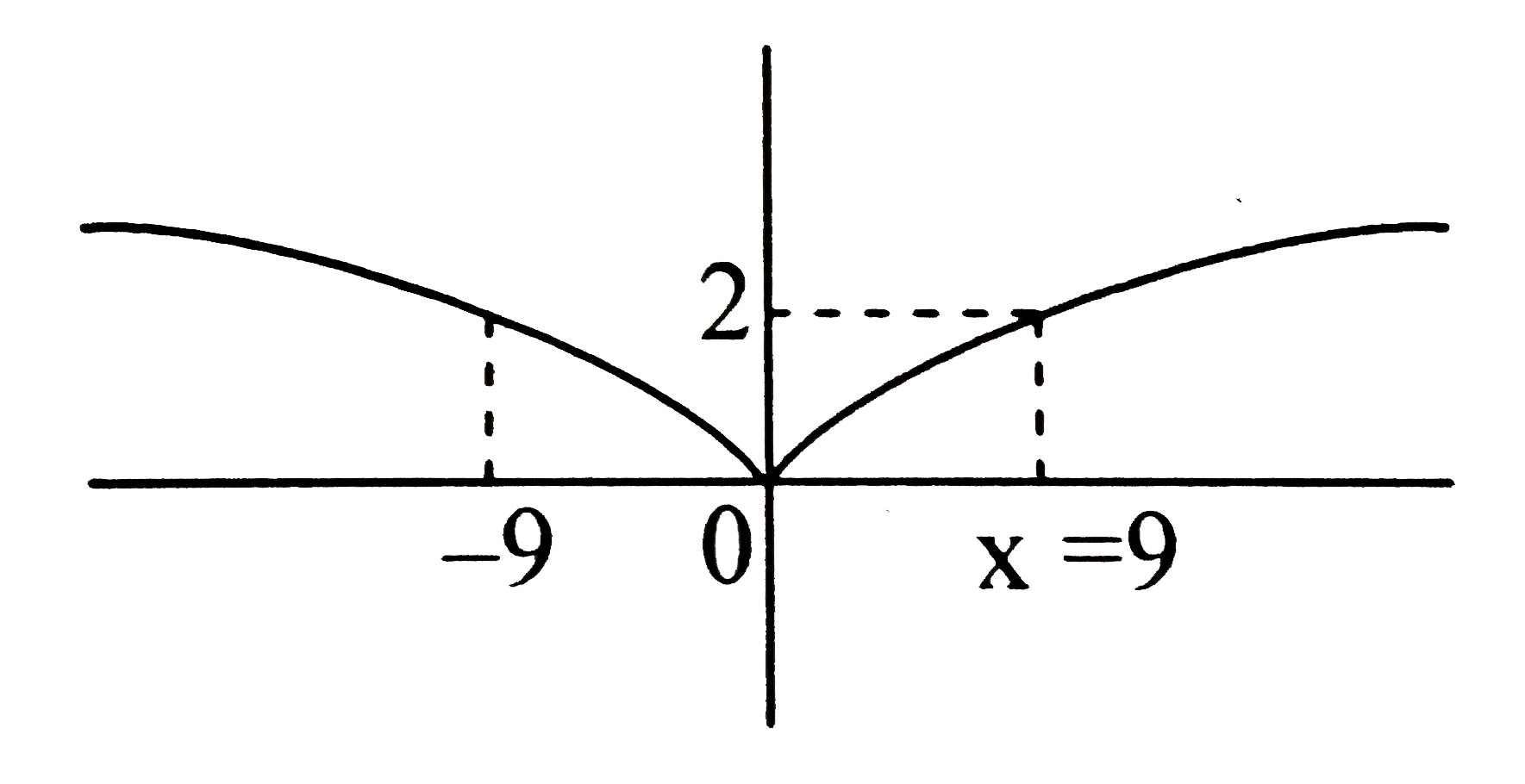 Clear from graph option (B) is right. |
|
| 27. |
An unbiased coin is tossed. If the result is head, a pair of unbiased dice is rolled and the number obtained by adding the numbers shown on the two faces is noted. If the result is tail, a card from a well shuffled pack of eleven cards numbered 2, 3, 4, ..., 12 is picked and the number on the card is noted. Find the prbability that noted number is either 7 or 8. |
|
Answer» |
|
| 28. |
Let [x] = greatest integer le x and {x} =x - [x], Let, f_(1)(x) = 2/pi [sin^(-1) (x) + cos^(-1)(x)] f_(2)(x) = sin^(2) (log_(5)x) + cos^(2) (log_(3)x) f_(3)(x) = sgn({x} +1) and f_(4)(x) = sec^(2) [{x}] - tan^(2) {[x]} sgn(x) = {{:(-1, if x lt 0),(0, if x=0),(1, if gt 0):} Then which of the follwing is not true? |
|
Answer» `f_(1) =f_(2)` |
|
| 30. |
If the centroid of the triangle with vertices (3c+2,2,0),(2c,-1,-1)and(c+2,3c+1,c+3) lies in the plane z=c, then the coordinates of the centroid are: |
|
Answer» `(-(2)/(3),-(1)/(3),(1)/(3))` |
|
| 31. |
A company manufacutres two types of sweaters type A and type B. It costs 360 to make type A sweater and 120 to make a type B sweater. The company can make atmost 300 sweater and spent atmost 72000 a day. The number of sweaters of type B cannot exceed the number of sweaters of type A by more than 100. The company makes a profit of 200 for each sweater of type A and 120 for every sweater of type B. Formulate this problem as a LPP to maximise the profit to the company. |
|
Answer» Also, the company spend atmost 72000 a day `therefore 360x+120 le 72000` `Rightarrow 3x+y le 600...(i)` Also, company can make atmost 300 sweaters. `x+y le 300....(ii)` Further, the number of sweaters of type B cannot exceed the number of sweater of type A by more than 100 i.e. `x+100 ge y` `Rightarrowx-y ge -100 ...(ii)` Also, we have have non-negative constraints for x and y i.e. `x ge 0, x ge 0, y ge 0,....(iv)` Hence, the company makes a profit fo 200 each sweater of type A and 120 for each sweater of type B i.e. Profit (Z)=200x+120y Thus, the required LPP to maximise profit is Maximise Z=200x+120y is subjected to constraints. `3x+y le 600` `x+y ge300` `x-y ge -100` `x ge 0, y ge 0` |
|
| 32. |
Fill in the blanks in each of the following, using the answers given against each of them : The angle between the lines x = 2 and x- sqrt3y + 1 = 0 is _____ |
| Answer» ANSWER :B | |
| 33. |
If the lines barr={a+1(1-a)}hati+(a-ta)hatj+{c+t(1-c)}hatk and barr_1={c+t(1-c)}hati+(c-tc)hatj+{b+t(1-b)}hatk lies on the plane x/a+x/b+z/c=1, then |
| Answer» Answer :B | |
| 34. |
'S' is the sample space obtainedwhen a pair of symmetric dice are tossed , X is the random variable defined by X(a,b) = max {a,b} so that therange of X is the set {1,2,3,4,5,6}. Then the meanof X is |
|
Answer» 5.5 |
|
| 35. |
If f has a local extremum at a and if f'(a) exists then ………………. . |
|
Answer» `f'(a) LT 0` |
|
| 37. |
Which of the following is always true? |
|
Answer» <P>`(p to Q) -= ~q to ~p` |
|
| 38. |
The value of (1+(a^(2)x^(2))/(2!)+(a^(4)x^(4))/(4!)+…)^(2)-(ax+(a^(3)x^(3))/(3!)+(ax+(a^(3)x^(3))/(3!)+(a^(5)x^(5))/(5!)+..)^(2) is |
| Answer» Answer :d | |
| 39. |
(a-b)/(a)+(1)/(2)((a-b)/(a))^(2)+(1)/(3)((a-b)/a)^(3)+....= |
|
Answer» `log_(E )(AB)` |
|
| 40. |
Let R be the relation in the set {(1,2,3,4} given by R ={(1,2), (2,2), (1,1) (4,4),(1,3), (3,3), (3,2)}. Choose the correct answer. |
|
Answer» R is REFLEXIVE SYMMETRIC but not transitive. |
|
| 41. |
Using elementary transformations, find the inverseof the matrices [(2,0,-1),(5,1,0),(0,1,3)] |
|
Answer» |
|
| 42. |
Solve the following equations (where [*] dentoes greatest integer function and {*} represent fractional part function) (i) 2[x]+3[x]=4x-1 (ii) 4[x]=x+{x} (iii) [x]+2{-x}=3x |
|
Answer» |
|
| 43. |
(Manufacturing problem): A manufacturing company makes two models A and B of a product. Each piece of Model A requires 9 labours for fabricating and 1 labour hour for finishing. Each piece of Model B requires 12 labour hours for fabricating and 3 labour hours for finishing. For fabricating and finishing the maximum labour hors available are 180 and 30 respectively. The company makes a profit of Rs. 8000 on each piece of model Aand Rs. 12000 on each piece of Model B. How manypiecesof Model A and Model B should be manufactured per week to realise a maximum profit? What is the maximum profit per week? |
|
Answer» |
|
| 44. |
If f(x)=|x| + |sin x| for x in (-(pi)/(2),(pi)/(2)), then its left hand derivative at x = 0 is |
| Answer» ANSWER :C | |
| 46. |
[{:( 2,-3,3),(2,2,3),(3,-2,2):}] |
|
Answer» `Now, A=IA ` ` IMPLIES [{:( 2,-3,3),( 2,2,3),( 3,-2,2):}]=[{:( 1,0,0),( 0,1,0),( 0,0,1):}]A` `implies [{:( 1,1,4),( 2,2,3),( 3,-2,2):}]=[{:( 1,1,-1),( 0,1,0),(0,0,1):}]A R_(1) to R_(1) +R_(2) -R_(3)` `={:( 1,1,4),( 0,0,-5),(0,-5,-10):}]=[{:(1,1,-1),(-2,-1,2),(-3,-3,4):}]A` ` R_(2) to R_(2) -2R_(1)` ` R_(3)to R_(3) - 3R_(1)` `implies [{:( 1,1,4),( 0,-5,-10),( 0,0,-5):}]-[{:( 1,1,-1),( -3,-3,4),( -2,-1,2):}]AR_(2) harr R_(3)` `implies [{:(1,1,4),( 0,1,2),(0,0,1):}]=[{:(1,1,-1),( (3)/(5),(3)/(5),-(4)/(5)),( (2)/(5),(1)/(5) ,-(2)/(5)):}]A R_(2) to -(1)/(5) R_(2),` `R_(3) to -(1)/(5) R_(3)` `implies [{:(1,0,2),(0,1,2),(0,0,1):}]=[{:((2)/(5),(2)/(5),-(1)/(5)),((3)/(5),(3)/(5),-(4)/(5)),((2)/(5),(1)/(5),-(2)/(5)):}]AR_(1)to R_(1)- R_(2)` `implies [{:(1,0,0),(0,1,0),(0,0,1):}]=[{:(-(2)/(5),0,(3)/(5)),(-(1)/(5),(1)/(5),0),((2)/(5),(1)/(5) ,-(2)/(5)):}]A` `R_(1) to R_(1) - 2R_(3),R_(2) to R_(2) -2R_(3)` `thereforeA^(-1)=[{:(-(2)/(5),0,(3)/(5)),(-(1)/(5),(1)/(5),0),((2)/(5),(1)/(5),-(2)/(5)):}]=-(1)/(5)[{:(2,0,-3),(1,-1,0),(-2,-1,2):}]` |
|
| 47. |
Determine order and Degree(if defined) of differential equations given ((d^(2)y)/(dx^(2)))^(2) + cos ((dy)/(dx)) = 0 |
|
Answer» |
|
| 48. |
The curve y^2(x-2)=x^2(1+x) has ....... |
|
Answer» only ONE LOOP between x=-1 and x=0 |
|
| 49. |
If ""^(8)C_(3)+""^((n+2))C_(4)=""^(9)C_(4), then n is |
|
Answer» 6 |
|