

Saved Bookmarks
This section includes 7 InterviewSolutions, each offering curated multiple-choice questions to sharpen your Current Affairs knowledge and support exam preparation. Choose a topic below to get started.
| 1. |
For the circle x^(2)+y^(2)-3x-5y+1=0, the points (4,2), (3,-5) are |
|
Answer» CONJUGATE POINTS |
|
| 2. |
intcottheta cosec^7theta d theta |
|
Answer» SOLUTION :`intcottheta cosec^7theta d THETA` =`intcosec^6theta.(cosectheta.cottheta)d theta` [PUT `sectheta=t` Then `cosectheta.cottheta d theta=DT`] =`intt^6(-dt)=-1/7t^7+C=-1/7cosec^7theta+C` |
|
| 3. |
Seeing that Max has managed to solve the puzzle, the trainer gives Max another challenge. The trainer has a dozen Pokéballs,arranged in a 3xx 4 grid, which forconvenience we have labeled A through L. Two of the pokéballs are chosen randomly, and they have a pokémon inside them.The other ten are empty. Max is given two options. He can either open them in the order A,B,C,D,E,F,G,H,I,J,K,L (Option A) or he can open in the orderA, E, I, B, F, J, C, G, K, D, H, L (Option B). Whatever option Max chooses, the trainer will choose the other.You stop when you have found a pokéball with a pokémon inside. Your score is the number of pokéballs you have opened. Once you have found a pokéball with a pokémon, you once again put the pokémon back in the same pokéball and leave it intact. The one with the lowest score wins. For example, let the pokémon be in H and K. Let’s say Max chooses Option A. Then he will find the first pokémon in H, and will score 8 points. Whereas thetrainer, following option B, will find his first Pokémon in K, and score 9 points. Which option should Max choose so that he has a higher chance of winning the game ? |
|
Answer» A, B, C, D, E, F, G, H,I, J, K, L `{:(x x,b2,b3,b4),(c2,c5,b7,b8),(c3,c6,c9,x x):}` Note that there are five b Pokeballs and five c Pokeballs. So the cases in which the pokemon is in pokeball A or Pokeball L are EQUALLY split between Max and Brock. Similarly if Alice selects two b Pokeballs then Max necessarily wins, but these are balanced out by an equal NUMBER of cases in which Alice selects two c Pokeballs and C necessarily wins.The crucial cases occur when Alice selects one b Pokeball and one c Pokeball. Max wins if the b Pokeball has a lower score than the c Pokeball: b2 and (c3 or c5 or c6 or c9) b3 adn (c5 or c6 or c9) ltbr. b4 and (c5 or c6 or c9) b7 and c9 b8 and c9 Brock wins if the c Pokeball has a lower score than the b Pokeball:c2 and (b3 or b4 or b7 or b8) c3 and (b4 or b7 or b8) |
|
| 4. |
Which of the following is related with Gall bladder :- (A) Thin Muscular sac (B) Helps in storation of bile (C) Concentrate the bile (D) Connect with Hapatic duct with the help of common bile duct |
|
Answer» A, B, C, D |
|
| 5. |
If a circle cuts the rectangular hyperbola xy = 1 in the points (x_(r), y_(r)), r = 1, 2, 3, 4 prove that x_(1), x_(2),x_(3), x_(4) = y_(1), y_(2), y_(3), y_(4) = 1 |
|
Answer» |
|
| 6. |
The mean of two samples of size 50 and 100 respectively are 54.1 and 50.3 and the standard deviations are 8 and 7. Obtain the mean and standard deviation of the sample of size 150 obtained by combining the two samples. |
|
Answer» |
|
| 7. |
Theterm independent ofx ( x gt 0,xne1 )intheexpansionof[ ((x+ 1 ))/((x ^(2//3) -x^(1//3 ) + 1 )) -(( x - 1 )) /(( x- sqrt x )) ] ^(10)is |
|
Answer» `105 ` `= [ ((x ^(1/3)) ^3+1 ^(3))/( (x ^(2//3) -x ^(1/3)+ 1 ) )- ((sqrt x- 1 )(sqrt x+ 1 ))/(sqrtx (sqrt x - 1 ))] ` ` [ (x ^(1/3) + 1 )-((sqrtx+ 1 ))/(sqrtx)]^(10)= [ x ^(1/3)-x ^( -1/2 ) ]^(10) ` LET` T _( r + 1 )`be independentof`.x.` ` rArrT_ (r + 1 )= ""^(10) c _r (x ^(1/3 )^(10- r )(-x ^(-1/2 ) ^ r` `x ^( (10- r ) / (3) ) .x ^(- (r)/(2))=x ^(0) ` ` rArr(10)/(3)-(r)/(3) -(r)/(2)=0 ` ` rArr(10)/(3) = ( 5r ) /(6 ) ` ` rArr r=4 ` `therefore `Thetermsis ` ""10 c_4( -1) ^(4)` `= 210 ` |
|
| 8. |
Show that the locus of the feet of the perpendiculars drawn from foci to any tangent of the ellipse is the auxilliary circle. |
|
Answer» |
|
| 9. |
Let f : R - {-(4)/(3) } to R be a function defined as f (x) = (4x )/( 3x +4). The inverse of f is the map g: Range fto R {-(4)/(3)} given by |
|
Answer» `G (y) = (3Y)/(3-4Y)` |
|
| 10. |
Each of the statement p implies~q,~rimplies q and p is true. Then |
| Answer» Answer :B | |
| 11. |
Find the number of solution(s) of following equations: (i) x^(2)-sinx-cosx+2=0 (ii) cos(x^(2)+x+1)=2^(x) + 2^(-x) (iii) sin^(2)x - 2sinx - x^(2)-3=0, x int [0,2pi] (iv) (sin (pix)/(2sqrt(2)))= x^(2)-2sqrt(2)x+3 |
|
Answer» Solution :We have, (i) `x^(2)+2= sinx + cosx` The range of `x^(2) + 2` is `[2, infty]` and the range of `sinx + cosx` is `[-sqrt(2), sqrt(2)]` As there is no common value ini the ranges hence no solution EXISTS. (iii) `cos(x^(2)+ x+1) = 2^(x) + 2^(-x)` The range of `cos(x^(2)+x+1)` is `[-1,1]` Using A.M. `ge` G.M. `(2^(x) + 2^(-x))/(2) ge sqrt(2^(x). 2^(-x))` `RARR r^(x) + 2^(-x) ge 2` Hence, RHS `int [2, infty]` Since, there is no common value in the ranges, hence number of SOLUTIONS is zero. (iii) The equation can be written as `(sinx-1)^(2)=1` Hence no solution exists. (iv) `sin (pix)/(2sqrt(2))= (x-sqrt(2))^(2)+1` LHS `int [-1,1]` and RHS `int [1,infty]` Hence, solution is obtained at LHS = RHS=1 If (`x-sqrt(2))^(2) + 1=1 rArr x=sqrt(2)` Also at `x=sqrt(2)`, LHS `=sin(PI xx sqrt(2))/(2sqrt(2))=1` Hence, `x=1` is the only value satisfying the given equation and consequently number of solution is one. |
|
| 12. |
A uniform thin ................. |
|
Answer» `df=(m/R dx)(GM)/x^(2)` Total force on rod is `F= int df=(GMm)/R underset(R)OVERSET(2R)(int) 1/x^(2) dx` `=(GMm)/R [-1/x]_(R)^(2R)` `=(GMm)/(2R^(2))` |
|
| 13. |
Find the Vector and Cartesian equation of line passing through (1, -2, 3) and parallel to the planes x - y + 2z = 5 and 3 x + 2y - z = 6 |
|
Answer» |
|
| 14. |
If I = int_(0)^(pi//2) (dx)/(5 + 3 sin x) = lamda tan^(-1) ((1)/(2)), then lamda= |
|
Answer» `(1)/(4)` |
|
| 15. |
Find the area enclosed by the curve y=-x^(2) and the straight line x+y+2=0. |
Answer» 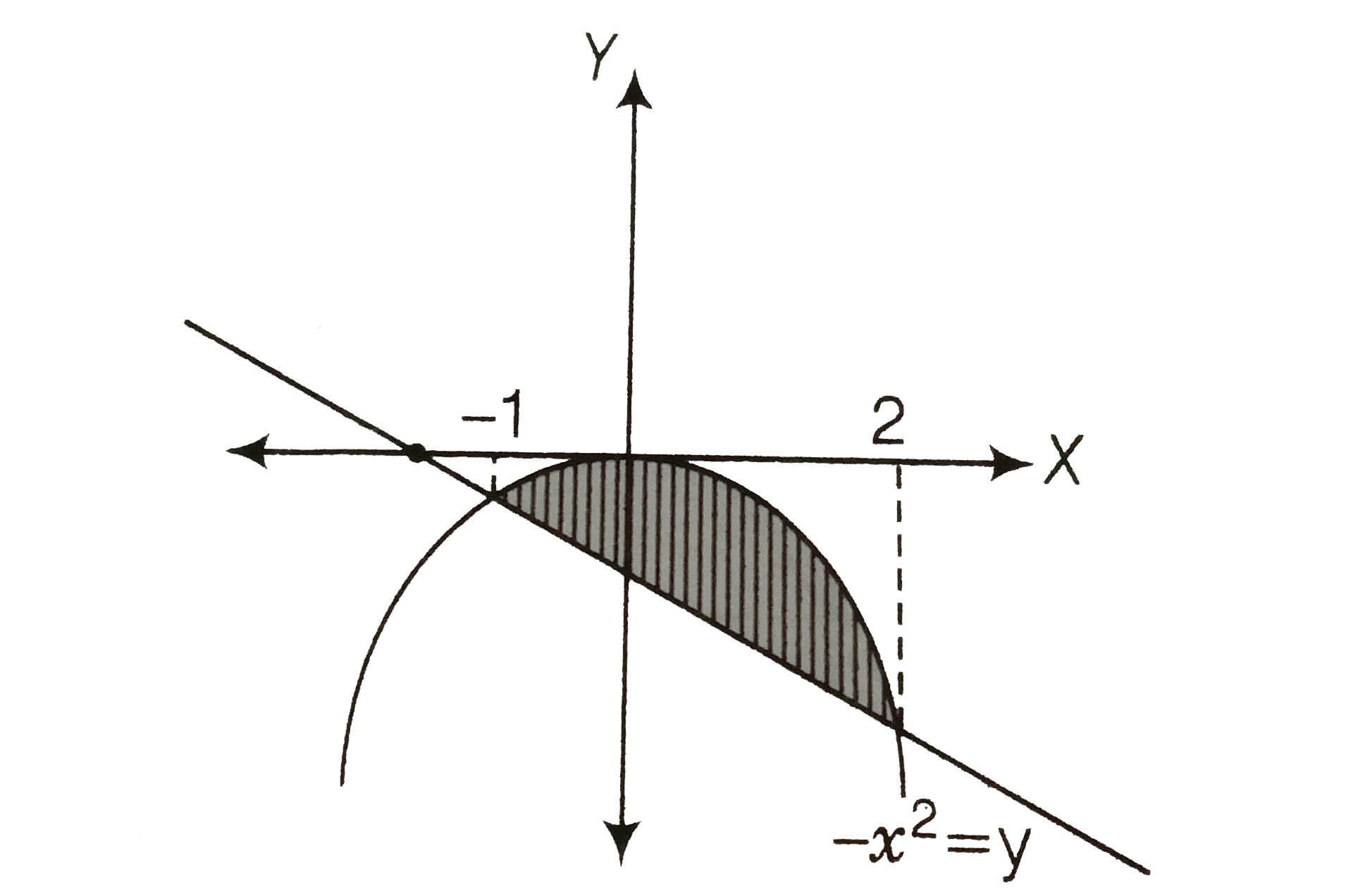 `rArr-x-2=-x^(2)rArrx^(2)-x-2=0` `rArrx^(2)+x-2x-2=0rArrx(x+1)-2(x+1)=0` `rArr(x-2)(x+1)=0rArrx=2, -1` `:. "AREAOF shaded region, " A=abs(int_(-1)^(2)(-x-2+x^(2))dx)=abs(int_(-1)^(2)(x^(2)-x-2)dx)` `=abs([(x^(3))/3-(x^(2))/2-2x]_(-1)^(2))=abs([8/3-4/2-4+1/3+1/2-2])` `=abs((16-12-24++3-12)/6)=abs(-27/6)=9/2" sq units"` |
|
| 16. |
Find the range of rational expression y =(x^(2) -x+4)/(x^(2) +x+4) is x is real. |
|
Answer» |
|
| 17. |
The radius of the shortest orbit in a one-electron system is 18 pm. It may be |
|
Answer» Hydrogen |
|
| 18. |
What is the largest positive integer n such that lfloor33 is divisible by 2''. |
|
Answer» |
|
| 19. |
A rectangular sheet of tin 45 cm by 24 cm is to be made into a box without top, by cutting off square from each corner and folding up the flaps. What should be the side of the square to be cut off so that the volume of the box is maximum ? |
|
Answer» |
|
| 20. |
Find 4^(th) term of (8-x)^(1//3) |
|
Answer» |
|
| 21. |
Given two independent events A and B such that P(A) = 0.3, P(B) = 0.6. Findi. P(A and B) ii. P(A and not B) iii. P(A or B) iv. P( neither A nor B) |
|
Answer» |
|
| 22. |
A coin is tossed twice and following events are defined. Event A : Both head and tail are obtained. Event B : at most one tail is obtained. Then find probabilities of the following.(1) P(A) (2) P(B) (3) P(A | B) (4) P(B | A) |
|
Answer» |
|
| 23. |
If AD, BE, CF are the diameters of circumcircle of Delta ABC, then prove that area of hexagon AFBDCE is 2Delta |
|
Answer» Solution :Chord AC SUBTENDS the same angle at point B and D `:. Angle ADC = B` So, in right ANGLED triangled ACD `CD = AC cot B` `:. CD = b cot B` Similarly from `Delta ABD`, `BD = c cot C`  `:. " Area of " Delta BDC` `Delta_(BDC) = (1)/(2) (b cot B) (c cot C) sin (B + C)` `= (bc)/(2) sin A cot C cot B` `= (abc)/(4R) cot B cot C` Similarly `Delta_(AEC) = (abc)/(4R) cot A cot C` and `Delta_(AFB) = (abc)/(4R) cot A cot B` `:.` Area of hexagon AFBDCE `= Delta_(BDC) + Delta_(AFC) + Delta_(AFB) + Delta_(ABC)` `= (abc)/(4R) [cot A cot B + cot B cot C + cot C cot A] + Delta` `= Delta + Delta` (as in `Delta ABC, cot A cot B + cot B cot C + cot A = 1`) `=2 Delta` |
|
| 24. |
int(dx)/(xsqrt(2x^2-2x+1))= |
|
Answer» `-logx+log|1-x+sqrt(1-2x+2x^2)|+C` |
|
| 25. |
If x,y, z in R then the least value of the expressionE = 3x^(2) + 5y^(2) + 4z^(2) - 6x + 20y- 8z - 3 is |
|
Answer» `-15` |
|
| 26. |
If the lengths of the tangents drawn from a point P to the three circles x^(2) + y^(2) - 4 = 0, x^(2) + y^(2) -2x + 3y = 0 and x^(2) + y^(2) + 7y -18 = 0 are equal, then the coordinates of P are |
|
Answer» (2,5) |
|
| 27. |
If the directin cosines of two lines satisfy the equation l + m + n =0 and 2lm + 2ln - m n =0, then the acute angle between those two lines is |
| Answer» ANSWER :B | |
| 28. |
If f(x) = sin^44x - cos^44 &g(x) = sin x + cosx. Then general solution of f(x) = [g(pi/10)] is ? |
| Answer» Answer :A | |
| 29. |
A trapezium is inscribed in the parabolay^(2)=4x, such that its diagonal pass through the point (1, 0) and each has length (25)/(4). If the area of the trapezium be P, then 4P is equal to : |
|
Answer» 70 |
|
| 31. |
Let f(x) be a function satisfying f(x)f(x+2) = 10 AA x in R, then |
|
Answer» `f(X)` is a periodic FUNCTION |
|
| 32. |
The roots of the equation x ^(5) - 40 x ^(4) + ax ^(3) + bx ^(2) + cx + d =0 are in GP. Lf sum of reciprocals of the roots is 10, then find |c| and |d| |
|
Answer» |
|
| 33. |
Normal at point (5, 3) to the rectangular hyperbola x y - y - 2 x - 2 = 0 meets the curve at the point whose coordinates are |
|
Answer» `0,-2` |
|
| 34. |
The relation R in the set {1,2,3} given by R= {(1,1),(2,2),(3,3),(1,2),(2,3)} is not transitive. Why? |
|
Answer» <P> |
|
| 35. |
Find the equation of the locus of P, if A=(2,3), B=(2,-3) and PA +PB =8. |
|
Answer» |
|
| 36. |
Find the nature of the roots of 2x^(2)+x+3=0 |
|
Answer» |
|
| 37. |
How many selections of atleast one red ball can be made from 4 red balls and 3 green balls if balls if balls of same colour are different in size. |
|
Answer» |
|
| 38. |
Solvethe followingequations x^5 -5x^4 +9x^3 -9x^2 +5x -1=0 |
|
Answer» |
|
| 39. |
The plane having equation 2x+5z+1=0 is parallel to_____plane. |
| Answer» SOLUTION :DISTANCE of `3x+4y=1` from o (0,0) is `(|3xx0+4xx0-1|)/SQRT(3^3+4^2)=1/5` | |
| 40. |
Let f(x)=e^(x),g(x)={:{(x^(2),if,xlt(1)/(2)),(x-(1)/(4),if,xge(1)/(2)):} and h(x)=f(g(x)). The derivative of h(x) and x=(1)/(2) is e^((1)/(a)) then a equal to |
|
Answer» `h((1)/(2))=h(((1)/(2))^(+))=h(((1)/(2))^(-))=e^((1)/(4))` `impliesh^(')((1)/(2))=e^((1)/(4)),a=4` |
|
| 41. |
Let f:R rarr R be a function as f(x)=(x-1)(x+2)(x-3)(x-6)-100. If g(x) is a polynomial of degree le 3 such that int (g(x))/(f(x))dx does not contain any logarithm function and g(-2)=10. ThenThe minimum value of f(x) is |
|
Answer» -136 |
|
| 42. |
Number of points of intersectionsof circle x^(2)+y^(2)+2x=0 with y^(2)=4x is |
|
Answer» 1 |
|
| 43. |
Consider a hyperbola (y^(2))/(4)-(x^(2))/(4) = alpha, If the common tangent of the hyoerbola and parabola meets the coordinates axes at x and A and B, then locus of mid point of AB is |
|
Answer» `x^(2) = -2y` `:.` MID point of `AB` is `((L)/(2),(t^(2))/(2))` `:.` the LOCUS is `y = -2x^(2)` |
|
| 44. |
Prove that the sequence with the general term x_n=1/n^(k) (k gt 0)is an infinitely small sequence. |
|
Answer» |
|
| 45. |
If overset(bar)a=overset(^)i+overset^(j)-2overset(^)k,overset(bar)b=2overset(^)i-overset(^)j+overset(^)k andoverset(-)c=moverset(bar)a+noverset(-)b, then m+n = |
|
Answer» 0 |
|
| 46. |
If the variables with values 10, 20 , 30 , 40have frequencies x, x+2,x -2,x+4and the mean is 2. 7 then the value of x is |
|
Answer» 2 |
|
| 47. |
Integrate the following int_0^(pi/2)cos^12thetad theta |
| Answer» SOLUTION :`int_0^(pi/2)cos^12thetad theta=11/12 CDOT 9/10 cdot 7/8 cdot 5/6 cdot 3/4 cdot 1/2 cdot pi/2=(4455pi)/92160` | |
| 48. |
The equation of the circle which cuts orthogonally the three circles x^2+y^2+4x+2y+1=0, 2x^2+2y^2+8x+6y-3=0, x^2+y^2+6x-2y-3=0 is |
|
Answer» |
|
| 49. |
P is a point on the ellipse (x^(2))/(a^(2))+(y^(2))/(b^(2))=1S and S^(1) are foci A & A^(1) are the vertices of the ellipse thenthe ratio |(SP-S^(1)P)/(SP+S^(1)P)| is |
|
Answer» E cos `THETA` |
|