

Saved Bookmarks
This section includes 7 InterviewSolutions, each offering curated multiple-choice questions to sharpen your Current Affairs knowledge and support exam preparation. Choose a topic below to get started.
| 1. |
Is delta modulation digital or analog ? |
| Answer» SOLUTION :DELTA MODULATION is DIGITAL modulation SYSTEM. | |
| 2. |
The figure shows four identical conducting plates each of area A the seperation between the consecutive plates is equal to L. When both the switches are closed, if charge present on the upper surface of the lowest plate from the top is written as (xV_(0)vareosilon_(0)A)/L then what is the value of x? Treat symbols as having usual meaning |
|
Answer» for `w_(2) varepsilon=(2l)/3[((varepsilon_(p))/(1+R))R/l]` .....(2) Dividing eq (1) by (2) and on solving we GET RESISTANCE of WIRE `w_(2)=1Omega` |
|
| 3. |
A p-n photodiode is manufactured from a semiconductor with band gap of 3.1 eV. Which of the following wavelengths can be detected by it? |
|
Answer» 4000 A |
|
| 4. |
2.25 N force is acting on 15 xx 10^(-4)C charge placed at a point in a uniform electric field. So, intensity of this electric field is...... |
|
Answer» 150 N `THEREFORE E = F/q` `=(2.25)/(15 xx 10^(-4))` `=1500 V//m` |
|
| 5. |
An air capacitor is completely charged upto the energy U and removed from battery. Now distance between plates is increased slowly by an external agent. If work done by external agent is 3U then ratio of final separation between the plates to the initial separation : |
|
Answer» 5 When di-electric is pulled out, then `U + 3U = (q^(2))/(2C_(0))` `4U = (q^(2))/(2C_(0))`….(ii) Then, (ii) & (i) `rArr K = 4`. |
|
| 6. |
For a certain metal, v = 2v_0 and the electrons come out with a maximumvclocity of 40 xx 10^6 m s^(-1). If the value of v = 5v_0 then maximumvelocity of photoelectrons will be : |
|
Answer» `2 xx 10 ^7 ms^(-1)` |
|
| 7. |
Consider arrangement shown In figure for davisson-Germer experiment when voltage applied to A is increased in diffracted beamwill have maximum number of electron for value diffraction angle (theta)such that….. |
|
Answer» Will be larger than the earlier value. Now ,as PER the statement,for no.Of electrons getting diffracted at angle `theta` to become maximum,value of matter wavelength of moving electrons.`lambda` should be such that it can satisfy the condition of constructive interference. Thus ,2din`theta lambda` `therefore` 2din `theta=n((h)/(sqrt(2Vem)))` `implies` As V increases, sin`theta` decreases and so `theta` will also decrease. Second method: In Dacisson-Germer experiment let voltage applied to andoe is V.De-Broglie wavelength assocaited wth electron, `lambda=(12.27)/(sqrt(V))Å`.......(1) For electron diffracted at angle `theta` condition for CENTRAL maximum `lambda-2dsintheta`.......(2) From equation (1) if V INCREASE then `lambda` will decrease and from equation (2) in `lambda` decrease then `theta` will also decrease. (For samll angle of diffraction sin`theta~~theta`). |
|
| 8. |
Figure shows three oscillating LC circuit with identical inductors and capacitors.If t_(1),t_(2), t_(3) are the time taken by the circuits I, II, III for fully discharge, then |
|
Answer» `t_(1) gt t_(2) gt t_(3)` Clearly `t_(2) lt t_(1) lt t_(3)`. |
|
| 9. |
A convex lens of focal length 16 cmproduces real image of magnification 2. The object distance from the lens is. |
|
Answer» 8 cm |
|
| 10. |
The force of repulsion between two identical positive charge when kept with a separation r in air is F. Half the gap between the two charges is filled by a dielectric slab of dielectric constant = 4 Then the new force of repulsion between those two charges become |
|
Answer» SOLUTION :`F^(1)=1/(4piepsi_(0))(q_(1)q_(2))/((r-t+tsqrtk)^(2))` `F/F^(1)=([r-(r/2)+(r/2)SQRT4]^(2))/r^(2)` = `((3r)/2)^(2)/r^(2)` = `(9/4r^(2))/r^(2)` `F/F^(1)=9/4` `F^(1)=4/9F` |
|
| 11. |
A body starts from rest with uniform acceleration in a st. line, Then distance travelled by body in 3rd and 4th second are in the ratio : |
|
Answer» `1:1` |
|
| 12. |
A concave mirror of focal length f in air is used in a transparent liquid of R.I. 2 for producing an imge of the object. What is its new focal length ? |
|
Answer» 4f |
|
| 13. |
The electric potential at the centre of a charged conductor is |
|
Answer» zero |
|
| 14. |
The ionization energy of a hydrogen like Bohr atom is 5 Rydberg, (a) What is the wavelength of radiation emitted when the electron jumps from the first excited state to the ground state? (b) What is the radius of the first orbit for this atom? Given that Bohr radius of hydrogen atom = 5 xx 10^(-11) m and 1 Rydberg = 2.2xx10^(-18)J |
|
Answer» |
|
| 15. |
In a single state transistor amplifier, when the signal changes by 0.02 V, the base current change by 10uA and collector current by10 mu A. If collector load R_c = 2k Omegaand R_L = 10k Omega , Calculate : Voltage gain and |
|
Answer» SOLUTION :Voltage GAIN and ` A_v = betaxx ( R_(AC ) )/( R_("in")) = ( 100 XX 1.66)/(2) = 83` |
|
| 16. |
The wavelength of blue light in air is 4500 Å . What is its frequency? If the refractive index for blue light is 1.55 in glass what will be the wavelength of blue light in glass? (c = 3 xx 10^8 m//s) |
| Answer» SOLUTION :`6.6 XX 10^(14 ) HZ ,2903 Å` | |
| 17. |
In a single state transistor amplifier, when the signal changes by 0.02 V, the base current change by 10uA and collector current by10 mu A. If collector load R_c = 2k Omegaand R_L = 10k Omega , Calculate : Power gain. |
|
Answer» Solution :Power gain. ` A_p` = CURRENT gain`xx` VOLTAGE gain `= 100 xx 83= 8300` |
|
| 18. |
In a single state transistor amplifier, when the signal changes by 0.02 V, the base current change by 10uA and collector current by10 mu A. If collector load R_c = 2k Omegaand R_L = 10k Omega , Calculate : Input impedance, |
|
Answer» SOLUTION :INPUT impedance, ` R_i= ( DeltaB_(BE ))/(DELTA I_b)=( 0.02 )/( 10mu A )= 2000Omega= 2K Omega ` |
|
| 19. |
In a single state transistor amplifier, when the signal changes by 0.02 V, the base current change by 10uA and collector current by10 mu A. If collector load R_c = 2k Omegaand R_L = 10k Omega , Calculate : Effective ac load, |
|
Answer» SOLUTION :EFFECTIVE AC load, ` R_(AC ) = R_C||R_L` ` thereforeR_(AC )= ( 2 xx 10 )/( 2+10) = 1.66k OMEGA` |
|
| 20. |
In a single state transistor amplifier, when the signal changes by 0.02 V, the base current change by 10uA and collector current by10 mu A. If collector load R_c = 2k Omegaand R_L = 10k Omega , Calculate : Current Gain |
| Answer» SOLUTION :Currentgrain ` beta= ( Deltai_C)/( Delta i_C )beta= (Delta i_C)/( Delta i_b)= (1 m A)/( 10 MU A) = 100` | |
| 21. |
Water flowing along an open channel drives an undershot waterwheel of radius 2m (figure). The water approaches the wheel with a speed of 5.0m//s and leaves with a speed of 2.5m//s, the amount of water passing by is 200 kg per second. At what rate does the water deliver angular momentum to the wheel (in J)? |
|
Answer» `(dL)/(DT)=(dm)/(dt)(v_(1)-v_(2)R=200xx(5-2.5)xx2=1000J` |
|
| 22. |
3.5 gm of solid Barium fouoride is added to water forming 1 lit of solution at 25^(@)C. Solubility product of salt is 4xx 10^(-5). What will be the minimum volume of water to be added to above solution to dissolve the salt completely . (At wt. Bva: 137, F: 19) |
|
Answer» 2 lit `(2xx 10^(-2))/( V) =10^(-2)` `implies V =2` lit Added volume =1 lit |
|
| 23. |
The circuit shown has been operating for a long time. The instant after the switch in the circuit labeled S is opened, what is the voltage across the inductor V_(L) and which labeled point (A to B) of the inductor is at a higher potential? Take R_(1)=4.0Omega, R_(2)=8.0Omega, and L=2.5H. |
|
Answer» `V_(L)=12 V`, POINT A is at the higher POTENTIAL `I=E/(R_(1)||R_(2))=8/3 Amp`. 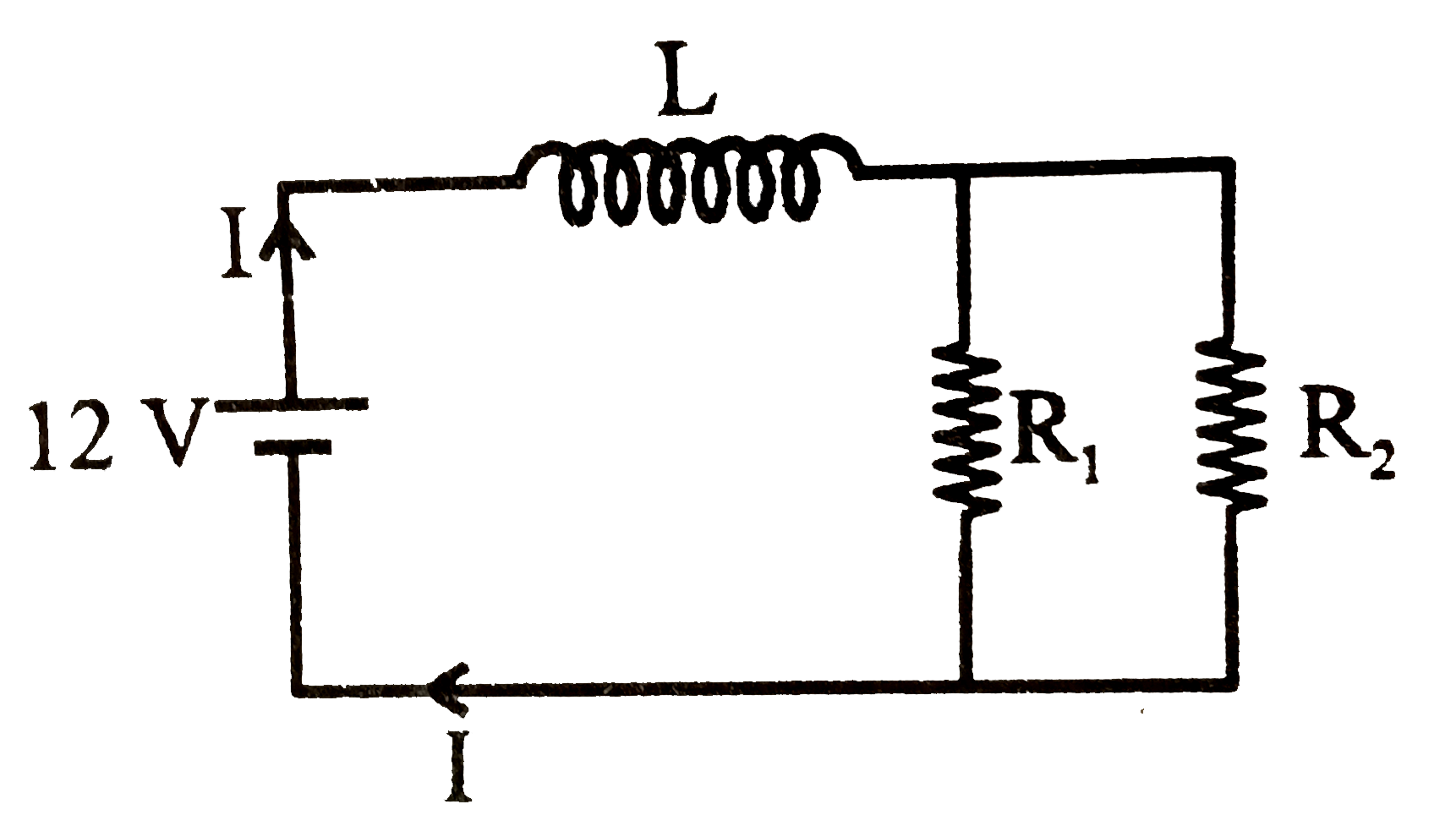 Just after switch is opened. Current in indouctor cannot change instantaneously applying loop law `12-V_(L)-IR=0` `12-V_(L)-4xx8/3=0 implies V_(L)=6` volt 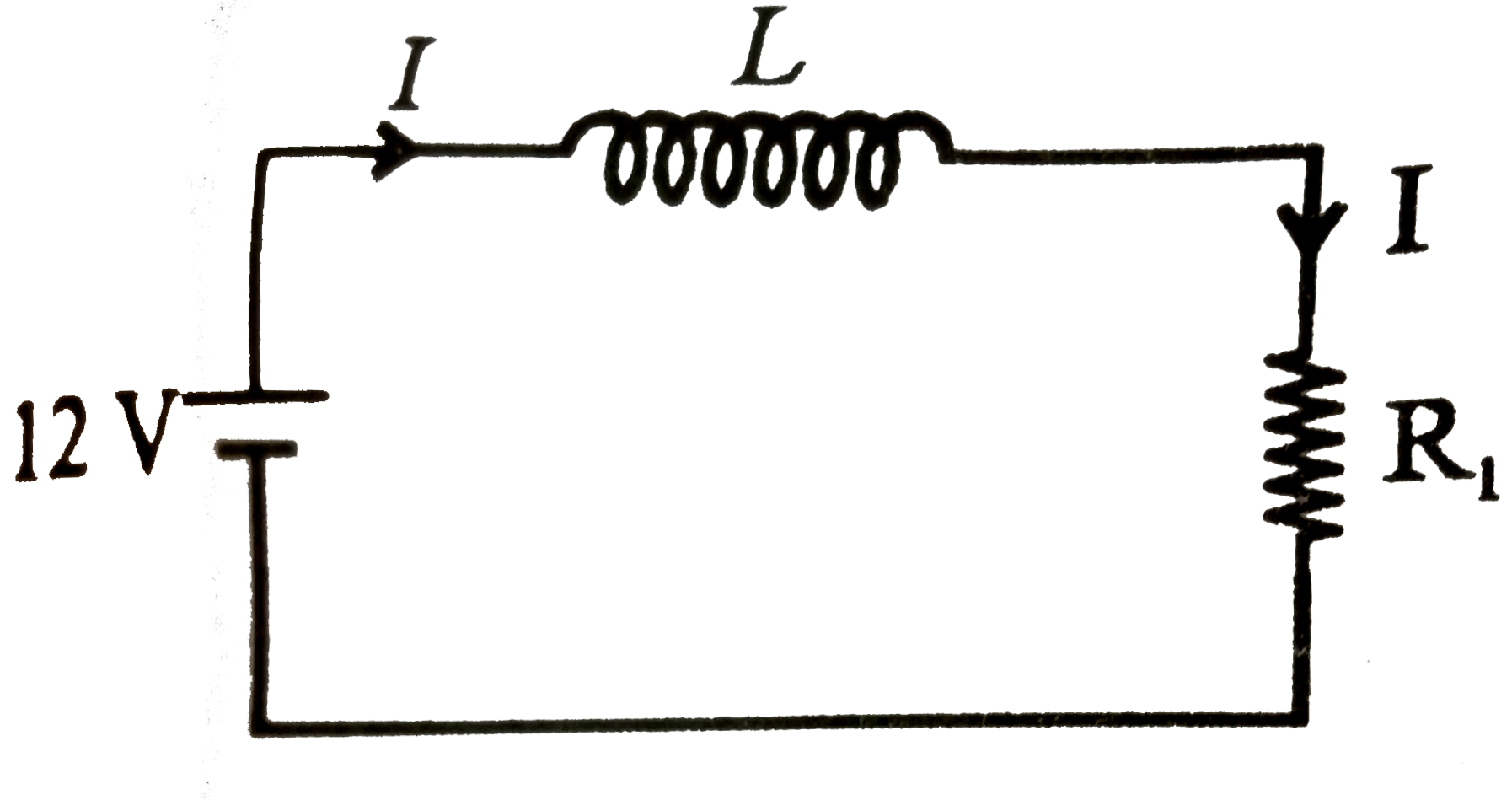 so their is `6V` rise ACROSS inductor. |
|
| 24. |
Statement-1: When a wire is stretched with in the proportionality limit such that its length becomes n times that of its initial value, the resistance of wire may become n^(2) times of its initial resistance Statement-2: The poisson's ratio of the wire's material can be 1//2. |
|
Answer» STATEMENT-1 is true, statement-2 is true and statement-2 is CORRECT explanation for statement-1. `Rightarrow (2Deltar)/r+(Deltal)/l=0=0 `Rightarrowpoisson's ratio `=-(Deltar//r)/(Deltal//l)=1/2` |
|
| 25. |
To increase the frequency by 20 %, the tension in the string vibrating on a sonometer has to be increased by |
|
Answer» 0.44 |
|
| 26. |
How many time constants will elapse before the power delivered by the battery drops to half of its maximum value in an RC circuit? |
|
Answer» 1.23 |
|
| 27. |
(A): Charges at rest or uniform motion generate electromagnetic waves. (R) : Accelerated charges radiate electromagnetic waves. |
|
Answer» Both 'A' and 'R' are TRUE and 'R' is the CORRECT EXPLANATION of 'A'. |
|
| 28. |
Inertial frames are "____________" frames |
|
Answer» variable |
|
| 29. |
What type of mirror is used in search lights and head lights of vehicles? |
|
Answer» |
|
| 30. |
A n-type silicon sample of width 4xx10^(-3)m, thickness 25xx10^(-5)m and length 6xx10^(-2)m carries a current of 4.8 mA when the voltage is applied across the length of the sample. If the free electrondensity is 10^(22)m^(-3), then find how much time does it take for the electrons to travel the full length of the sample? Given that charge on anelectron e=1.6xx10^(-19)C |
| Answer» SOLUTION :`4800 A//m^(2)`,0.02s | |
| 31. |
A and B are two identical bulbs of 40 W connected to a V = 12 volt cell. Switch S is closed to connect a third bulb C in the circuit. What happens to brightness of bulb A? Answer for two cases: (i) Bulb C is a very high wattage bulb. (ii) Bulb C is a very low wattage bulb. All the three bulbs have rated voltage of 12 volt. |
|
Answer» (II) A becomes slightly more BRIGHTER |
|
| 32. |
An object AB is kept in front of a concave mirror as shown in the figure. (i) Complete the ray diagram showing the image formation of the object. (ii) How will the position and intensity of the image be affected if the lower half of the mirror's reflecting surface is painted black ? |
Answer» SOLUTION :(i) 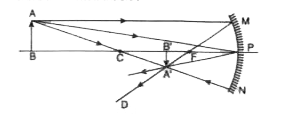 (ii) Position of IMAGE will remain same `//` UNCHANGED, but INTENSITY of the iamge will DECREASE. |
|
| 33. |
A unit positive point charge of mass m is projected with a velocity v inside the tunnel as shown. The tunnel has been made inside a uniformly charged nonconducting sphere. The minimum velocity with which the point charge should be projected such it can it reach the opposite end of the tunnel is equal to |
|
Answer» `[rhoR^2//4mepsilon_0]^1/2` `DeltaK+DeltaU=0` or `(0+(1)/(2)mv^(2))+q(V_(F)-V_(i))=0` or `V_(f)=(V_(s))/(2)(3-(R^(2))/(R^(2)))=(pR^(2))/(6epsilon_(0))(3-(r^(2))/(R^(2)))` Hence `r=(R)/(2)` `V_(f)=(pR^(2))/(6epsilon_(0))*(3-(R^(2))/(4R^(2)))=(11pR^(2))/(24epsilon_(0))` `V_(i)=((pR^(2))/(3epsilon_90))` `(1)/(2)mv^(2)=1[(11pR^(2))/(24epsilon_(0))-(pR^(2))/(3epsilon_90)]=(pR^(2))/(3epsilon_(0))[(11)/(24)-(1)/(3)]` `=(pR^(2))/(8epsilon_(0))` or `V=((pR^(2))/(4mepsilon_(0)))^(1//2)` Hence, velocity should be slightly GREATER than `V`. |
|
| 34. |
What is superconductivity ? |
| Answer» SOLUTION :The ABILITY of CERTAIN METALS, their compounds and alloys to conduct electricity with zero resistance at very temperatures is called SUPERCONDUCTIVITY. | |
| 35. |
Which event was organized for a week? |
|
Answer» END CHILD SLAVERY Week |
|
| 36. |
A diplomatic light of intensity I is passed through .The intensity of the transmitted lipits will be |
| Answer» Answer :B | |
| 37. |
A radioactive material has a half-life of 5 hours. In 20 hours 1g of material is reduced to ............. . |
| Answer» Solution :`1/16g`[t=20h=4 half-lives, hence RADIOACTIVE MATERIAL REMAINING INTACT is `M=M_(0)[1/2]^(4)=M_(0)/16=1/16g`] | |
| 38. |
Two plane mirrors are kept parallel to each other at a distance of 2 cm. An object is kept at the midpoint of the line joining them. Locate the images by drawing appropriate Ray diagram. |
Answer» SOLUTION :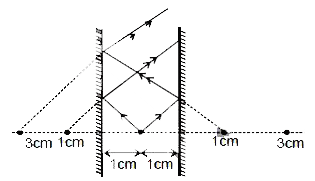 THUS, it FORMS an A.P. |
|
| 39. |
Specific resistance of a wire depends upon |
| Answer» Answer :D | |
| 40. |
Two metallic spheres of radius 1 cm and 2 cm are given charge 10^(-2) and 5 xx 10^(-2) C respectively. If they are connected by a conducting wire, the final charge on the smaller sphere is |
|
Answer» `3 xx 10^(-2)` C |
|
| 41. |
Let us list some of the factors, which could possibly infuence the speed of wave propagation. (i) Nature of the source (ii) Direction of propagation (iii) Motion of the source and /or observer (iv) Wavelength v. Intensity of the wave. On which of these factors, if any, does a. the speed of light in vacuum. b. the speed of light in a medium (say, glass or water), depend? |
|
Answer» Solution :(a) The speed of light in vacuum is a universal constant independent of all the factors LISTED and anything else. In particular, note the SURPRISING fact that it is independent of the relative motion between the source and the observer. This fact is a basic axiom of Einstein’s special theory of relativity. (b) Dependence of the speed of light in a medium: (i) does not depend on the nature of the source (wave speed is determined by the properties of the medium of propagation. This is also true for other waves, e.g., sound waves, water waves, etc.). (II) independent of the direction of propagation for isotropic MEDIA. (iii) independent of the motion of the source relative to the medium but depends on the motion of the observer relative to the medium. (iv) depends on wavelength. (v) independent of intensity. [For HIGH intensity beams, however, the situation is more complicated and need not concern us here.] |
|
| 42. |
Radiowaves are: |
|
Answer» LONGITUDINAL ELECTROMAGNETIC WAVES |
|
| 43. |
Electric charges of + 10 mu C,+ 5 mu C, - 3 mu C and + 8 mu C are placed at the corners of a square of side sqrt2m. The potential at the centre of the square is |
|
Answer» `1.8 V` `R = a/sqrt2 = sqrt2/sqrt2 =1m` ` :.` Potential at O, `V = 1/( 4 pi epsi_0.r)[q_1 + q_2 + q_3 + q_4]` ` = (9 xx 10^9)/1 [ 10+ 5- 3+ 8] xx 10^(-6) = 1.8 xx 10^5 V` 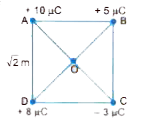
|
|
| 44. |
The flux linked per each turn of a coil of N turns changes from phi_1to phi_2. If the total resistance of the circuit including the coil is R. The induced charge in the coil is _____ |
|
Answer» `(N(phi_2-phi_1))/t` `Deltaphi=Nphi_2-Nphi_1` `therefore Deltaphi=N(phi_2-phi_1)` INDUCED emf in coil `|epsilon|=N(Deltaphi)/(DELTAT)` `therefore IR=N(Deltaphi)/(Deltat) "" [because |epsilon|=IR]` `therefore Q/(Deltat)=(NDeltaphi)/(RDeltat)` `therefore Q=(N(phi_2-phi_1))/R` |
|
| 45. |
The dimensions of angular displacement is, |
|
Answer» `[M^1L^1T^1]` |
|
| 46. |
Light of wavelength 6328 A^(0)is inclined normallyon havinga widthof 0.2 mmthe measured frommaximum of diffraction pattern on screen metroaway will be about |
|
Answer» `0.36` DEGRESS |
|
| 47. |
In the figure shown P_(2) and P_(2)are two conducting plates having charges of equal magnitude and opposite sign. Two dielectrics of dielectric constant K_(1) and K_(2)fill the space between the plates as shown in the figure. The ratio of electrical energy in 1^("st")dielectric to that in the 2^(nd)dielectric is : |
|
Answer» `1:1` |
|
| 48. |
The length of a wire is increased by 1mm on the application of certain load. In a wire of the same material of twice the length and half the radius of the first, the same force will produce an extension |
| Answer» Answer :C | |
| 49. |
Find the binding energy of L electron in titanium if the wavelength difference between the first line of the K series and its short-wave cut-off is Delta lambda= 26p m |
|
Answer» Solution :By Moseley's law ` ħ omega=(2 pi ħc)/(LAMBDA)E_(k)-E_(L)=(3)/(4) ħR(Ƶ-1)^(2)` where `-E_(k)` is the energy of the `K` electron and `-E_(L)` of the `L` electron. Also the enrgy of the LINE corresponding to the short wave cut off of the `K` series is `E_(k)=(2piħc)/(lambda-Delta lambda)=(2 piħc)/((2pic)/(omega)-Delta lambda)` `=(ħ)/((1)/(omega)-(Delta lambda)/(2 PIC))=(ħ omega)/(1-(omega Delta lambda)/(2 pic))` Hence `E_(L)=(ħomega)/(1-(omegaDeltalambda)/(2 pi c))-ħomega=(ħomega)/((2 pic)/(omegaDeltalambda)-1)` Substitution gives for TITANIUM `(Ƶ=22)` `omega= 6.85xx10^(18)s^(-1)` and hence `E_(L)= 0.47keV` |
|
| 50. |
A particle undergoes uniform circular motion. About which point on the plane of the circle, will the angular momentum of the particle remain conserved? |
|
Answer» at the CENTRE of the circle In uniform circular motion the torque about the centre of circle is ZERO. THEREFORE, L = CONSTANT. |
|