Saved Bookmarks
This section includes 7 InterviewSolutions, each offering curated multiple-choice questions to sharpen your Current Affairs knowledge and support exam preparation. Choose a topic below to get started.
| 1. |
Infrared radiation was discovered in 1800 by |
|
Answer» WILLIAM Wollaston |
|
| 2. |
In a reverse biased diode, when the applied voltage changes by 1V the current changes by 0.5muA . What is the reverse bias resistance of the diode ? |
|
Answer» `2xx10^5Omega` |
|
| 3. |
(i) An a.c. source of voltage V=V_(m) sin omega t is connected to a series combination of L, C and R. Use the phasor diagram to obtain expressions for impedance of the circuit and phase angle between voltage and current. Find the condition when current will be in phase with the voltage. What is the circuit in this condition called ? (ii) In a series LR circuit X_(L) =R and power factor of the circuit is P_(1) . When capacitor with capacitance C such that X_(L) = X_( C)is put in series, the power factor becomes P_(2) . Calculate P_(1)//P_(2) |
|
Answer» Solution :(i) N/A (ii) In the series LR CIRCUIT, power factor `P_(1) = cos phi = R/Z = R/sqrt(R^(2) + X_(L)^(2))`, Since, `X_(L) =R`, hence power `P_(1) = R/sqrt(R^(2) + R^(2)) = 1/sqrt(2)` When a capacitor is PUT in series then new power factor `P_(2) = R/Z = R/sqrt(R^(2) + (X_(L)-X_(C))^(2))` As `X_(L) =R` and `X_(C) =X_(L)`, hence, we have `P_(2) = R/sqrt(R^(2) + 0) =1` `RARR P_(1)/P_(2) = (1//sqrt(2))/1 = 1/sqrt(2)` |
|
| 4. |
The phase of a particle performing S.H.M. increases by pi//2 after every 4 seconds. Its time period of oscillation is |
|
Answer» 8s |
|
| 5. |
A parallel plate capacitor consists of two circular plates each of radius 12 cm and separated by 5.0 mm. The capacitor is being charged by external source. The charging current is constant and is equal to 0.15 A. The rate of change of potential difference between the plates will be : |
|
Answer» `1.873 xx 10^(7) V // s` |
|
| 6. |
If C and L denote the capacitance and inductance, then the units of LC are : |
|
Answer» `M^(0)L^(0)T^(2)` `V=(1)/(2pisqrt(LC))` `:.LC=(1)/(4piv^(2))=(1)/(T^(-1))^(2)=T^(2)=[M^(0)L^(0)T^(2)]` Hence correct choice is `(a)` |
|
| 7. |
Two charges q_(1) and q_(2) are placed at (0, 0, d) and (0, 0, - d) respectively. Find locus or points where the potential is zero. |
|
Answer» Solution :Let us talce a point of the REQUIRED plane as (x, y, z). The two charges lies on z-axis at a separation of 2D. The potential at the point P due to two charges is given by `V= V_(1)+V_(2)` `:. 0 = (kq_(1))/(sqrt(x^(2)+y^(2)+(z-d)^(2)))+(KQ^(2))/(sqrt(x^(2)+y^(2)+(z+d)^(2)))` `:. (q_(1))/(sqrt(x^(2)+y^(2)+(z-d)^(2)))=-(q_(2))/(sqrt(x^(2)+y^(2)(z+d)^(2)))` `(q_(1))/(q_(2))=- sqrt((x^(2)+y^(2)+(z-d)^(2))/(x^(2)+y^(2)+(z+d)^(2)))` Compendo and DIVIDENDO `sqrt(x^(2)+y^(2)+(z-d)^(2))` `(q_(1)+q_(2))/(q_(1)-q_(2))=-(+sqrt(x^(2)+y^(2)+(z-d)^(2)))/(sqrt(x^(2)+y^(2)+(z-d)))` Squaring both side ` (x^(2)+y^(2)+z^(2)-2zd+d^(2))` `((q_(1)+q_(2))^(2))/((q_(1)-q_(2))^(2))=-(+(x^(2)+y^(2)+z^(2)+2zd+d^(2)))/((x^(2)+y^(2)+z^(2)-2zd+d^(2)))` `-(x^(2)+y^(2)+z^(2)+2zd+d^(2))` `=(2(x^(2)+y^(2)+z^(2)+d^(2)))/(2(2zd))` `((q_(1)+q_(2))^(2))/((q_(1)-q_(2))^(2))=(x^(2)+y^(2)+z^(2)+d^(2))/(2zd)` `:. x^(2)+y^(2)+z^(2)+2zd((q_(1)+q_(2))^(2))/((q_(1)-q_(2))^(2))+d^(2)=0` This is the equation of SPHERE with centre , `(0,0,-2d[(q_(1)^(2)+q_(2)^(2))/(q_(1)^(2)-q_(2)^(2))])` |
|
| 8. |
White light is passed through a dilute solution of potassium permanganate. The spectrum produced by the emergent light is |
|
Answer» band EMISSION spectrum |
|
| 10. |
In photoelectric emission, a radiation whose frequency is 4 times threshold frequency of a certainn metal is incident on the metal. The an the maximum possible velocity of the emitted electron will be………………… |
|
Answer» `sqrt((hv_(0))/(m))` `K_(max) = h UPSILON - h upsilon_(0)""[upsilon = 4 upsilon_(0)]` `(1)/(2) mV_(max)^(2) = 4 h upsilon_(0) - h upsilon_(0)` `V_(max)^(2) = (6 h upsilon_(0))/(m)` `V_(max) = sqrt((6 h upsilon_(0))/(m))` |
|
| 11. |
Explain nuclear fusion reaction with an example. |
|
Answer» e.g. two deuterons can fuse together to form a medium nucleus and release energy of about 24 MeV. i.e., `""_(1)H^(2)+""_(1)H^(2) rarr ""_(2)He^(4)+24` M eV. Some other EXAMPLES of such REACTIONS are `""_(1)H^(1)+""_(1)H^(1) rarr ""_(1)H^(2)+""_(+1)e^(0)+0.42` M eV `4""_(1)H^(1) rarr ""_(1)He^(4)+2""_(+1)e^(0)+26.7` M eV `""_(1)H^(3)+""_(1)H^(2) rarr ""_(2)He^(4)+""_(0)n^(1)+17.6` M eV `""_(4)Li^(7)+""_(1)H^(1) rarr ""_(2)He^(4)+""_(2)He^(4)+17.3` M eV. Nuclear fusion reaction takes place in the PRESENCE of very high temperature ( about `10^(7)` K), so they are called thermonuclear reactions. All these reactions are exoergic and release huge energies. The energy come from conversion of mass of final stage nucleus formed as a result of fusion is always less than that of the indiyidual light nuclei. The temperature of the order of `10^(7)` K is very difficult to obtain. The mechanism involved for producing high temperature is a self-sustained fission explosion. When an atom bomb containing `U^(235)` explodes, very high temperature `( ~= 10^(7)K)` is produced. Thus atomic explosion acts as trigger and release tremendousamount of energy. Conditions for Fusion (1) Either the reacting nuclei should be given large amount of kinetic energy to overcome the mutual repulsion between them. (2) Or a very higher temperature should be produced. Such high temperature exists in the territoryof stars. Therefore, thermal fission is possible in stars. Example Nuclear fusion takes place in sun and stars. Hence they emit a Jarge amount of energy. Use Nuclear fusion is used in hydrogen bomb. |
|
| 12. |
Define current density. |
|
Answer» SOLUTION :The CURRENT density (J) is defined as the current per unit AREA of cross section of the CONDUCTOR `J=(I)/(A)` The S.I. unit of current density. `(A)/(m^(2))(or) Am^(-2)` is |
|
| 13. |
A : When tiny circular obstacle is placed in the path of light from some distance, a bright spot is seen at the centre of the shadow of the obastacle. R : Destructive interference occurs at the centre of the shadow of circular obstacle. |
|
Answer» Both A and R are true and R is the correct EXPLANATION of A |
|
| 14. |
In photoelectric emission, a radiation whose frequency is 4 times threshold frequency of a certain metal is incident on the metal. Then the maximum possible velocity of the emitted electron will be |
|
Answer» `SQRT((hv_(0))/( m))` |
|
| 15. |
The wave length of the sound produced by a source is 0.8m. If the source moves towards the stationary listner at 32 ms^(-1) , what is the apparent wave length of sound if the velocity of sound is 320 ms^(-1) |
|
Answer» 0.32 m |
|
| 16. |
For which colour of light, refractive index of glass is maximum ? |
| Answer» SOLUTION :Violet | |
| 17. |
Two conducting spheres of radii R_(1) and R_(2) are at the same potential. The electric intensities on their surfaces are in the ratio of |
|
Answer» `1 : 1` |
|
| 18. |
Sertoli cells are regulated by the pituitary hormone know as |
|
Answer» LH |
|
| 20. |
Time period of a charged particle undergoing a circular motion in a uniform magnetic field is independent of |
|
Answer» SPEED of the particle. |
|
| 21. |
From where does the couple borrow money to pay off their instalments? |
|
Answer» THRIFT and PROVIDENCE TRUST Corporation. |
|
| 22. |
Transistor functions as a switch. Explain. |
Answer» SOLUTION :The transistor in saturation and cut-off regions functions like an electronic switch that helps to TURN ON or OFF a given circuit by a small control signal।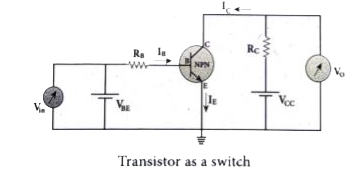 Presence of de source at the input (saturation region): When a high input VOLTAGE (V। = +5V) is applied, the base current `(I-B)` increases and in turn increases the collector current। The transistor will move into the saturation region (turned ON)। The increase in collector current `(I_C)` increases the voltage drop across R, thereby lowering the output voltage, close to zero। The transistor acts like a closed switch and is equivalent to ON condition। Absence of de source at the input (cut-off region):A low input voltage `(V_in = OV)`, decreases the base current `(1_B)` and in turn decreases the collector current `(1_C)`। The transistor will move into the cut-off region (turned OFF)। The DECREASE in collector current `(1_C)` decreases the drop across Rc, thereby increasing the output voltage, close to +5 V। The transistor acts as an open switch which is considered as the OFF condition। It is manifested that, a high input gives a low output and a low input gives a high output। In addition, we can say that the output voltage is opposite to the applied input voltage। Therefore, a transistor can be used as an inverter in COMPUTER logic circuitry |
|
| 23. |
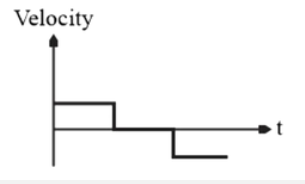
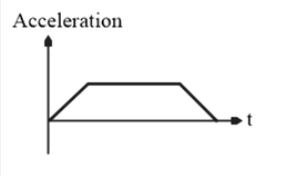
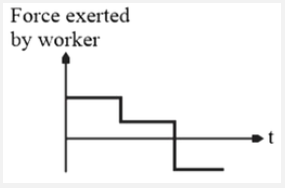
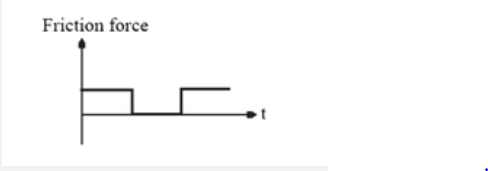
A boy is pushing a box on horizontal floor from a position of rest to rest , while moving along a straight line. Consider the three phases of motion. The floor is rough with a small friction coefficient . (i) Initially a constant hard push on the box to get it moving and attain a maximum velocity . (ii) Mild push to keep the box moving with constant velocity (iii) To pull back the box the to bring it to stop with the same retardation. Which of the following graph is CORRECT ? |
|
Answer»
|
|
| 24. |
shows a circuit used in an experiment to detrmine the emf and interanl resistance of the battery C. A graph was plotted of the potential difference V between the terminals of the battery against the current I, which was varied by adjusting the rheostat. The graph is shown in x and y are the intercepts of the graph with the axes as shown. What is the internal resistance of the battery? |
|
Answer» x From GRAPH it is clear that slope `= -r = -y//x` or `r = y//x`. |
|
| 25. |
When a photon is emitted from an atom , the atom recils The kinetic energy of recoils and the energy of the photon come from the difference in energy between the state involved in the transition suppose a hydrogen atom change its state from n = 3 to n = 2 calculate the fractional change in the wavelength of light emitted , due to the recoil |
|
Answer» `n=3` to `n=2` is `1.89 EV`. LET recoil energy be E. Then `m_0[V_2^2 -V_3^2]+E` `=1.89 eV` `=1.89 xx 1.6 xx 10^-19J` :' `1/2 xx 9.1 xx 10^-31[(2187/2)^2-(2187/3)^2]+E` `=3.024 xx 10^-19J` implies `E=10^-9` |
|
| 26. |
The energy stored in 5 mu F and 8 mu F capacitors are |
|
Answer» `250 xx 10^(-6) J , 36 xx10^(-4) J` |
|
| 27. |
In the circuit shown, the switch ‘S’ has been closed for a long time and then opens at t = 0. (a) Find the current through the inductor just before the switch is opened.(b) Find the current I a long time after the switch is opened.(c) Find current I as a function of time after the switch is opened. Also write the current through the cell as a function of time. |
|
Answer» (c) `I = 4 + 2E^(-5T)`, CURRENT through cell `= (21)/(4) + 2e^(-5t)` |
|
| 28. |
A crown glass prism of angle 5^@ is to be combined with a flint glass prism in such a way that the mean ray passes undeviated. Find (a) the angle of the flint glass prism needed and (b) the angular dispersion produced by the combination when white light goes through it. Refractive indices for red, yellow and viloet light are 1.514, 1.517 and 1.523 respectively for crown glass and 1.613 1.620 and 1.632 for flint glass. |
|
Answer» SOLUTION :The deviation produced by the CROWN PRISM is `delta = (mu - 1)A` and by the flint prism is `delta' = (mu' - 1)A'` The prisms are placed with respect to each other. The deviation are also in opposite direction. Thus, the net deviation is `D = delta -delta'= (mu-1)A - (mu' - 1)A'.... (i)` (a) if the net deviation for the mean ray is zero, `(mu -1)A = (mu' -1)A'` or `A' = ((mu -1)/((mu' -1))A = (1.517-1)/(1.620 -1)xx5^@` `=4.2^@` (b) The angular DISPERSION prouced by the crown prism is `delta_(UPSILON) - delta_r=(mu_(upsilon) - mu_r)A` and that by the fint prismis `delta_(upsilon) - delta_r = (mu_(upsilon) - mu_r)A'` The net angular dispersion is, `delta = (mu_(upsilon) - mu_r)A - (mu_(upsilon) - mu_r)A'` `=(1.523 - 1.514 xx 5^@ - (1.632 - 1.613) xx 4.2^@` `=- 0.-348^@.` The angular dispersiom has magnitude `0.0348^@.` |
|
| 29. |
The distance between a north pole of strength 6 xx 10^(-3)Am and a south pole of strength 8xx10^(-3) Am is 10 cm. The poles are separated in air. Find the force between them. |
| Answer» SOLUTION :`48 xx 10^(-11)N` | |
| 30. |
Define power factor, what are the maximum and minimum values of power factor |
|
Answer» SOLUTION :It is DEFINED as the RATION of true power to the apparent power of an a.c circuit. It is equal to the cosine of the phase angle between current and voltage in the a.c circuit. It is given by `cosphi=("TOUE power")/("Apparent power")` `=(P_("avearage"))/(V_(ms)-I_(ms))` |
|
| 31. |
Calculate the density of hydrogen nuclear in SI units. Given R_(0) = 1.1 fermi and m_(p) = 1.007825 amu. |
|
Answer» <P> Solution :`rho = (3m_(p))/(4piR_(0)^(3)) = (3xx1.007825 XX 1.66 xx 10^(-27))/(4xx 3.14 xx(1.1 xx 10^(-15))^(3))`` = (5.0189685 xx 10^(-27))/(16.71736 xx 10^(-45))` `rho = 2.98 xx 10^(17) kg m^(-3)` |
|
| 32. |
A planoconvex lens has a maximum thickness of 6 cm. When placed On a horizontal table with the curved surface in contact with the table surface, the apparent depth of the bottommost point of the lens is found to be 4 cm. If the lens is inverted such that the plane face of the lens is in contact with the surface of the table, the apparent depth of the center of the plane face is found to be (17/4)cm. The radius of curvature of the lens is............. |
|
Answer» 68 CM 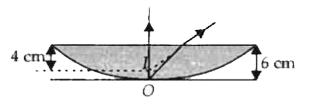 Here,`mu_(1)=mu,mu_(2)=1` u=-6cm,v=-4 cm,`R=oo` `therfore (1)/((-4))-(mu)/((-6))=(1-mu)/(00)` or `mu=(6)/(4)=(3)/(2)` And when plane surface is on the table,refraction will TAKE place at curved surface 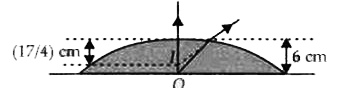 Here `mu_(1)=mu=(3)/(2),mu_(2)=1` u=-6cm,v`=-(17)/(4)` cm `(1)/((-17//4))-((3//2))/((-6))=(1-(3//2))/((-R))` `(-4)/(17)+(1)/(4)=(1)/(2R)implies(-16+17)/(68)=(1)/(2R)` `implies(1)/(68)=(1)/(2R)impliesR=(68)/(2)`cm=34cm |
|
| 33. |
A small conducting sphere of radius a mounted on an insulated handle and a positive charge q is inserted through a hole in the wall of a hollow conducting sphere of inner radius b and outer radius c. The hollow sphere is supported on an insulating stand andis initially uncharged. The small sphere is placed at the center of the hollow sphere. Neglect any effect of the hole. Which of the following statements will be true for this system? |
|
Answer» No work will be done in CARRYING a small charge from the inner conductor to the outer conductor. Charge on inner sphere can be SUPPOSED to be concentrated as a point charge at the center, hence electric field at a point in the region between the spheres at a distance `r` from the center is `(q//4pi_(0)r^(2))`. Due to induction, equla and opposite charges will appear on the inner and outer surface of the outer sphere. Hence, net charge which can be supposed to be placed at the center is `q` and electric field due to it at a point outside the hollow sphere at a distance `r` from center is `(q//4piepsilon_(0)r^(2))`. Potential of inner sphre is `(q)/(4piepsilon_(0))((1)/(a)+(1)/(b)+(1)/(c))` And potential of outer sphere is `(q)/(4piepsilon_(0)c)` Potential of inner sphere with respect to the outer sphere `(q)/(4piepsilon_(0))((1)/(a)-(1)/(b))` |
|
| 34. |
Two point dipoles phat(k) & (p)/(2) are located at (0,0,0)& (1 m, 0, 2m) respectively. The resultant electric field due to the two dipoles at the point (1 m, 0, 0) is |
|
Answer» `(9p)/(32piepsilon_(0))HAT(K)` |
|
| 35. |
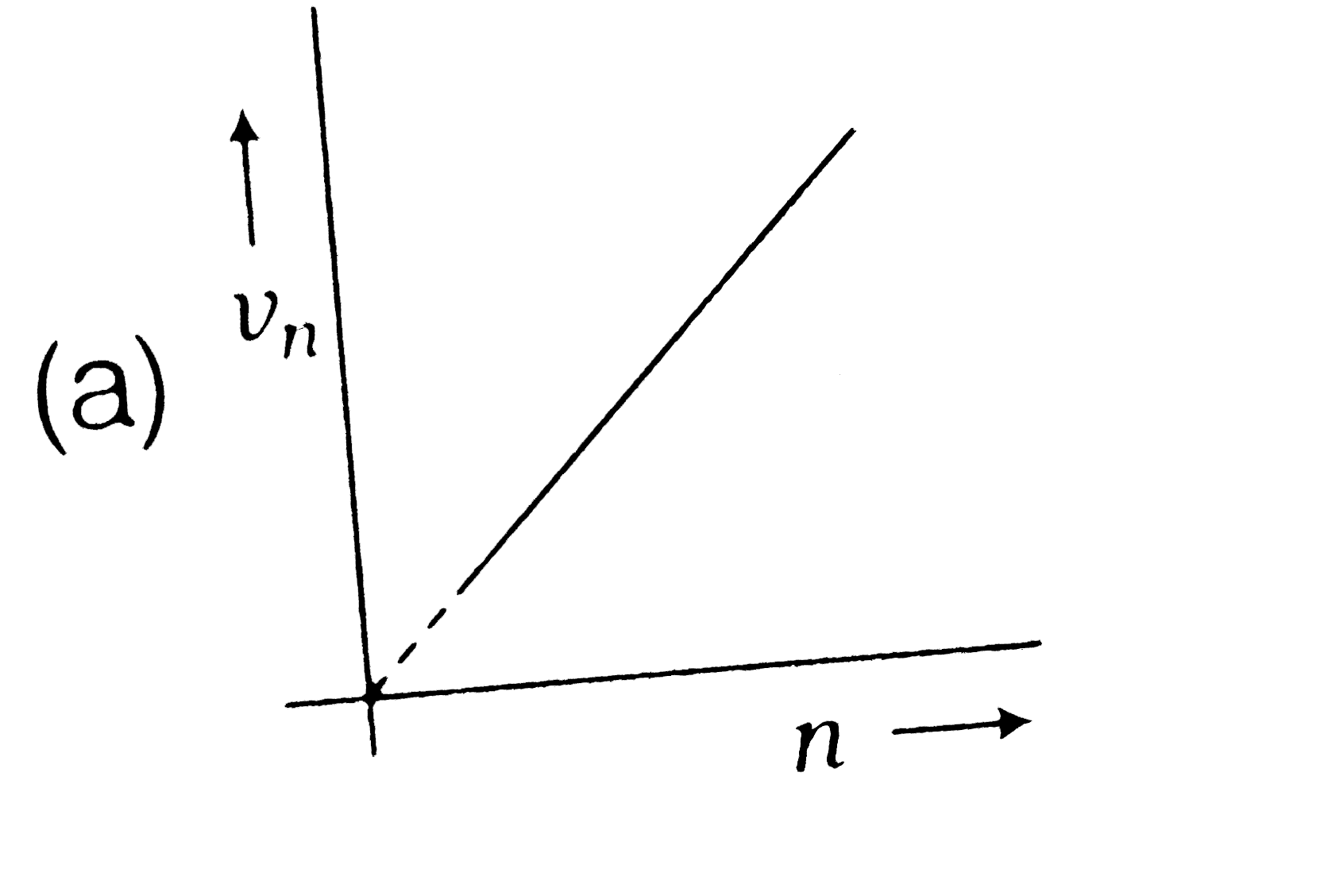
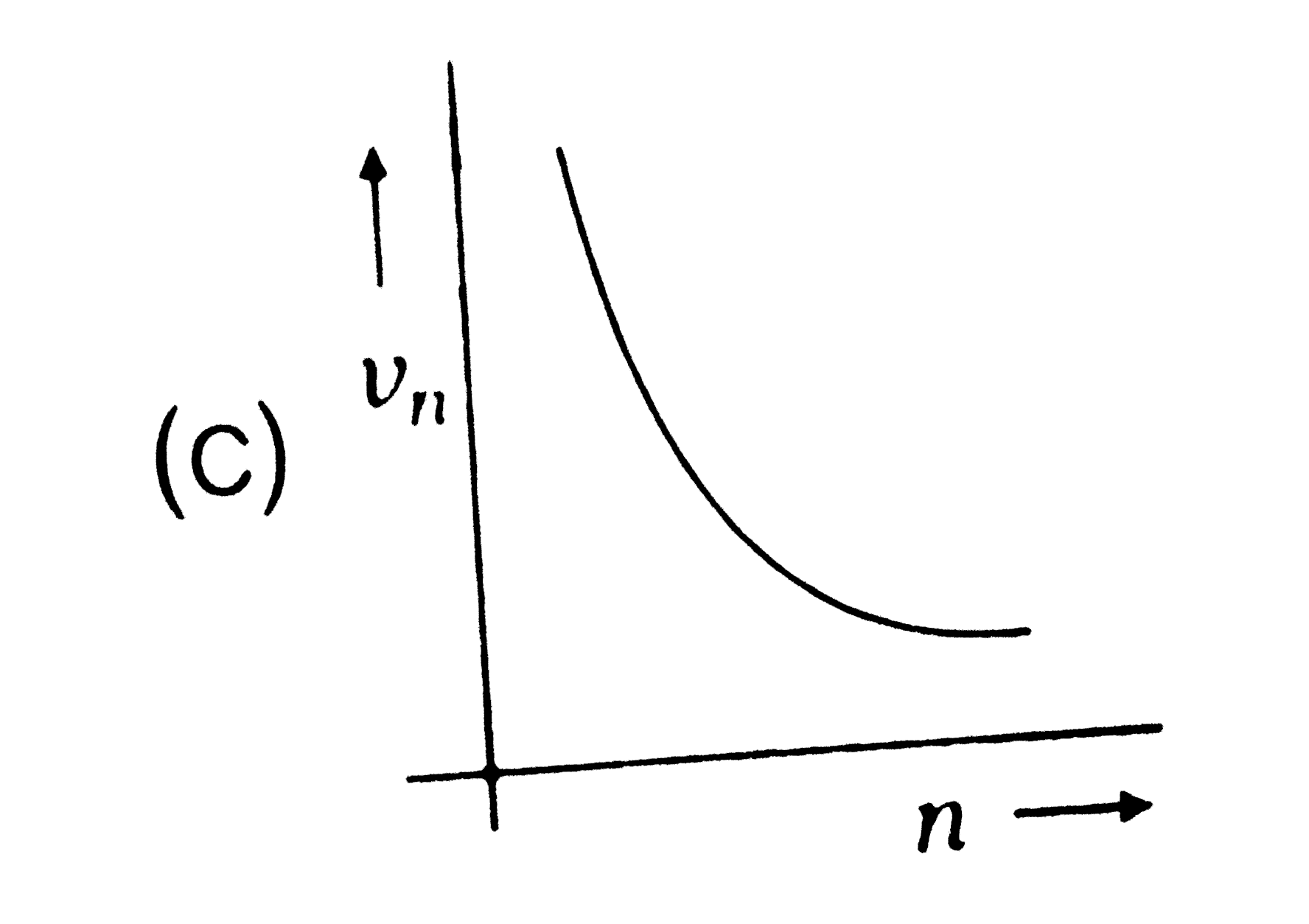
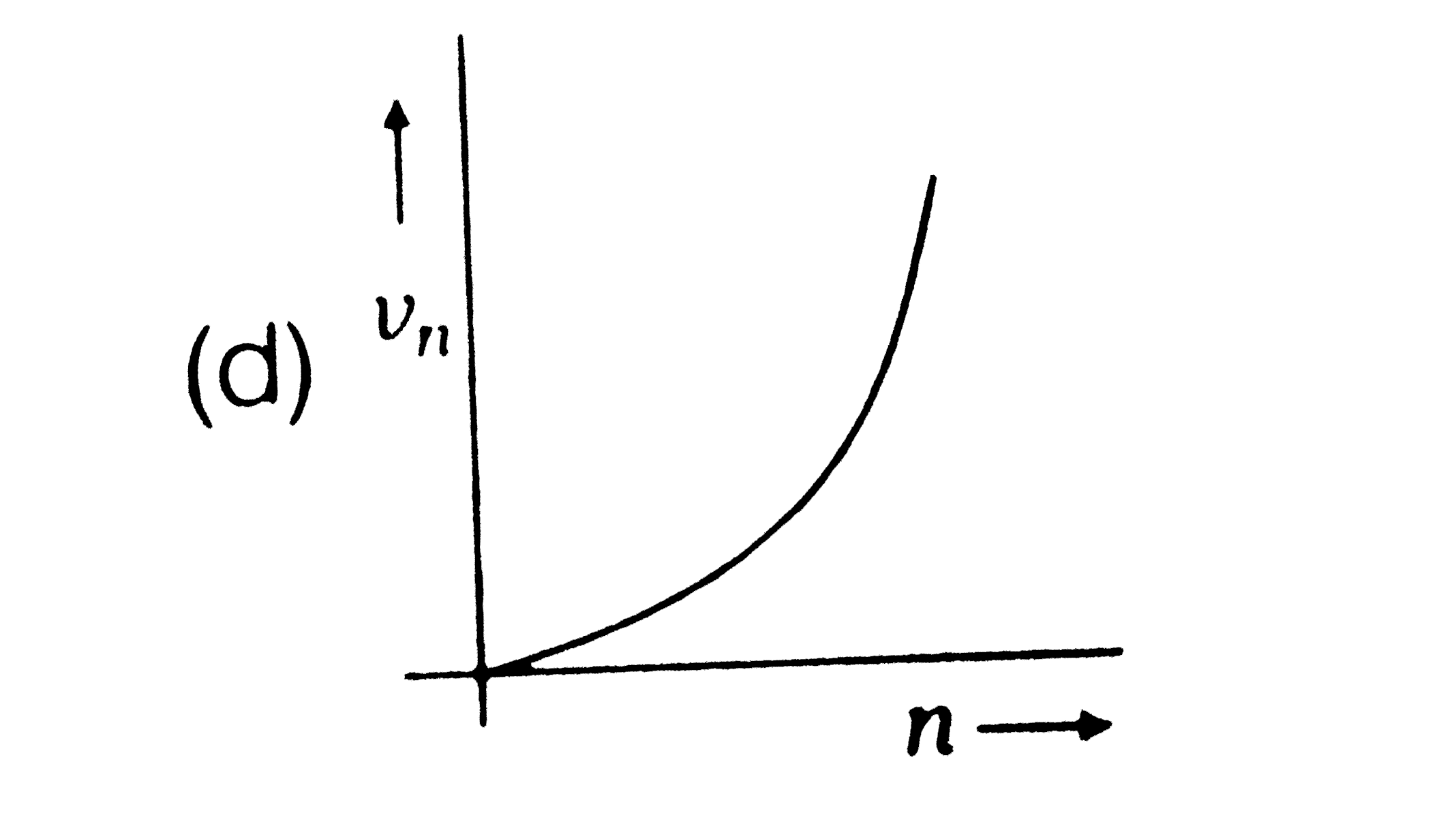
Speed (V_(n)) of electron in nth orbit versus principal quantum number (n) graphs is |
|
Answer»
|
|
| 36. |
Given that for a reaction of order n. the intergrated form of the rate equation isk= (1)/(t(n-1))[(1)/(C^(n-1))-(1)/(C_(0)^(n-1))] where C_(0) and C are the values after time t. What is the relationship between t_(3//4) and t_(1//2) where t_(3//4) is the time required for C to become 1//4C_(0)- |
|
Answer» `t_(3//4) = t_(1//2)[2^(n-1) +1]` `= (1)/(k(n-1)) (4^(n-1)-1)C_(0)^(n-1)` `:. t_(1//2)=(1)/(K(n-1))(2^(n-1)-1)` `So (t_(3//4))/(t_(1//2)) =2^(n-1)+1` |
|
| 37. |
(A) : A current I flows along the length of an infinitely long, straight, thin-walled pipe. Then the magnetic field at all points inside the pipe is zero. (R) : The whole pipe carrying current can be supposed to be made of thin rings. The magnetic field on the axis of the ring is is zero. |
|
Answer» Both 'A' and 'R' are true and 'R' is the correct explanation of 'A'. |
|
| 38. |
Two bullets are fired simultaneously, horizontally and with different speeds from the same place. Which bullet will hit the ground first ? |
|
Answer» the FASTER one |
|
| 39. |
The force between two parallel current carrying conductors I_1 and I_2 is given by F=-________. |
| Answer» SOLUTION :`mu_@/(4PI) (I_1I_2)/RL` | |
| 40. |
A1 KWsignal is transmitted using a communication channel which provides attenuatiom at the rate of- 2 dB per km . If the communication channel has a total length of5 km , the power of the signal received is [ gain in dB = 10 log ((P_(0))/(P_(i)))] |
|
Answer» <P>900W `=(-2dB//km)5km=-10dB` `therefore 10"log"(P_(0)//P_(i))=-10, "or log" (P_(0)//P_(i))=-1` or `(P_(0)//P_(i))=10^(-1)=(1)/(10)` or `P_(0)=P_(i)//10=(1KW)/(10)=100W` |
|
| 41. |
A uniform conducting wire of length 12a and resistance R is wound up as a current carrying coil in the shape of : (i) an equilateral triangle of side a, (ii) a square of sides a and, (iii) a regular hexagon of sides a. The coil is connected to a voltage source V_(0) . Find the magnetic moment of the coils in each case. |
|
Answer» Solution :Magnetic dipole moment for this coil is m = nIA (i) For equilateral triangle : Side of equilateral triangle be a. Total length of wire be 12 a. `therefore` NUMBER of turns of coil N = 3 Magnetic dipole moment for coil, `m=nIA=4I(sqrt3/4a^(2))" "[BECAUSEA=(SQRT3A^(2))/4]` `m=Ia^(2)sqrt3`  (ii) For square coil : Number of turn n = 3, Area of square A = `a^(2)` Magnetic dipole moment for square LOOP = nIA = `3I(a^(2))`  (iii) For hexagon loop : Number of turn n = 2. Magnetic dipole moment, m = nIA = `2I((6sqrt3)/4a^(2))` m = `3sqrt3Ia^(2)` 
|
|
| 42. |
A ray of light is incident at an angle of 75^@ into a medium having refractive index mu. The reflected and the refracted rays are found to suffer equal deviations in opposite direction. Then mu equals to |
|
Answer» `(SQRT3 + 1)/(sqrt3 - 1)` |
|
| 43. |
Regarding the power of an optical instruments match the following two cloumns. |
|
Answer» |
|
| 44. |
Find charges on each capacitor. MOT_CON_JEE_PHY_C25_SLV_009_Q01.png" width="80%"> |
|
Answer» Solution :CHARGE on `C_1 =C_1V_1 =2xx ( 20-5 ) mu C ` `""= 30 mu C ` Charges on ` C_2 =C_2 V_2 = 2 xx ( 20 - ( -10 ) ) mu C ` ` (##MOT_CON_JEE_PHY_C25_SLV_009_S01.png" width="80%"> charge on ` C_1 =C_1 V_2 =4 xx ( 20 -10 ) mu C ` = 40 mu C ` |
|
| 45. |
Nuclear fusion is possible |
|
Answer» only between LIGHT NUCLEI |
|
| 46. |
The period of oscillation of a dip needle when vibrating in the magnetic meridian is 1.5s. In a plane at right angles to the magnetic meridian it is 2s. Find the dip of the place |
|
Answer» |
|
| 47. |
What is interference of light waves ? State two essential conditions to observe it. In Young's double slit experiment, light of wavelength 6000 overset(*)A is used to get an interference pattern on a screen. The fringe width changes by 1.5 mm when the screen is brought towards the double slit by 50 cm. Find the distance between the two slits. |
|
Answer» Solution :Interference of LIGHT is the phenomenon of redistribution of light energy in medium on account of superposition of light waves from two coherent SOURCES. Conditions (i) Two sources must be coherent, so that the sources emit continuous wave of same wavelength and having no phase or constant phase difference. (ii) Two sources must be very CLOSE to each other, because the fringe width is inversely proportional to distance between the sources. In first case. `beta=(lambda D)/(d)` ...(i) In second case. `(beta-0.0015)=(lambda)/(d)(D-0.5)` ...(ii) Dividing Eq. (ii) by (i), we get `(beta-0.0015)/(beta)=(D-0.5)/(D)` `1-(0.0015)/(beta)=1-(0.5)/(D)` `(0.0015)/(beta)=(0.5)/(D)` `(D)/(beta)=(0.5)/(0.0015)=(5000)/(15)=(1000)/(3)` Now `beta=(lambda D)/(d)` or `d=lambda(D)/(beta)` or `d=6000 xx 10^(-10)((1000)/(3))` or `d=2 xx 10^(-4) m` or d =0.2 mm |
|
| 48. |
when NPN transistor is used as an amplifier then ………. |
|
Answer» <P>electrons move from base to collector |
|
| 49. |
To get output 1 for the following circuit, the correct choice for the input is |
|
Answer» A = 0, B = 1, C = 0 |
|
| 50. |
When a coil joined to a cell, the current through the coil grows with a time constant tau. After what time, the current will reach 10% of its steady- state value? |
|
Answer» Solution :The GROWTH of current in L-R CIRCUIT at time .t. is given by `i=i_(0)(1-e^(-(t)/(tau))), (i_(0))/(10)=i_(0)(1-e^(-(t)/(tau))), (9)/(10)=e^(-(t)/(tau))` `(10)/(9)=e^((t)/(tau))`, Applying log on both SIDES `LN((10)/(9))=(t)/(tau), t=tau ln((10)/(9))` |
|