

Saved Bookmarks
This section includes 7 InterviewSolutions, each offering curated multiple-choice questions to sharpen your Current Affairs knowledge and support exam preparation. Choose a topic below to get started.
| 1. |
If m_n and m_p represents the mass of neutron and proton respectively, nucleus of an element having mass M has N neutrons Z protons, the the correct relation will be |
|
Answer» `MLT(zm_p+Nm_n)` |
|
| 2. |
A thin uniform rod of length l and massm is swinging freely about a horizontal axis passing through its end. It maximum angular speed is omega. Its centre of mass rises to a maximum height of : |
|
Answer» `(1)/(2)(l^(2)omega^(2))/(g)` `(1)/(2)IOMEGA^(2)=mgh` `(1)/(2)XX(1)/(3)ML^(2)omega^(2)=mgh` implies `h=(l^(2)omega^(2))/(6g)` |
|
| 3. |
Electric dipole moment is......quantity. |
| Answer» Answer :B | |
| 4. |
Define the term 'amplitude modulation'. Explain any twofactors which justify the needfor modulating a low frequency base-band signal. |
|
Answer» Solution :AmplitudeModulation : It is process in which the amplitudeof the highfrequency carrier wave changein accordance with the instantaneousvalue of MODULATING signal . Factor Justifying the need of Modulation: (i) Effective power radiatedby antenna : As `P alpha 1/(lambda^(2))`,for good transmission , l must befrequency signal . `v = 15 KHz`, `lambda = c/v = (3 xx 10^(8))/(15 xx 10^(3)) = 20000 m` `rArr ` length of antenna should be `= (lambda)/(4) = 5000 m`, which is practically impossible. If transmission frequency is raisedto 1 MHz, then `lambda = c/v= (3xx 10^(8))/(10^(6)) = 300 m` and length of antenna `= lambda/4 = 75m`, which is reasonable. THUS there is need ofconvertinginformation contained in original LOW frequency base-band signal to high frequency setting transmission. |
|
| 5. |
In a meter bridge experiment Two unknown resistances X and Y are connected to left and right gaps of a meter bridge and the balancing point is obtained at 20cm from left (X lt Y)The new position of the null point from left if one decides balance a resistance of 4X against Y. |
| Answer» ANSWER :A | |
| 6. |
Three charges .q. each are at vertices of equilateral triangle of side .r.. How much charge should be placed at the centroid so that the system remains in equilibrium? |
Answer» Solution : Due to three identical charges kept at three CORNERS of a triangle, null point (E=0) is FORMED at centre O. LET .Q. be the charge placed at centre of triangle then the charge .Q. is in equilibrium. For system to be in equilibrium the force on each charge must be zero. Consider the forces on charge at C. Let `F_(A), F_(B) and F_(0)` be the forces on the charge at .C. due to the charge at A. B and .Q. RESPECTIVELY. `F_(A) = F_(B) = (1)/(4pi in_(0))(q^(2))/(a^(2))` Angle between `VEC(F)_(A) and vec(F)_(B) " is " 60^(@)` The magnitude of resultant of `vec(F)_(A) and vec(F)_(B)= sqrt3 xx (1)/(4pi in_(0))(q^(2))/(a^(2))` The direction of resultant is along OC. The force on C due to ..Q.. is `vec(F)_(O) = (1)/(4pi in_(0))(Qq)/(((a)/(sqrt3))^(2))= 3 xx (1)/(4pi in_(0))(Qq)/(a^(2))` (along CO) The resultant force on charge at C is zero. `vec(F)= vec(F)_(A) + vec(F)_(B) + vec(F)_(O)= 0` `sqrt3 (1)/(4pi in_(0))(q^(2))/(cancel(r)^(2)) + (1)/(4pi in_(0)) (3Q cancel(q))/(cancel(r)^(2))= 0` `rArr Q = - (q)/(sqrt3)` Negative sign indicates that the force `vec(F)_(O)` is opposite to the resultant of `vec(F)_(A) and vec(F)_(B)`. |
|
| 7. |
A coil has inductance of 0.4 H and resistance of 8Omega . It is connected to an AC source with peak emf 4 V and frequency (30)/(pi) Hz. The average power. dissipated in the circuit is |
|
Answer» 1W `P_(avg) = V_(rms) I_(rms) COS phi` ` = (V_(MAX) )/(sqrt2) xx ( (V_(max) )/(sqrt2) ) xx 1/Z xx R/Z` ` = (V_(max)^2)/(2) xx (R )/(cancelZ^2) = (V_(max)^2) xx (R )/((sqrt(X_L^2 + R^2) )` ` ((4)^2)/(2) xx (8))/(sqrt(0.4 xx 60)^2 + 8^2)^2)` ` = (16 xx 8)/(2 xx (24^2 + 8^2) ) = 64/640= 1/10 = 0.1 W` |
|
| 8. |
A jet plane is travelling towards west at a speed of 1800 km/h. What is the voltage difference developed between the ends of the wing having a span of 25 m, if the Earth's magnetic field at the location has a magnitude of 5 xx 10^(-4) T and the dip angle is 30^@. |
|
Answer» Solution : Here component of magnetic field of Earth which is PERPENDICULAR to both `vecv` and `VECL`is vertical component `B_V`, given by FORMULA `B_V=B sin phi` (Where `phi`=dip angle of given place) `=(5XX10^(-4))sin30^@` `therefore B_V=2.5xx10^(-4)` T Induced emf across LENGTH l of the wing of a plane is , `epsilon=B_V vl` `=1800xx10/36=500 m/s` `=(2.5xx10^(-4))(500)(25)` `therefore epsilon`=3.125 V (volt) |
|
| 9. |
Compare the kinetic energies of rotation of the pulgar and of the Sun . What is the source of the increase in kinetic energy? |
|
Answer» `k_(o.)=(I_(o.)omega_(o.)^2)/2 =(4pi^2M_(o.)R_(o.)^2)/(5T_(o.)^2)` The kinetic energy of pulsar.s rotation is `K=4pi^2M_(o.)R^2//5T^2` The ratio of these quantities is `K/K_(o.)=T_(o.)^2/T^2~~2 xx10^9` The INCREASE in the kinetic energy of rotation of a star in the process of its contraction (COLLAPSE) is at the expense of the WORK of gravitational forces. |
|
| 10. |
Two concetric spherical shells of radii R and 2R carry charges Q and 2Q respectively. Change in electric potential on the outer shell when both are connected by a conducing wire is (K = (1)/(4pi epsilon_(0))) |
|
Answer» ZERO |
|
| 11. |
A uniform magnetic field B of 0.3 T is along the positive Z-direction. A rectangular loop (abcd) of sides 10 cm xx 5 cm carries a current I of 12 A. Out of the following different orientations which one corresponds to stable equilibrium? |
|
Answer»
As M and B are same in each CASE (in MAGNITUDE) for STABLE equilibrium, potential energy should be minimum. Minimum potential energy is possible if`vecM` and `VECB` are in same direction. So option (d) is correct. |
|
| 12. |
The output logic level of an OR gate is one (a) if both inputs are zero (b) only if both inputs are one (c) if ether or both inputs are one (d) If the inputs are neither zero nor one An AND gate |
|
Answer» is EQUIVALENT to a series SWITCHING circuit' |
|
| 13. |
What is the band width in amplitude modulation ? |
|
Answer» Equal to AUDIO SIGNAL FREQUENCY |
|
| 14. |
Two metal spheres have their surface areas in the ratio 9:16. They are put in contact with each other. A charge of 7 xx 10^(-6) C is given to the system and now they are separated so that each exerts no influence on the other then the ratio of surface charge densities is |
| Answer» ANSWER :A | |
| 15. |
In the previous example, if the net force on the car at its highest point is straight down, why doesn't the car fall straight down? |
| Answer» Solution :REMEMBER that force tells an object how to accelerate. If the car has zero VELOCITY at this point, then it WOULD fall straight down, but the car has a nonzero velocity (to the left) at this point. The fact that the acceleration is downward means that, at the next moment v will point down and to the left at a slight angle, ensuring that the car remains on a circular path, in contact with the track. this contact force is the normal force. you can THINK of the normal force as a measure of the strength of contact between TWO surfaces. if it is a high value, they are pressing very hard against one another. if it is a low value, they are not pressing very hard against one another. it is easy to see, them, that if the normal force is zero, there is not contact between the cart and the surface. so long as the normal force is not zero, the cart is still in contact with the surface. | |
| 16. |
Pick out the correct statements from the following I. Electron emission during Brta-decay is always accompanied by neutrons. II. Nuclear force is charge independent. III. Fusion is the chief source of stellar energy. |
|
Answer» Both I and II are correct |
|
| 17. |
In an n-p-n transistor amplifier, the collector current is 9 mA. If 90% of the electrons emitted reach the collector, then |
|
Answer» the emitter current is 1 mA. |
|
| 18. |
A loop of a string of mass per unit length is |l and radius R is rotated about an axis passing through centre perpendicular to the plane with an angular velocity CO. A small disturbance is created in the loop having the same sense of rotation. The linear speed of the disturbance for a stationary observer is xRomega. Find .x.. |
|
Answer» |
|
| 19. |
The mass of a proton is 1840 times that of an electron. An electron and a proton, with equal kinetic energies, enter perpendicularly uniform magnetic field. Now ______ . |
|
Answer» The PATH of proton will be more corved than that of the electron `r_(p)=(sqrt(m_(p)k_(p)))/(qB)` `:.""r_(e)/r_(p)=sqrt((m_(e)k_(e))/(m_(p)k_(p)))=sqrt(m_(e)/(m_(p)))` `(because k_(e)= k_(p))` `:. "" r_(p) gt r_(e)` |
|
| 20. |
Adouble slit S_(1)S_(2) is illuminatedby a coherentlight of wavelength lambda. The slits are sepa- rated by a distance d . A plane mirror is pplacedin frontof the doubleslitat a distance D_(1) from it and a screen Sigmais placed behind the doubl slitat a distance D_(2)from it . The screen Sigmareceives only the light reflected by the mirror .Find the fringes -width of the interference pattern on the screen . |
|
Answer» `LAMBDA/d (D_(1)+D_(2))` |
|
| 21. |
The horizontal range of a projectile projected with a velocity V at angle 15° with the horizontal is 50 m. What will be its horizontal range if its angle of throw is increased by 30° keeping the velocity of throw to be the same ? |
|
Answer» 60 m or `R=u^(2)/g sin2theta=u^(2)/gxxsin30^@` `50=u^(2)/gxx1/2` `:. U^(2)/g=100m` When the ANGLE is INCREASED by `30^@` i.e. 30° +15° = 45° Then `R=u^(2)/gsin90^@=u^(2)/g` `:.R=u^(@)/g=100m` |
|
| 22. |
Draw a labelled diagram of Van de Graff generator. State its working principle to show how by introducing a small charged sphere into a larger sphere, a large amount of charge can be transferred to the outer sphere. State the use of this machine and also point out its limitations. |
Answer» SOLUTION :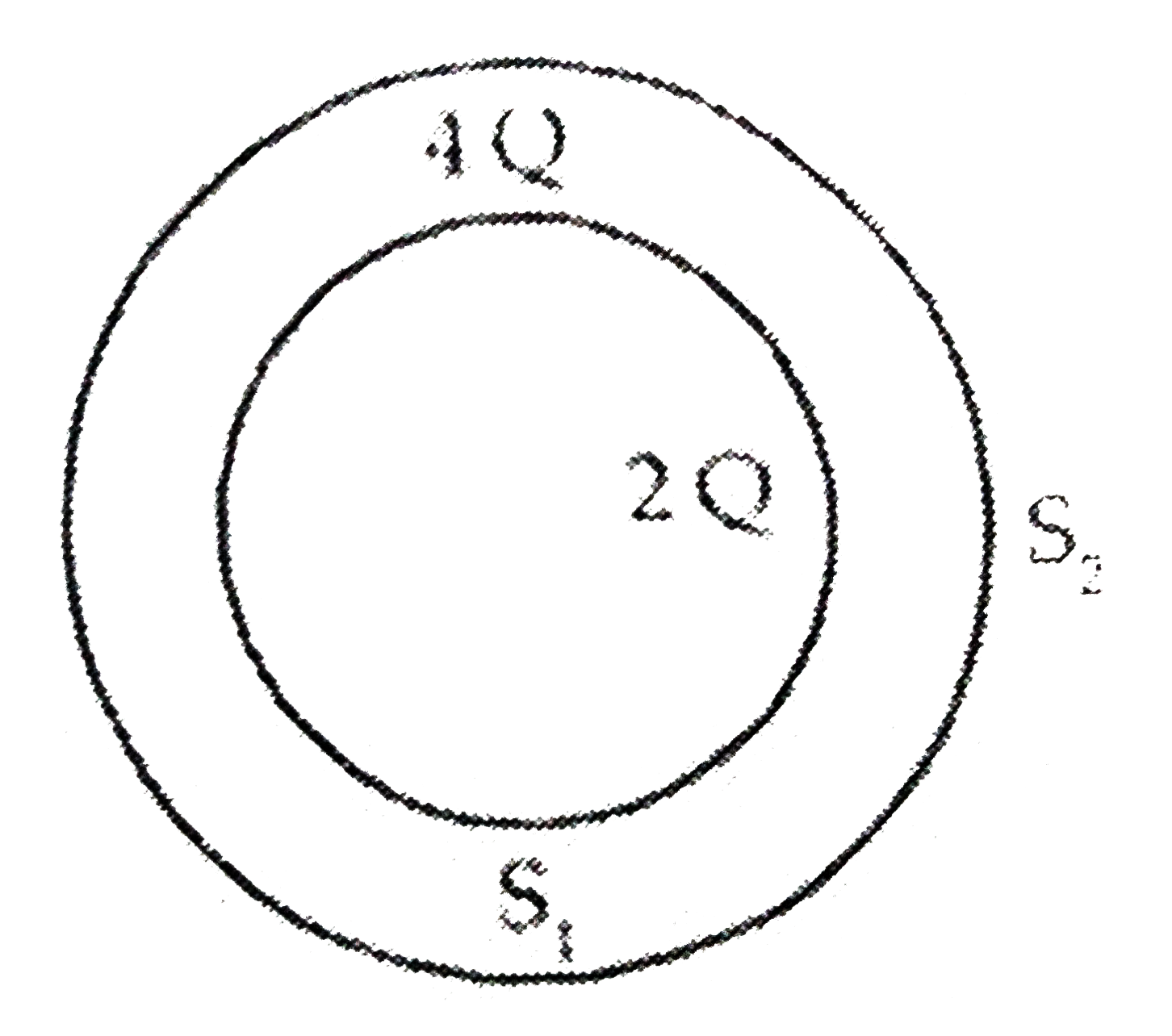
|
|
| 23. |
Light undergoes successive total internal reflection as it moves through an optical fibre. |
|
Answer» |
|
| 24. |
Photo electric effect shows |
|
Answer» wave like behaviour of LIGHT |
|
| 25. |
Who will have to pay for older generation's mistake: |
|
Answer» Children |
|
| 26. |
An elevator weighing 6000kg is pulled upward by a cable with an acceleration of 10 m/s^(2). Taking g to be 10 ms^(-2), find the tension in the cable |
|
Answer» 120 KN |
|
| 27. |
If a charged ebonite rod is made to touch the disc of a gold-leaf electroscope, the leaves diverge. Then the rod is removed from the disc and it is found that the diver gence of the leaves decreases a little-explain. |
|
Answer» Solution :Suppose, the ebonite rod is charged positively. Ebonite is a non-conductor of ELECTRICITY. So when the rod touches the disc of a gold-leaf electroscope, the charges of both of them existing at the place of contact spread on the disc and the LEAVES of the electroscope. So the leaves spread apart. Now the charges on the other parts of the ebonite rod do not move to the electroscope. So these charges induce negative charge on the disc and positive charge on the leaves. For this REASON, divergence of the leaves increases further. Divergence of the leaves depends on both of induction and con induction of charges. When the ebonite rod is REMOVED, induction will be absent. So then the leaves will have positive charges due to conduction only. So, divergence of the leaves DECREASES a little. |
|
| 29. |
Two point charges q_(1) and q_(2) are kept r distance apart in a uniform external electric field vecE. Find the amount of work done in assembling this system of charges. |
|
Answer» Solution :Let a system of two point charges `q_(1) and q_(2)` is brought from INFINITY to the points `vecr_(1) and vecr_(2)` respectively in an external electric field `vecE`, where `|vecr_(1)-vecr_(2)|=r`, the distance between the two charge. We first calculate the WORK DONE in BRINGING the charge `q_(1)` from infinity to `vecr_(1)`. work done in this step is `W_(1)=q_(1)V(vecr_(1))`, where `V(vecr_(1))` is the electrostatic potential at `vecr_(1)`. Now we consider the work done in bringing `q_(2)` to `vecr_(2)`. In this step work `W_(2)` is done against the electric field and work `W_(12)` is done against the field due to charge `q_(1)`. Obviously `W_(2)=q_(2)V(vecr_(2))`, where `V(vecr_(2))` is the electrostatic potential at `vecr_(2)` and `W_(12)=(q_(1)q_(2))/(4pi in_(0)*r)`, where `r=|vecr_(1)-vecr_(2)|= ` distance between `q_(1) and q_(2)` `therefore` Total work done in bringing `q_(2)` to `vecr_(2)=W_(2)+W_(12)=q_(2)V(vecr_(2))+(q_(1)q_(2))/(4pi in_(0)*r)` |
|
| 30. |
The velocity of a body of mass 2 kg moving in circle of radius 3 m at any time is 3 m//s. If its speed is increasing at the rate of 4 m//s^(2) then the net acceleration on the body is : |
|
Answer» `4 m//s^(2)` Tangential acceleration, `a_(t) = 4 m/s^(2)`  :.net acceleration, `a = SQRT(a_(c)^(2) + a_(t)^(2))= sqrt((3)^(2)+ (4)^(2))` `= 5 m//s^(2)` HENCE the correct CHOICE is (d) |
|
| 31. |
मानव आमाशय में कौन-सा अम्ल उत्पन्न होता है ? |
|
Answer» सल्फयूरिक अम्ल |
|
| 32. |
The maximum kinetic energy of a photoelectron is 3 eV. What is its stopping potential ? |
|
Answer» Solution :SINCE maximum KINETIC energy of PHOTOELECTRONS `K_(max)=3eV` `THEREFORE` STOPPING potential `V_(0)=(K_(max))/(e)=3V`. |
|
| 33. |
Snorkeling by humans and elephants. When a person snorkels, the lungs are connected directly to the atmosphere through the snorkel tube and thus are at atmospheric pressure. In atmospheres, what is the difference Deltap between thisinternal air pressure and the water pressure against the body if the length of the snorkel tube is (a) 20 cm (standard situation) and (b) 3.5 m (probably lethal situation)? In the latter, the pressure difference causes blood vessels on the walls of the lungs to rupture, releasing blood into the lungs. As depicted in Fig. 14-52, an elephant can safely snorkel through its trunk while swimming with its lungs 3.5 m below the water surface because the membrane around its lungs contains connective tissue that holds and protects the blood vessels, preventing rupturing. |
| Answer» SOLUTION :(a) 0.019 ATM , (B) `~~ 0.34` atm | |
| 34. |
In a negative feedback amplifier ,the gain without feedback is 100,feed back ratio is 1/25 and input voltage is 50 m V.Calculate. i)gain with feedback ii)feedback factor iii)output voltageiv)feedback voltage v)new input voltage so that output voltage with feedbckthe output voltage without feedback |
|
Answer» Solution :(i)Gaib with feedback `A_(i)=(A)/(I+betaA)=(100)/(1+1//25xx1000)=20` (ii)Feedback factor `betaA=(1)/(25)xx100=4` (iii)OUTPUT voltage `V_(0=A_(f)V_(i)=20xx50 mV=1volt` (iv)Feedback voltage `betaV_(0)=(1)/(25)xx1=0.04` volt (v)NEW increased input voltage `V_(1)=V_(1)(1+betaA)` `=50(1+(1)/(25)xx100)=250MV` |
|
| 35. |
A Cassegrain telescope uses two mirrors as shown in Fig. 9.10. Such a telescope is built with the mirrors 20 mm apart. If the radius of curvature of the large mirror is 220 mm and the small mirror is 140 mm, where will the final image of an object at infinity be ? |
|
Answer» Solution :Radius of curvature of LARGER mirror `R_(1) = 220 mm = 22 cm` and hence, its focal length `f_(1) = 11 cm`For an object situated at `infty`,this mirror may focus, in the absence of smaller mirror, at a distance 11 cm from it. This image will behave as a virtual object for the smaller convex mirror. `therefore` For smaller mirror `f_(2) =R_(2)/2 = (140 mm)/2 = 70 mm = 7 cm` As distance between the two MIRRORS`x= 20 mm = 2cm` As `1/v_(2) + 1/u_(2) = 1/f_(2)` and `u_(2)` and `f_(2)` both are postiive, hence, `1/v_(2) = 1/f_(2) -1/u_(2) =1/7 - 1/9 rArr v_(2) = 31.5 cm = 315 mm` Thus, the final image is at a distance of 31.5 cm from the smaller mirror (or 29.5 cm BEHIND the bigger mirror). |
|
| 36. |
The figure shows a rectangular conducting frame MNOP of resistance R placed partly in a perpendicular magnetic field vecB and moved with velocity vecv as shown in the fig. 6.52. Obtain the expressions for the (a) force acting on the arm 'ON' and its direction, and (b) power required to move the frame to get a steady emf induced between the arms MN and PO. |
|
Answer» Solution :As the rectangular frame MNOP moves into the magnetic field, magnetic flux linked with the frame increases at a rate `Deltaphi = BDeltaA = BvlDeltat` and hence magnitude of induced EMF `|varepsilon|= (Deltaphi)/(Deltat)=(BvlDeltat)/(Deltat)= Bvl` As resistance of frame is R, hence induced current `I = varepsilon/R = (BLV)/R` The induced current flows in an anticlockwise direction i.e., along ONMPO. (a) The force acting on the arm ON is given by `F = | I vecl xx vecB| = I lB = (Blv)/R. lB= (B^(2)l^(2)v)/R` The force is directed opposite to the direction of v (i.e., towards RIGHT). (b) Power required to move the frame to get a steady emf induced between the arms MN and PO, Powre `P = Fv = (B^(2)l^(2)v^(2))/R` |
|
| 37. |
Which of the following doesn.t play any role in rainbow formation ? |
|
Answer» REFLECTION |
|
| 38. |
A quartz glass prism of refracting angle 4^(@) is to be combined with a crown glass prism to create a direct-vision prism combination . (a) Find the refracting angle of the crown prism. (b) Find the angular width of the spectrum found by the combination. (For crown glass mu_(R)=1.52, mu_(v)=1.56, and for quartz glass mu_(R)=1.70,mu_(v)=1.74). |
|
Answer» |
|
| 39. |
What is the effect on neutron to proton ratio in a nucleus when beta^(-) particle is emitted ? Explain your answer with the help of a suitable nuclear reaction. |
|
Answer» <P> SOLUTION : DECREASES as NUMBER of neutrons decreases and number of protonsincreases. `N to P+""_(-1)e^0` |
|
| 40. |
Using the mathematical expression for the conductivity of a material, explain how it varies with temperature for (i) semiconductors, (ii) good conductors. |
|
Answer» SOLUTION :Conductivity of a material is reciprocal of its RESISTIVITY i.e., `rho = 1/rho` THUS, `sigma = J/E = ("ne"^2 tau)/(m)` . THEREFORE, (i) a semiconductor increases with increase in temperature, but that of (ii) a good conductor decreases with increase in temperature. |
|
| 41. |
Explain the two processes involved in the information of a p-n junction diode. Hence, define the term'barrier potential'. |
|
Answer» Solution :A small quantity of trivalent impurity (In) is fused to thin wafer of n type semiconductor (Ge or Si) just below the surface of contact. This p-type semiconductor along n type semiconductor wafer constitute a p-n junction. ALSO when a small quantity of PENTAVALENT impurity is dropped in a p-type semiconductor p-n junction is FORMED p-n junction can be formed when p-type semiconductor is heated in phosphorus gas to form diffused n type LAYER on the semiconductor. The potential difference due to negative immobile ions on p-side of the junction and positive immobile ions on the n-side of the junction is CALLED potential barrier. It prevents the movement of electrons from n region to p-region and movement of holes from p-region to n-region through the junction. |
|
| 42. |
A square loop ABCD carrying a current i, is placed near and coplanar with a long straight conductor XY carrying a current I, the net force on the loop will be : |
|
Answer» `(2mu_(0)II)/(3pi)` |
|
| 43. |
2.What change brought international leaders to South Africa? |
|
Answer» END of Apartheid |
|
| 44. |
0.01 moles of an ideal diatomic gas is enclosed in an adiabatic cylinder of cross-sectional area A=10^(-4)m^(2) In the arrangement shown, a block of mass M= 0.8 kg is placed on a horizontal support, and piston of mass m=1 kg is suspended from a spring of stiffness constant k=16 N//m Initially, the springs is relaxed and the volume of the gas is V= 1.4 xx10^(-4)m^(3) When the gas in the cylinder is heated up the piston starts moving up and the spring gets compressed so that the block M is just lifted up. Determine the heat supplied (in Joule) Take atmospheric pressure P_(0)=10^(5) Nm^(-2) , g=10 m//s^(2) |
|
Answer» <P> `mgx+1/2kx^(2)+P_(0)Ax=omega_(gas)` `Omega_(gas)=12 j Rightarrow DeltaQ=75J` |
|
| 45. |
What type of image a convex, mirror always produces ? |
| Answer» SOLUTION :VIRTUAL, ERECT, DIMINISHED | |
| 46. |
A cross section at midpoint of the middle piece of human sperm will show |
|
Answer» CENTRIOLE, MITOCHONDRIA, 9+2 ARRANGEMENT of MICROTUBULES |
|
| 47. |
A square of side L metre lies in the x - y plane in a region, where the magnetic field is given by vecB = B_(0) (2hati +3hatj +4hatk) T, where B_(0), is constant. The magnitude of flux passing through the square is [Exemplar Problem] |
|
Answer» `2B_(0)L^(2)Wb` Magnetic flux `phi_(B)=vecB. vecA=B_(0) [2hati+3hatj+4hatk]. L^(2) hatk=4B_(0) L Wb` |
|
| 48. |
Refractive index of glass is 1.5 and that of water is 1.3. What is refrective index of glass w.r.t. water ? |
| Answer» SOLUTION :`MU`= of GLASS w.r.t. WATER=`(mu_g)`/`(mu_w1)` = 1.5/1.3=.15 | |
| 49. |
In case of an artificial radiactive transformation as given by ._(15)P^(20) rarr ._(14)Si^(30) + X, the emitted particle X is |
|
Answer» NEUTRON |
|
| 50. |
In the circuit shown , R_1=4Omega, R_2=R_3 =15Omega, R_4 = 30 Omegaand epsi = 10V .Calculate the equivalent resistance of the circuit and the current in each resistor. |
Answer» Solution :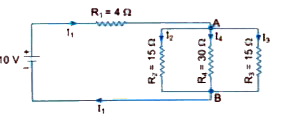 The GIVEN circuit can be redrawn as shown in Fig. Here `R_2 , R_3` and `R_4`are in parallel and their combined resistance R. will be `(1)/(R.) = (1)/(R_2)+ (1)/(R_3) + (1)/(R_4) = 1/15 + 1/15 + 1/30 = (2 + 2 + 1)/(30) = 5/30` ` rArr R. = 6OMEGA` Now R. and `R_1`are in series, hence equivalent resistance of the circuit `R = R. + R_1 = 6Omega +4Omega = 10 Omega` Main circuit CURRENT `I_1 = E/R = (10V)/(10 Omega) = 1 A ` `I_2+ I_3 + I_4 = I_1 = 1A` and potential difference between A and B remains constant, i.e., `15I_2 = 15I_3 = 30 I_4` ` rArr I_2 = I_3 = 2I_4` Therefore, on simplifying, we get `I_2 = I_3 = 0.4A` and `I_4 = 0.2 A ` |
|


