

Saved Bookmarks
| 1. |
A 2.00 kg particle moves along an x axis in onedimensional motion while a conservative force along that axis acts on it. The potential energy U(x) associated with the force is plotted in Fig. 8-36a. That is, if the particle were placed at any position between x=0 and x=7.00m, it would have the plotted value of U. At x=6.5 m, the particle has velocity vec(v)_(0) = (-4.00 m//s)hat(i). (a) Form Fig. 8-36a, determine the particle's speed at x_(1)=4.5 m. |
|
Answer» Solution :KEY IDEA (1) The particle.s kinetic energy is given by Eq. 8-1 `(K=1//2mv^(2))`. (2) Because only a CONSERVATIVE force acts on the particle, the mechanical energy `E_("mec")(=K+U)` is conserved as the particle moves. (3) Therefore, on a plot of U(x) such as Fig. 8-36a, the kinetic energy is equal to the difference between `E_("mec")` and U. Calculations: At `x=6.5m`, the particle has kinetic energy `K_(0)=1/2 mv_(0)^(2)=1/2(2.00kg)(4.00 m//s)^(2)` `=16.0 J`. 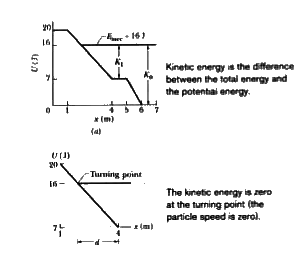 Figure 8-36 (a) A plot of potential energy U versus position x. (b) A section of the plot used to find where the particle turns around. Because the potential energy there is `U=0`, the mechanical energy is `E_("mec")=K_(0)+U_(0)+16.0 J + 0 = 16.0 J`. This VALUE for `E_("mec")` is plotted as a HORIZONTAL line in Fig. 8-36 a. From that figure we SEE that at `x=4.5m`, the potential energy is `U_(1)=7.0J`. The kinetic energy `K_(1)` is the difference between `E_("mec")` and `U_(1)`: `K_(1) = E_("mec")-U_(1)=16.0J-7.0J = 9.0 J`. Because `K_(1) = 1//2 mv_(1)^(2)`, we `v_(1)=3.0 m//s.` |
|