

Saved Bookmarks
| 1. |
(a) A particle of mass 1 mg and having charges 1 muC is moving in a magnetic field vec(B) = 2hat(i) + 3hat(j) + kT, with velocity vec(v) = 2 hat(i) + hat(j) - hat(k) m//sec. Find magnetic force in vector form and magnitude of acceleration. (b) A magnetic field of 8 hat(k)T exerts a force 8 hat(i) + 6hat(j) N on a particle having a charge 2C and going in x-y plane. Find the velocity of the particle. ( c) A particle is moving in a magnetic field 3hat(i) + 4hat(j) T and acceleration of particle is lambda hat(i) + 3hat(j) m//sec^(2). Find the value of lambda. (d) When a proton has a velocity bec(v) = (2 hat(i) + 3hat(j)) xx 10^(6) m//sec it experiences a force vec(F) = (- 1.28 xx 10^(-13) vec(k)) N. When its velocity is along the z-axis, it experiences a force along the x-axis. What is the magnetic field ? (e) A circular loop of radius 20 cm carries a current of 10 A. An electron cross the plane of the loop with a speed of 2.0 xx 10^(6) m//sec. The direction of motion makes an angle centre. Find the magnitude of the magnetic force on the electron at the instant it crosses the plane. |
|
Answer» Solution :(a) `m = 1 mg = 10^(-6)kg, q = 1 muC = 10^(-6C` `vec(B) = 2hat(i) + 3hat(j) + hat(k)T, vec(v) = 2hat(i) + hat(j) - hat(k) m//sec` `vec(F) = q vec(v) xx vec(B) = 10^(-6)|(hat(i),hat(j),hat(k)),(2,1,-1),(2,3,1)|` `vec(a) = (vec(F))/(m) = (10^(-6))/(10^(-6))(4hat(i) - 4hat(j) + 4hat(k))` `= 4hat(i) - 4hat(j) + 4hat(k) m//sec^(2)` `|vec(a)| = a = 4sqrt(3) m//sec^(2)` (b) The particle is moving in `x-y` plane, hence its velocity `vec(v) = v_(x) hat(i) + v_(y) hat(j) m//sec` `q = 2C, vec(B) = 8hat(k)T, vec(F) = 8 hat(i) + 6 hat(j) N` `vec(F) = q vec(v) xx vec(B) = 2 |(hat(i),hat(j), hat(k)),(v_(x), v_(y), 0),(0, 0, 8)|` `= 2 [ 8v_(y)hat(i) - 16v_(x) hat(j)]` `8 hat(i) + 6hat(j) = 16v_(y)hat(i) - 16v_(x)hat(j)` Comparing coefficient of `hat(i)` and `hat(j)` `16v_(y) = 8 rArrv_(y) = (1)/(2)` `- 16v_(x) = 6rArrv_(x) = -(3)/(8)` `vec(v) = v_(x)hat(i) + v_(y) hat(j) = -(3)/(8)hat(i) + (1)/(2) hat(j) m//sec` ( c) `vec(B) = 3hat(i) + 4 hat(j)T, vec(a) = lambdahat(i) + 3 hat(j) m//sec^(2)` SINCE `vec(F) = qvec(v) xx vec(B), vec(F)` is `_|_^(ar)` to `vec(v)` as wll as `vec(B)` `vec(F) = mvec(a)`, hence `vec(a)` is `_|_^(ar)` to `vec(B)` The dot product of perpendicular vectors is zero. `vec(B).vec(a) = 0` `(3hat(i) + 4hat(j)).(lambda hat(i) + 3 hat(j)) = 0` `lambda = -4` (d) `vec(v) = (2hat(i) + 3hat(j)) xx 10^(6) m//sec, vec(F) = -(1.28 xx 10^(-13) hat(k))` Since `vec(F)`is `_|_^(ar)` to `vec(B), vec(B)` should be in `x-y` plane Let `vec(B) = B_(x)hat(i) + B_(y)hat(j)` `vec(F) = qvec(v) xx vec(B) = (1.6 xx 10^(-9))|(hat(i), hat(j),hat(k)),(2 xx 10^(6), 3xx10^(6), 0),(B_(x), B_(y), 0)|` `-(1.28 xx 10^(-13)) hat(k) = (1.6 xx 10^(-19) xx 10^(6))[2B_(y) - 3B_(x)] hat(k)` `2B_(y) - 3 B_(x) = 0.8`...(i) Let`vec(v) = v_(0)hat(k), vec(F) = F_(0)hat(i)` `vec(F) = q vec(v) xx vec(B)` `F_(0)hat(i) = q(v_(0)hat(k)) xx (B_(x) hat(i)+B_(y)hat(j))` `= qv_(0) [B_(x)hat(j) - B_(y)hat(i)]` `= q v_(0)B_(x) hat(i) - q v_(0) B_(y) hat(i)` Comparing coefficient of `j` : `qv_(0) B_(x) = 0 rArr B_(x) = 0` `2B_(y) - 3B_(x) = 0.8rArr B_(y) = 0.4` `vec(B) = 0.4 hat(j) T` (e) 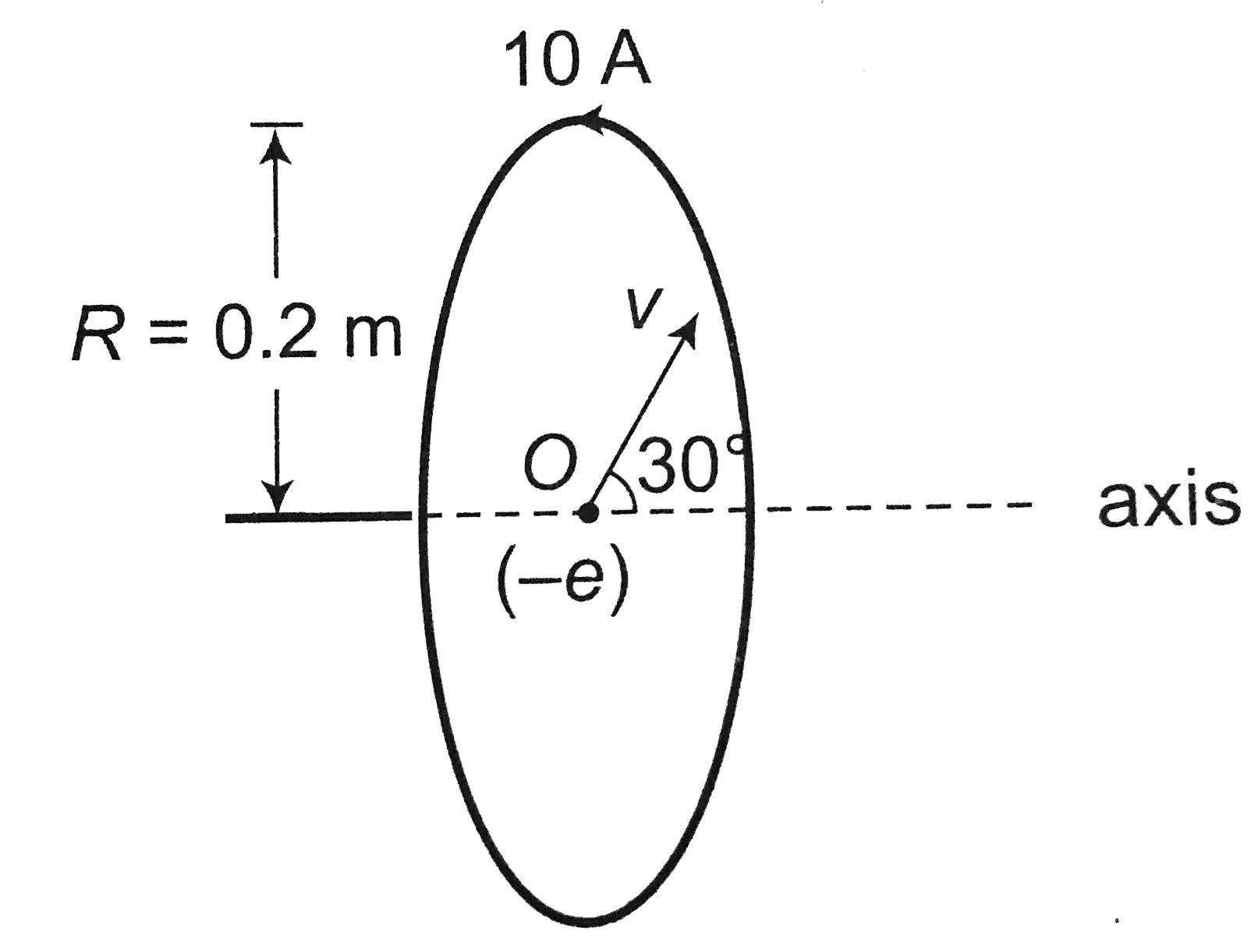 Magnetic field centre of loop `B = (mu_(0) i)/(2R) = ((4pi xx 10^(-7)) (10))/(2 xx 0.2) = pi xx 10^(-5) T`, along x-axis `vec(B) = pi xx 10^(-5) hat(i) T` Velocity of electron, `|vec(v)| = v = 2 xx 10^(6) m//sec` `vec(v) = v cos 30^(@) hat(i) + v SIN 30^(@) hat(j) = (sqrt(3)hat(i) + hat(j)) xx 10^(6) m//sec` `vec(F) = q vec(v) xx vec(B) = (-1.6 xx 10^(-19))|(hat(i), hat(j), hat(k)),(sqrt(3) xx 10^(6), 10^(6), 0),(10^(-5)pi, 0, 0)|` `= (1.6 xx 10^(-19)) (10^(6))(10^(-5)pi) hat(k)` `= 1.6 pi xx 10^(-18) hat(k) N` `|vec(F)| = 1.6pi xx 10^(-18)N` |
|