

Saved Bookmarks
| 1. |
(a) An electric dipole of dipole moment vecp is placed in a uniform electric field vecE at an angle theta with it. Derive the expression for torque (vec(tau)) acting on it. Find the orientation of the dipole relative to the electric field for which torque on it is (i) maximum, and (ii) half of maximum. (b) Two point charges q_(1)=+1muC and q_(2)=+4muC are placed 2 m apart in air. At what distance from q_(1) along the line joining the two charges, will the net electric field be zero ? |
|
Answer» As shown in here, forces qE and qE act on the two charges in mutually opposite directions. CONSEQUENTLY, net translational force on dipole is ZERO and there is no translatory motion of dipole. However, as the two forces act at two different points NON- linearly, they constitute a couple whose torque is given by : torque `tau = (qE)`. Normal distance between the forces `=qE2asintheta=pEsintheta` The torque has a tendency to align the dipole along the direction of electric field. Thus, according to right hand rule `vectau=vecpxxvecE` (iii) If `theta` = 90° i.e., dipole is set perpendicular to the direction of electric field E, then torque `tau` = pE sin 90° = pE = maximum. (ii) When torque is ONE half of maximum value, torque `tau.=(pE)/2=pEsintheta.rArrsintheta.=1/2` or `theta=30^(@)` (b) Let charges `q_(1)=+1muC` and `q_(2)=pm4muC` be placed at points A and B respectively separated by a distance AB = 2 min air. Let net electric field `vecE` be zero at a point C situated at a distance x m from `q_(1)` or (2-x) m from `q_(2)`. Then `abs(vecE_(A)+vecE_(B))=vec0` or `abs(vecE_(A))=abs(vecE_(B))` `rArr1/(4piepsi_(0))(q_(1))/(x^(2))=1/(4piepsi_(0))(q_(2))/((2-x)^(2))` `rArr(x/(2-x))=sqrt((q_(1))/(q_(2)))=sqrt((1muC)/(4muC))=1/2rArrx=2/3m` 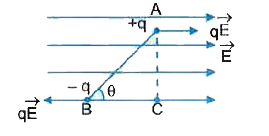
|
|