

Saved Bookmarks
| 1. |
A ball falls freely from a height of 180 m on to a hard horizontal floor and repectedly bounces . If the coefficient of restitution is 0.5 the average speed and aberage velocity of the ball before it ceases to rebound are respectively( acceleration due to gravity = 10 "ms"^(-2)) |
|
Answer» `10 MS^(-1), 10 ms^(-1)` 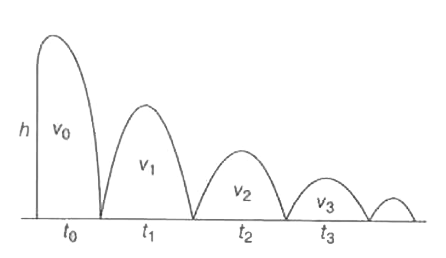 When ball dropped from height h then time taken to reach the ground `t_(0)sqrt((2h)/(g))` and speed `v_(0)= sqrt(2gh)` After first COLLISION its speed will become `v_(1)=ev_(0)=esqrt(2gh)` where e= coefficient of restitution . Now the ball will go up and will take time `t_(1)` when it STOPS `nu = mu + at ` `o= v_(1)-"gt"_(1)` `t_(1)= (v_(1))/(g)` It will coem down and take same time `t_(1)` before second collision.So time taken between first and second collision is `2t_(1)` . Similarly time taken between second and third collision will be `2t_(3)= (2v_(2))/(g)` Total time before it ceaser to REBOUND `T= t_(0)+2t_(1)+2t_(2)+ .........` ` T = t_(0)+ (2v_(1))/(g)+ (2v_(2))/(g) + ..........` `T= t_(0)+ (2ev_(0))/(g)+(2e^(2)v_(0))/(g)+...........` {as`v_(2)=ev_(1)=e^(2)v_(0)}` `T=sqrt((2h)/(g))[I+2e(1+e+e^(2)+e^(3)+cdots)]` `{as v_(0)= sqrt(sqrt(2h)/(g))}` It forms a GP, `T=sqrt((2h)/(g))[1+2e((1)/(1-e))]` `T=sqrt((2h)/(g))((1+e)/(1-e))` T= `6xx3 = 18 s` Calculation of distance in ENTIRE motion intitial height `h_(0)` = h After first collision = `h_(1) ` As ` e = (v)/(u)= =sqrt((2gh_(1))/(2gh_90))=sqrt(h_(1)/(h))` `h_(1)=e^(2)h` similarly `h_(2)= e^(2)(e^(2)h)` `h_(2)= e^(4)h` Total distance , `H=h_(0)+2h_(1)+2h_(2)+ .........` `H= h+2e^(2)h+2e^(4)h+ ............. ` `H = h[I+2e^(2)(1+e^(2)+e^(4)+ ...........)]` ` H =h [1+2e^(2)((1)/(1-e^(2)))]` `H=h((1+e^(2))/(1-e^(2)))` `H= 180 ((1+(1)/(4))/(1-(1)/(4)))e = 0.5 = (1)/(2)` `H= 180 xx(5)/(3)` H= 300 m Average speed v = `("Total distance" )/("Time")` `v=(300)/(18) = (50)/(3) `m/s Average velocity `v = ("Total displacement")/("Time")` `v=(180)/(18) = 10 ` m/s |
|