

Saved Bookmarks
| 1. |
A block of mass 2M is attached to a massless spring with spring-constant k. This block is connected to two other blocks of masses M and 2M using two massless pulleys and strings. The accelerations of the blocks are a_(1)a_(2) and a_(3) as shown in the figure. The system is released from rest with the spring in its unstretched state. The maximum extension of the spring is x_(0) Which of the following option(s) is(are) correct? [g is the acceleration due to gravity. Neglect friction] |
|
Answer» `a_(2)-a_(1)=a_(1)-a_(2)` `2Mg-T=3Ma_(3)`...(2) `2T-Kx=2Ma_(1)`...(3) From (1) and `M(a_(2)+a_(3))="Mg-T+Mg"(-T)/(2)=2Mg-(3T)/(2)|` implies`ubrace(2Ma_(1)=2Mg-(3T)/(2))_(xx(4)/(3)) implies(8Ma_(1))/(3)=(3Ma)/(3)=(3Ma)/(3)-2T` ...(4) `(3)+(4)implies(8Mg)/(3)-kx=(2M+(8M)/(3))a_(1)` `implies(14M)/(3)a_(1)=-K[x-(8Mg)/(3K)]impliesa_(1)=-(3K)/(14M)[x-(8Mg)/(3K)]` `omega=sqrt((3K)/(14M))`,`A=(8Mg)/(3K)(x_(0))/(2)=2A`[Maximum elongation=2A] `V_(max)=Aomega=(8Mg)/(3K)sqrt((3K)/(14M))``a_(1)atx=(x_(0))/(4)=-(3K)/(14M)xx(4Mg)(3K)=(2g)/(7)` Correct answer is (A) 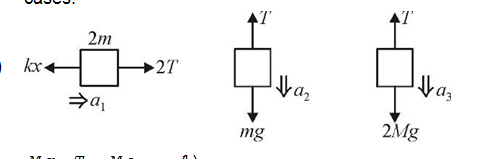 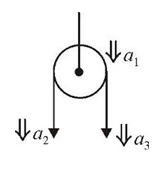
|
|