

Saved Bookmarks
| 1. |
A block of mass 4m is attached to a vertical spring of spring constant k. The block is made by gluing two blocks of mass 3m and m, respectively. Initially, the block is in equilibrium and at rest (Fig. 15.13a). At t=0, the part of the block having ass 3m falls down. Considering hanging point on ceiling as y=0 and downward direction as positive y, find y-coordinate of mass m as a function of time. |
|
Answer» Solution :(1) As the original block of mass 4m is in equilibrium, the combined mass will be STRETCHING the spring by 4mg/k. Thus, the spring will be 4mg/k below the natural length. As the bigger block falls, the smaller block will experience a FORCE larger than its weight in upward direction. (2) Theblock remaining attached to the spring will be undergoing SHM. To find equation of SHM, we need to find angular frequency, amplitude, and initial phase 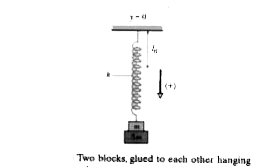 Calculations: When the EXTENSION in the spring is x, the net force on the block is `mg- kx = (md^(2)x)/(DT^(2))` Again as x= 0 is not position of equilibrium, we have to shift origin to the position of equilibrium. Defining `x= (mg//k) +s`, as at s=0, x = mg/k is the position of equilibrium. Substituting for x in the equation we get `mg- k ((mg)/(k) + s) = (md^(2)s)/(dt^(2))` On solving we get, `(d^(2)s)/(dt^(2)) = - ((k)/(m))s` `s= x_(m) sin (omega t+ phi)` (with `omega= sqrt((k)/(m))`) Now we have to find `x_(m)`. We have defined `x_(m)` as distance between v=0 and a=0.At t=0, the block was at rest with extension of spring being 4mg/k and at the new equilibrium position extension of spring is mg/k. Thus, `x_(m) = (3mg)/(k)` Now we have to find the initial phase. As the particle is at rest at t=0 on positive side, the initial phase will be `pi//2`. `phi = (pi)/(2)` 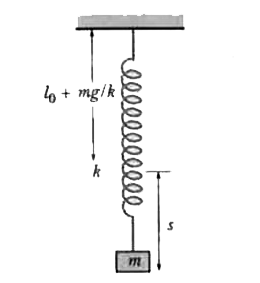 Thus, the y coordinate of the block `y= l_(0) + (mg)/(k) + s` Substituting, all the values from above, we get `y= l_(0) + (mg)/(k) + (3mg)/(k) sin [sqrt((k)/(m)) t + (pi)/(2)]` Note: At TIME t=0, the distance of the block from the ceiling is `l_(0) + 4 mg//k`, which can be verified by putting t=0 in the above equation. |
|