

Saved Bookmarks
| 1. |
(a) Briefly describe the Young's double-slit experiment of interference of light. Derive the expression for fringe width in the pattern. (b) Monochromatic light of wavelength 588 nm is incident from air to water interface. Find the wavelength and speed of the refracted light. The refractive index of water is 4/3. |
Answer» 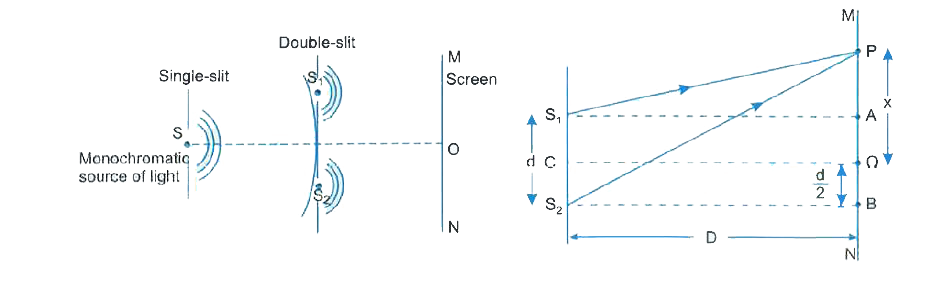 light waves reaching point P from two slit sources is `S_(2)P-S_(1)P`, where `(S_(2)P)^(2)=D^(2)+(x+d/2)^(2)` and `(S_(1)P)^(2)=D^(2)+(x-d/2)^(2)` `therefore(S_(2)P)^(2)-(S_(1)P)^(2)=[D^(2)+(x+d/2)^(2)]-[D^(2)+(x-d/2)^(2)]=2xd` `rArr(S_(2)P-S_(1)P)(S_(2)p+S_(1)P)=2xd` or `(S_(2)P-S_(1)P)=(2xd)/((S_(2)P+S_(1)P))` If x and dare very very small as compared to D, then `(S_(2)P+S_(1)P)` may be considered as 2D. Hence, `[S_(2)P-S_(1)P]=(2xd)/(2D)=(xd)/D` For constructive interference, path difference must be an integer multiple of `lamda` i.e., `(xd)/D=nlamda` where n = 0, 1, 2, 3, ... etc. `thereforex=(nDlamda)/d` i.e., positions of various maxima (bright bands) will be given by : `x_(0)=0,x_(1)=(Dlamda)/d,x_(2)=(2Dlamda)/d,x_(3)=(3Dlamda)/d` ........ For destructive interference, path difference must be an odd multiple of `lamda/2` i.e., `(xd)/D=(2n-1)lamda/2`, where n ::= 1, 2, 3, ... etc. `rArrx=((2n-1)Dlamda)/(2d)` i.e., positions of various minima (dark bands) will be given by : `x_(1).=(Dlamda)/(2d),x_(2).=(3Dlamda)/(2d),x_(3).=(5Dlamda)/(2d)` ...... Fringe width of the fringe pattern is defined as the distance between two successive maxima or successive minima. Therefore, considering two successive maxima, we have Fringe width `beta=x_(n+1)-x_(n)=((n+1)Dlamda)/d-(nDlamda)/d=(Dlamda)/d` (b) Here wavelength`lamda`= 588 nm and refractive index of water w.r.t. air `n =4/3` We know that speed of light in air =`c=3xx10^(8)ms^(-1)` `therefore` Speed of light in water v =`c/n=(3xx10^(8))/((4//3))=2.25xx10^(8)ms^(-1)` and wavelength of given light in water, `lamda_(w)=lamda/n=(588nm)/((4//3))=441nm` |
|