

Saved Bookmarks
| 1. |
A car travels starting form rest with constant acceleration alpha and reaches a maximum velocity V. It travels with maximum velocity for some time and retards uniformly at the rate of beta and comes to rest. If s is the total distance and t is the total time of journey then t= |
Answer» Solution :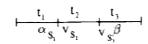 `V=0+alphat, t_1=v/alpha` `S_1=1/2alphat_1^2=v^2/(2ALPHA)` `O-V=betat_3 , t_3=v/beta` `O^2-V^2=-2betaS_3` `S_3=v_2/(2BETA)=1/2 betat_3^2` `t_2=S_2/V=(S-(S_1+S_3))/V=(S-v^2/2(1/alpha+1/beta))/V` `t=t_1+t_2+t_3` `=v/alpha+s/v-v/(2alpha)-v/(2beta)+v/beta` `t=s/v+v/2((alpha+beta)/(alphabeta))` `s_2=s-(s_1+s_2)=s-(v^2/(2alpha)+v^2/(2alpha))` `=s-v^2/alpha=s-(vt-s)` `s_2=2s-vt` [`S_2` = DISTANCE TRAVELLED with CONSTANT velocity] 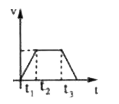
|
|