

Saved Bookmarks
| 1. |
A charge is distributed uniformly over a ring of radius r. obtain an expression for the electric intensity vecE at a point on the axis of the ring. Hence show that for points at large distances, the ring behaves as a point charge. |
|
Answer» Solution :Let us consider a circular loop of radius a held perpendicular to the plane of paper. Let whole of loop carries a charge q. charge on a small element of loop MN of LENGTH dl is `DQ=(q)/(2pia)dl`. . . (i) 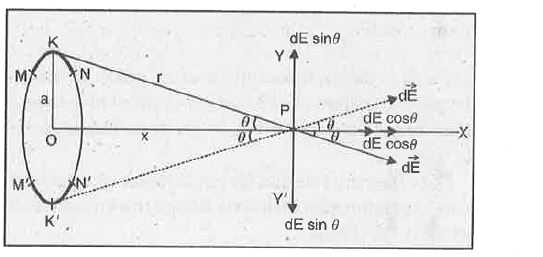 Electric field at P due to charge element MN is `dE=(1)/(4piepsi_(0))(dq)/(r^(2))` `=(1)/(4piepsi_(0))(dq)/((x^(2)+a^(2)))` along PX dE can be resolved into two rectangular components. dE cos `theta` acting horizontally along PZ and `dE sin theta` acting along PY. For a pair diagrammatically opposite element M., N., dE cos `theta` acts along PX and hence ADDD up but `dE sin theta` along PY. cancel with dE sin `theta` along PY. `therefore sumdE sin theta=0` for full loop and dE cos `theta` addd up `therefore E=sumdEcostheta` `=sum(1)/(4piepsi_(0))(dq)/((x^(2)+a^(2)))xx(x)/((x^(2)+a^(2))^(1//2))` or `E=int(1)/(4piepsi_(0))xx(x)/((x^(2)+a^(2))^(3//2))xx(q)/(2pia)dl` [Substituting the value of dq from (i)] or `E=(1)/(4piepsi_(0))xx(x)/((x^(2)+a^(2))^(3//2))xx(q)/(2pia)intdl` But `intdl=l=2pia` `therefore E=(1)/(4piepsi_(0))xx(x)/((x^(1)+a^(2))^(3//2))xx(q)/(2pia)xx2pia` or `E=(qx)/(4piepsi_(0)(x^(2)+a^(2))^(3//2))`. . (ii) Special case. when `x gt gt a ` i.e., P lies far off, then `a^(2) lt lt x^(2)` and hence can be neglected. `therefore E=(qx)/(4piepsi_(0)(x^(2))^(3//2))=(qx)/(4piepsi_(0)x^(3))` or `E=(1)/(4piepsi_(0))xx(q)/(x^(2))` which is the expression for E at a distance x from a charge q. therefore circular loop of charge behaves as a point when P is at a very very LARGE distance from the loop. |
|