

Saved Bookmarks
| 1. |
A charge is distributed uniformly over a ring of radius ‘a’. Obtain an expression for the electric intensity E at a point on the axis of the ring. Hence show that for points at large distances from the ring, it behaves like a point charge. |
|
Answer» Solution :Consider a point P on the axis of uniformly charged ring at a distance x from its centre O. Point P is at distance `r =sqrt(R^2++x^2)`from each element dl of ring. If q is total charge on ring, then, charge per metre length, `lamda=q/(2piR)` The ring may be supposed to be formed of a large number of ring elements. Consider an element of length dl situated at A. The charge on element, `dq = lamda DT` The electric field at P DUE to this element `dE_1 = 1/(4piepsilon_0)(dp)/r^2=1/(4epsilon_0)(lamdadl)/r^2` , along `bar(P)C` The electric field strength due to opposite symmetrical element of length dl at B is `bar(DE)_2=1/(4piepsilon_0)(dp)/r^2=1/(4piepsilon_0)=1/(4piepsilon_0)(lamdadl)/r^2` ,along `bar(PC)` 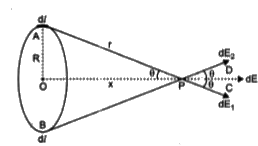 If we resolve `bar(dE) and bar(dE)_` along the axis and perpendicular to axis, we note that the components perpendicular to axis are oppositely directed and so get cancelled, while those along the axis are added up. Hence, due to symmetry of the ring, the electric field strength is directed along the axis. The electric field strength due to charge element of length dl, situated at A, along the axis will be`dE=dE_1costheta=1/(4piepsilon_0)(lamdadl)/r^2,(lamdadl)/r^2,` along `bar(PD)` But , `costheta=x/r` `:.dE(1)/(4piepsilon_0)(lamdadlx)/r^3=1/(4piepsilon_0)(lamdax)/r^3dt` The resultant electric field along the axis will be OBTAINED by adding fields due to all elements of the ring, i.e., `E=int1/(4piepsilon_0)(lamdax)/r^3dl1/(4piepsilon_0)(lamdax)/r^3intdt` But, f dl = whole length of ring `2piR and r = (R^2+x^2)^(1//2)` `E=1/(4piepsilon_0)(qx)/((R^2+x^2)^(3//2))2piR` As, `lamda=q/(2piR),""E=(1)/(2piepsilon_0)(((q)/(2piR))x)/((R^2+x^2)^(3//2))2piR` or, `E=1/(2piepsilon_0)(qx)/((R^2+x^2)^(3//2))` ,along the axis At large distances i.e., `x gt gt R,E=1/(4piepsilon_0)q/x^2` i.e., the electric field due to a point charge at a distance x. For points on the axis at distances much larger than the radius of ring, the ring behaves like a point charge. |
|