

Saved Bookmarks
| 1. |
A charge Q has been divided on two concentirc conducting spheres of radii R_(1) and R_(2) (R_(1) gt R_(2)) such that the surface charge densities on both the sphere is same. Find the potential at their common center. |
Answer» Solution :Let charge `Q_(1)` is given on the outer sphere then charge on the inner sphere is `Q_(z) = Q - Q_(1)`. Now it has been given that both the sphere have same SURFACE charge density i.e charge per unit area on both the sphere is same. 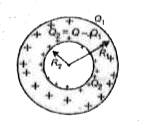 Therefore, `(Q_(1))/(4 PI epsilon_(0)R_(1)^(2)) = (Q_(2))/(4 pi epsilon_(0)R_(2)^(2))`( because area of sphere is `4 pi R^(2)` ) or , `(Q_(1))/(R_(1)^(2))= (Q-Q_(1))/(R_(2)^(2))` (because `Q_(2) = Q - Q_(1)` ) Doing CROSS multiplcation we get `Q_(1) = (Q.R_(1)^(2))/(R_(1)^(2) + R_(2)^(2))` therefore `Q_(2) = Q - Q_(1) = Q -(Q.R_(1)^(2))/(R_(1)^(2) + R_(2)^(2)) = (Q.R_(2)^(2))/(R_(1)^(2) + R_(2)^(2))` Now, the potential at the common centre O will be the surface potential of respective spheres added together. i.e. V = `(Q_(1))/(4 pi epsilon_(0)R_(1)) + (Q_(2))/(4 pi epsilon_(0)R_(2))` Subsitute for `Q_(1) and Q_(2)` and get V = `(1)/(4 pi epsilon_(0))[ (Q_(1))/(R_(1)) + (Q_(2))/(R_(2))] = (1)/(4 pi epsilon_(0)) [ (Q.R_(1)^(2))/(R_(1)(R_(1)^(2) + R_(1)^(2))) + (Q.R_(2)^(2))/(R_(2)(R_(1)^(2) + R_(1)^(2))) ]= (1)/(4 pi epsilon_(0)) (Q(R_(1) + R_(2)))/((R_(1)^(2) + R_(2)^(2)))` 
|
|