

Saved Bookmarks
| 1. |
A charged particle +q of mass m is placed at a distanced from another charged particle -2q of mass 2m in a uniform magnetic field B as shown in Fig. 1.28. If the particles are projected towards each other with same speed v, a. find the maximum value of projected speed v_m so that the two particles do not collide. b. find the time after which collision occurs between the particles if projection speed equals 2v_m. c. Assuming the collision to be perfectly inelastic, find the radius of the particle in subsequent motion. (Neglect the electric force between the charges.) |
|
Answer» So, for collision not to take PLACE, `r_1+r_2ltd` `(mv)/(Bq)+(2mv)/(2Bq)LTD`or `VLT(Bqd)/(2m)` Therefore, maximum speed should be `(Bqd)/(2m)` i.e., `v_mlt(Bqd)/(2m)` (b) From symmetry, it can be concluded that collision occurs at `d//2` if `v=2v_m=(qBd)/m` `r=(mv)/(qB)=d, sin theta=(d//2)/d=1/2, theta=pi/6` `t=T( theta/(2pi))=(2pim)/(qB)((pi//6)/(2pi))=(pim)/(6qB)` 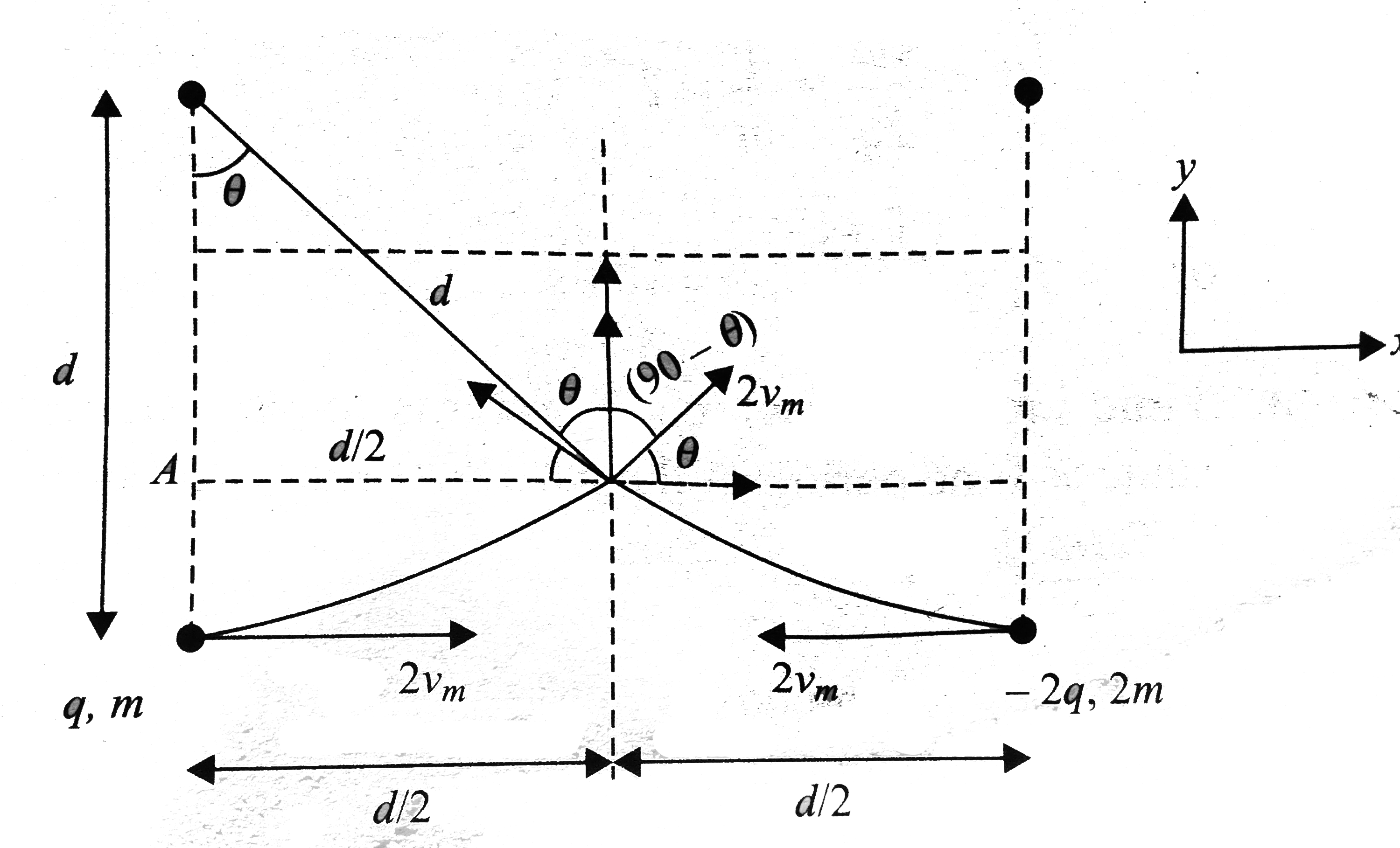 (c) After collision, charge on the combined particle `=-q`, Mass `=3m` The combined particle will have velocity in y direction just after collision. Using conservation of linear momentum `(mv cos thetai+mvsin thetaj)+(-2mvcos thetai+2mv sin thetaj)=3mvecv` `3mvecv=-mv cos thetai+3mvsin thetaj` `VECV=(-v/(2sqrt3)hati+v/2hatj)` `|vecv|=vsqrt((1/(4xx3)+1/4))=vsqrt(1/4(4/3))=v/(sqrt3)` `|v|=1/(sqrt3)xx2xx(qBd)/(2m)=(qBd)/(sqrt3m)` `:. r=3mxx(qBd)/(sqrt3mxxqB)=sqrt3d`. |
|