

Saved Bookmarks
| 1. |
A circular converging lens, with diameter d = 32 mm and focal length f = 24 cm, forms images of distant point objects in the focal plane of the lens. The wavelength is lambda = 550 nm. (a) Considering diffraction by the lens, what angular separation must two distant point objects have to satisfy Rayleigh's criterion? |
|
Answer» Solution :KEY IDEA Two distant point objects `P_(1)` and `P_(2)` the lens, and a viewing screen in the focal plane of the lens. It also shows, on the right, plots of light intensity I VERSUS position on the screen for the central MAXIMA of the images formed by the lens. Note that the angular separation `theta_(o)`, of the objects equals the angular separation `theta_(i)` of the images. Thus, the images are to satisfy Rayleigh.s criterion, these SEPARATIONS must be given by Eq. 35-64 (for small ANGLES). CALCULATIONS: From Eq. 35-62, we obtain `theta_(o)=theta_(i)=theta_(R)=1.22(lambda)/(d)` `((1.22)(550 xx 10^(-9) m))/(32 xx 10^(-3) m)=2.1 xx 10^(-5)` rad. (Answer) Each central maximum in the two intensity curves is centered on the first minimum of the other curve. 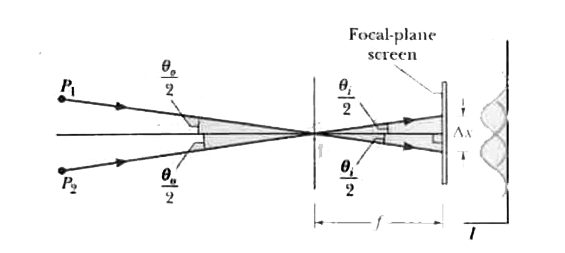
|
|