

Saved Bookmarks
| 1. |
A coherent parallel beam of microwaves of wavelength lambda = 0.5 mm falls on aYoung's double- slit apparatus. The separation between the slits is 1.0 mm. The intensity of microwaves is measured on a screen placed parallel to the plane of the slits at a distance of 1.0 m from it as shown in figure If the incient beam falls normally on the double-slit apparatus, find the order of the interference minima on the screen |
|
Answer» Only the first ORDER minima are possible `y = D tan theta = 1 tan theta` For first minima, `n = 1, sin theta_(1) = (1)/(4), tan theta_(1) = (1)/(sqrt 15)` For second minima, `n = 2, sin theta_(2) = (3)/(4), tan theta_(2) = (3)/(sqrt 7)` So, the positions of minima are `y_(1) = tan theta_(1) = (1)/(sqrt 15) = 0.258 m` `y_(2) = tan theta_(2) = (3)/(sqrt 7) = 1.13 m` The minima are symmetrically placed on either of central mixima, therefore will be 4 minima at positions `+- 0.258 m` and `+- 1.13 m` on the screen. a. When INCIDENT rays are incident normally, the waves arriving at slits are in phase, zero path difference before slit. Path difference after slits, at point P, is `d sin theta`. CONDITION for minima at y-axis is `d sin theta = (2 n - 1) (lambda)/(2)` `sin theta = ((2 n -1)lambda)/(2d) = ((2 n - 1)(0.5))/(2 XX 1) = ((2 n - 1))/(4)` As `sin theta le 1, ((2n - 1)/(4)) le` or `n le 2.5` Hence, only first-order and second-order minima are possible. 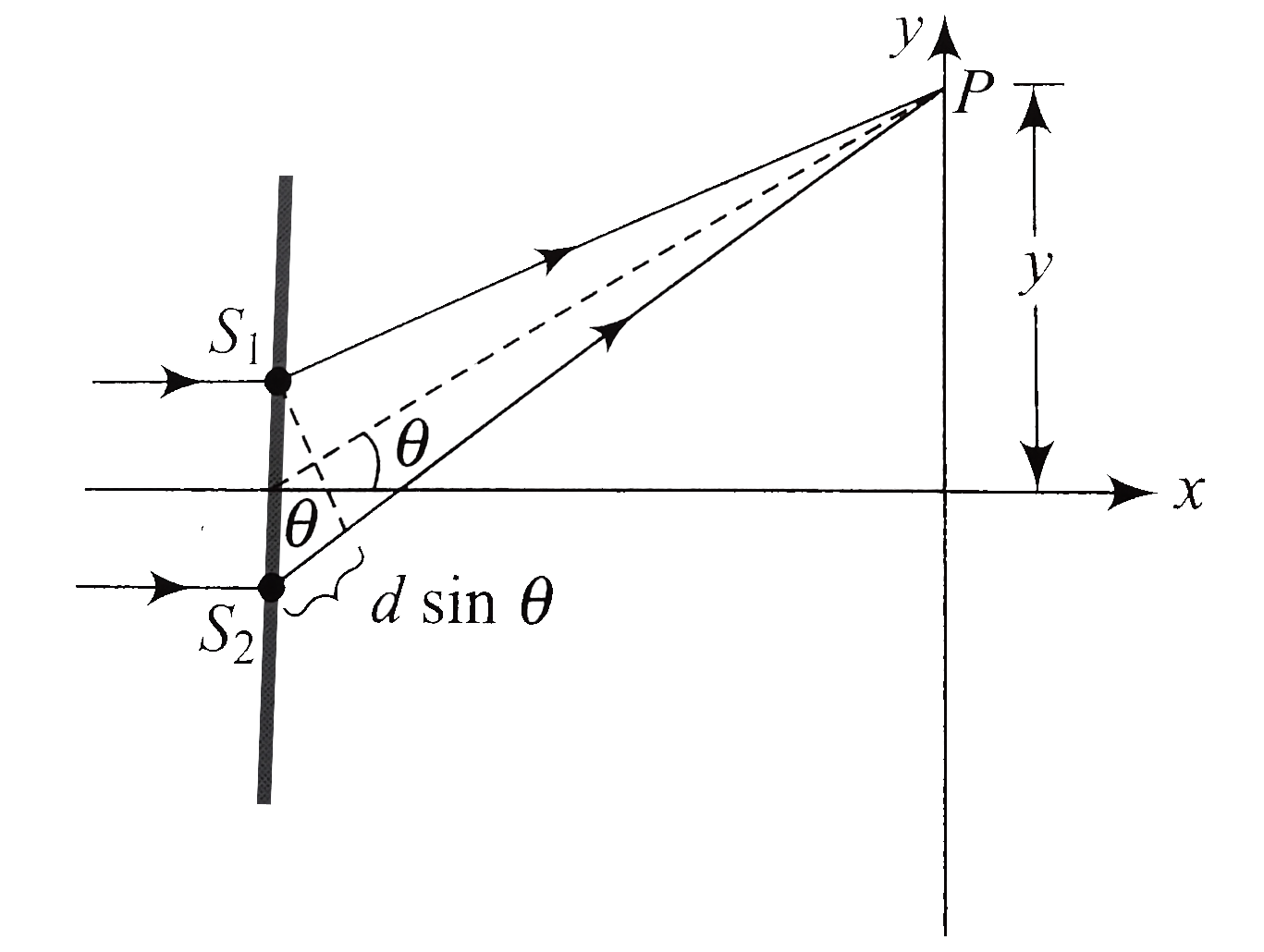 b. Path difference before slits `= d sin phi` Path difference after slits `= d sin theta` As path of rays before slits is longer at `S_(1)` and `S_(2) P gt S_(1) P` after slits, so net path difference for first minima is `d sin theta - d sin phi = +- (lambda)/(2)` `sin theta = sin phi +- (lambda)/(2)` `= sin 30^(@) +- (0.5)/(2 xx 1) = (3)/(4)` or `(1)/(4)` `tan theta = (3)/(sqrt 7)` and `(1)/(sqrt 15)` So, the position of first minima on either side of central maxima is `y = D tan theta = (3)/(sqrt 7)` and `(1)/(15) m` 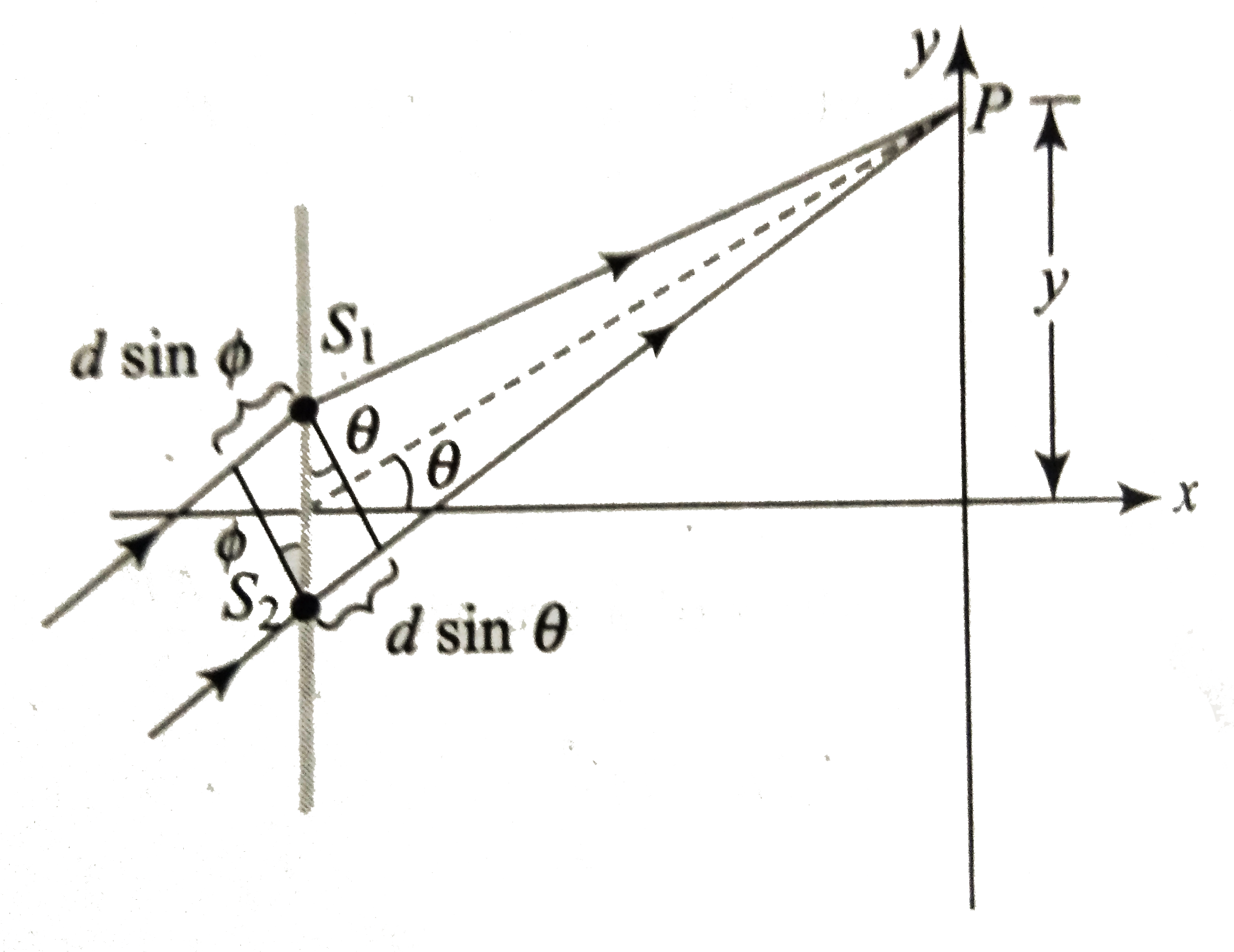
|
|