

Saved Bookmarks
| 1. |
A converging lens of focal length f_(1) is placed coaxially in contact with a diverging lens of focal length f_(2)((f_(1) gt f_(2)). Determine the power and nature of the combination in terms of f_(1) and f_(2). |
|
Answer» Solution :Consider two thin lenses A and B of focal lengths `f_(1)` and `f_(2)` placed in contact. Let a POINT object be placed at O, beyond the focus of first LENS A. Lens A forms a real image at `I_(1)`. This image serves as a virtual object for second lens B and the final real image is formed at I. For image `I_(1)` formed by first lens, we have `1/(v_(1))-1/u=1/(f_(1))` and for the image I formed by the second lens, we have `1/v-1/(v_(1))-1/(f_(2))` ...(ii) Adding (i) and (ii), we have `1/v-1/u=1/(f_(1))+1/(f_(2))` ...(iii) 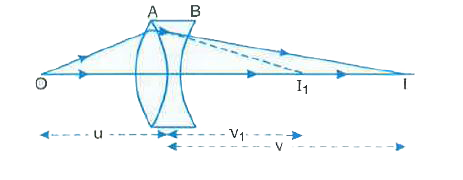 If the two lens system is considered as equivalent to a single lens of focal LENGTH f, then `1/v-1/u=1/f` ..(iv) Comparing (iii) and (iv), we get `1/f=1/(f_(1))+1/(f_(2))` or `P=P_(1)+P_(2)` As 1st lens is converging one but 2nd lens is diverging, hence `f_(1)` is +ve but /2 is -ve and moreover `f_(1)gtf_(2)`. `thereforeP=P_(1)+P_(2)=1/(f_(1))+1/((-f_(2)))=(f_(1)-f_(2))/(f_(1)f_(2))=-ve`, i.e. the COMBINATION behaves as a diverging lens. |
|