

Saved Bookmarks
| 1. |
A convex lens of focal length 15cm and a concave mirror of focal length 30cm are kept with their optic axes PQ and RS paralledl but separated in vertical direction by 0.6 cm as shown in Figure. The distance between the lens and mirror is 30cm. An upright object Ab of height 1.2 cm is placed on the optics axis PQ of the lens at a distance of 20 cm from the lens. If A^(')B^(')is the image after refraction from the lens and reflection from the mirror, find the distance of A^(')B^(') from the pole of the mirror and obtain its magnification. Also, locate positions of A^(')and B^(') with respect to the optic axis RS. |
|
Answer» Solution :For convex lens using sign convectionof coordinate geometry, `u=+20cm, f=-15cm` So, `(1)/(f)=(1)/(v)-(1)/(u)rArr -(1)/(15)=(1)/(v_(1)) -(1)/(20)` `rArr (1)/(v_(1)) =(1)/(20)-(1)/(15)=(3-4)/(60)rArrv_(1)=-60cm` i.e., IMAGE is formed at a distance 60 CM to the left of lens L. Magnification, `m_(1)=(v_(1))/(u_(1))=-(60)/(20)=-3` This image is real and inverted. It is intercepted by the mirror. For concave mirror, `u_(2)=-60+30=-30cm, f_(2)=+30cm` So, `(1)/(f)=(1)/(v)+(1)/(u)` gives `(1)/(30)=(1)/(v_(2))-(1)/(30)rArr (1)/(V_(2))=(1)/(30)+(1)/(30)=(2)/(30) rArr v_(2)=15cm` Magnification, `m_(2)=-(v_(2))/(u_(2))=-(15)/(-30)=+(1)/(2)` `:.` Net magnification, `m=m_(1)xxm_(2)=(-3)XX((1)/(2)) =-1.5 ` Size of image `A^(')B^(') = -1.5XX1.2cm=-18cm`. Magnification of mirror is HALF and image of B fomred by convex lens is 0.6 cm above RS, so the length of image will be 1.5 cm below RS. Thus, `B^(')` will be 0.3 cm above RS and `A^(')`will be 1.5 cm below RS. 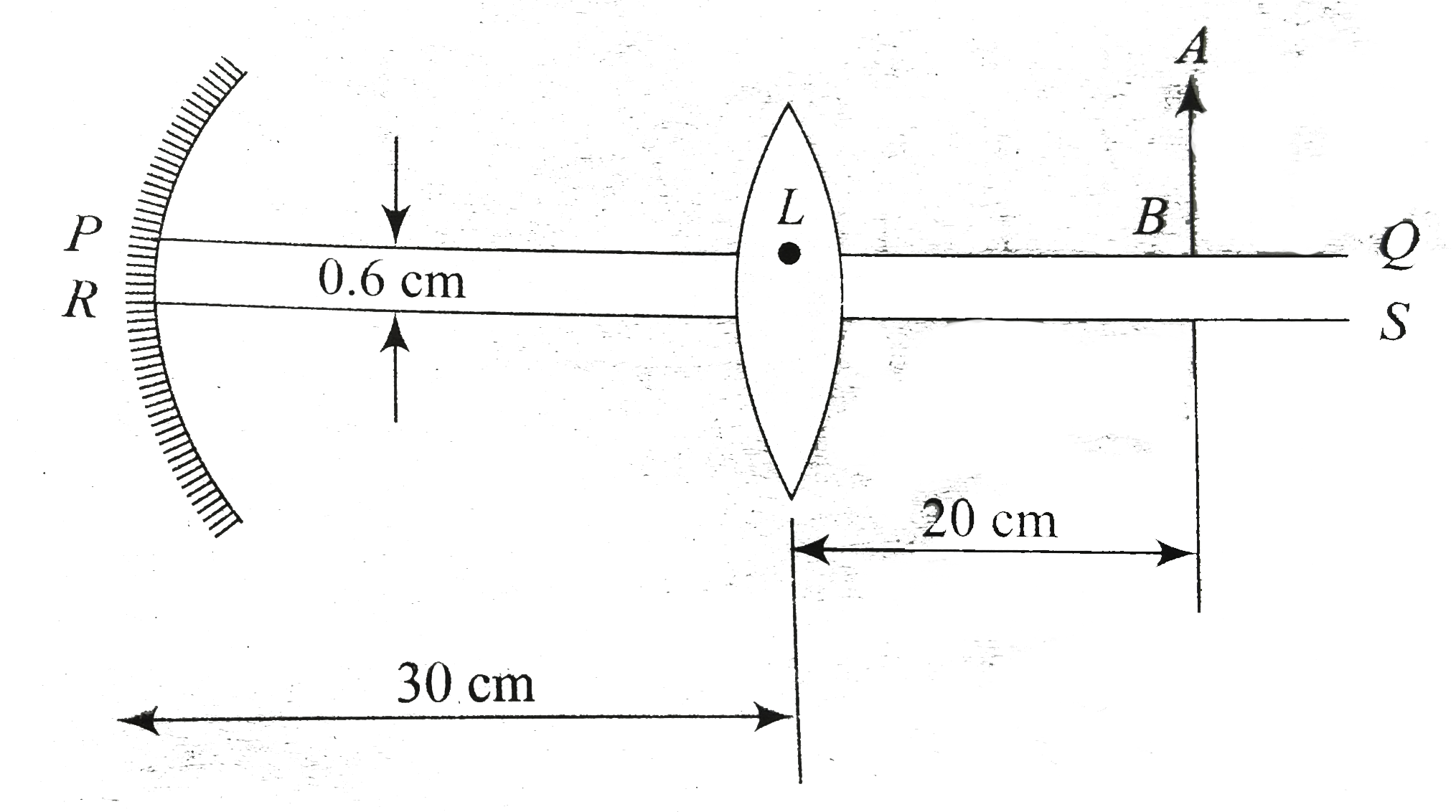 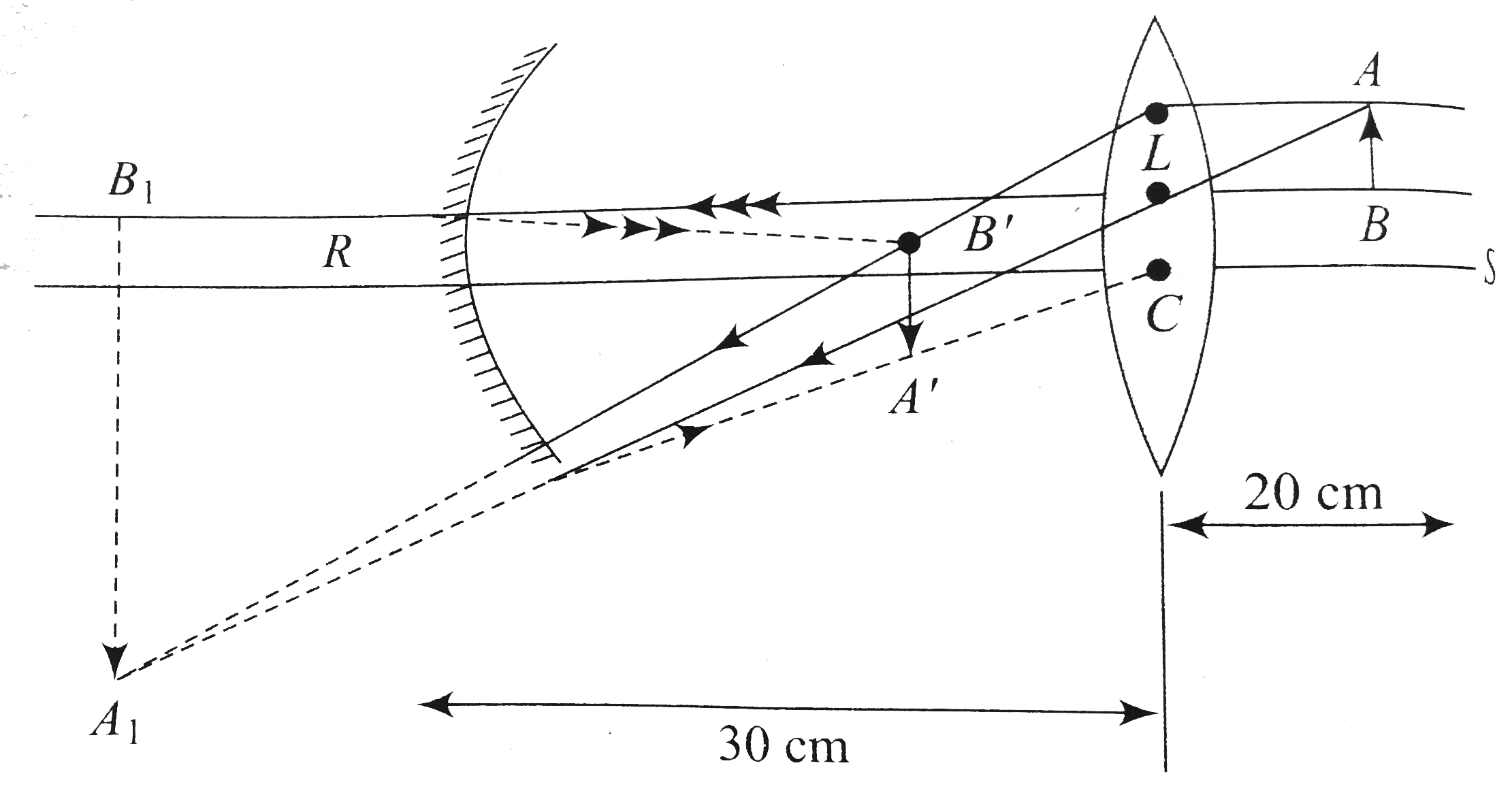
|
|