

Saved Bookmarks
| 1. |
(a) Derive a relation between electric current and drift velocity of charge carriers. 9b) Deduce the expression for resistivty. (c) What is the effect of temperature on resistivity? |
Answer» Solution :Ohm.s law. It states that current flowing through a conductor is proportional to the potential difference across its two ends, PROVIDED to physical conditions (temperature, mechanical strain etc.) of the conductor remain unchanged. 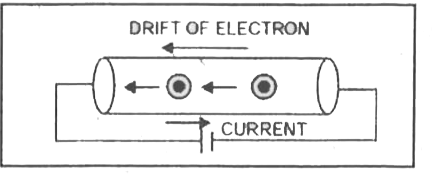 Drift velocity `(v_(d))` is the velocity of the free electrons with which they are drifted towards the positive terminal under the INFLUENCE of the external field. (a) Relation between electron current and drift velocity. CONSIDER that a wire of length l and area of cross-section A be subjected to an electric field of strength E. If V=Potential difference applied across the end of the wire, `therefore E=(V)/(l) or V=El` Let n=number of free electrons per unit volume of the conductor, `v_(d)=` Drift velocity of electrons `therefore` Charge flowing through the conductor wire=nA le Time taken by the electrons, `t=("Distance")/("Velocity")=(l)/(v_(d))` `therefore`Current, `I=("Charge")/("Time")=(nAl e)/((l)/(v_(d)))` `I=nv_(d)Ae`. . . (i) Since current density `J=(I)/(A)` So `J=nv_(d)e` this is the required relation between current and drift velocity. (b) Expression for Resistivity. According to Ohm.s law, `V=IR` or `V=(v_(d)nAe)R` `E=(V)/(l)=(v_(d)n eA)/(l)R` Force acting on each electron `eE=n e^(2)(AR)/(l)v_(d)` Acceleration under electric field`=(a=(eE)/(m))` `e(E)/(m)=((n e^(2))/(m))(AR)/(l)v_(d)`. .(ii) `therefore` Velocity acquired by the electron under the action of applied electric field is `therefore `Velocity acquired by the electron under the action of applied electric field is `v_(d)=(eE)/(m)tau` Where `tau`=relaxation time in which the electron is accelerated substituting `v_(d)` from above in equation (2), we have `(eE)/(m)=((n e^(2))/(m))(AR)/(l)xx(eE)/(m)tau` `therefore (AR)/(l)=(m)/(n e^(2))(1)/(tau)""[becauserho=(AR)/(l)]` `rho=(m)/(n e^(2))(1)/(tau)` This is the required expression for resistivity. (c) Variation of Resistivity with temperature Resistivity `rho=(m)/(n e^(2))(1)/(tau)` `thereforerhoprop(1)/(tau)` The resistivity varies with relaxation time. the relaxation time changes with collision. it will DECREASE with increase amplitude of vibration. since with the increase in temperature, the amplitude of vibration increases, relaxation time decreases and hence resistivity increases. In many metals, at room temperature resistivity increases with increase in temperature. at low temperature, resistivity increases at a higher power of T. this is shown in the figure. |
|