

Saved Bookmarks
| 1. |
(a) Derive the experience for the forest acting between two long parallel current carrying conductors. Hence , defined 1 A current . (b) A bar magnet of dipole moment 3 A m^2 . rests with its centre on a frictionless pivot. A force F is applied at right angles to the axis of the magnet , 10 cm from the pivot . It is observed that an external magnetic field of 0.25 T is required to hold the magnet in equilibrium at an angle of 30^@with the field. Calculate the value of F. How willthe equilibrium be effected if F is withdrawn? |
|
Answer» Solution :(a) Consider two straight , parallel , long current carrying conductors AB and CD carrying currents `I_1 and I_2`.respectively in same direction and let these be separated by a distance d . Now magnetic field `B_1`developed at a point Q on 2nd conductor due to current `I_1`flowing in Ist conductor is `B_(1)=(mu_0I_1)/(2pid)` As per right hand rule `B_1`is acting to the plane of the PAPER pointing inward . Thus, conductor CD carrying `I_2`is magnetic field which is perpendicular to its LENGTH . Therefore , force experienced by 2nd conductor CD due to `B_1` `F_(21)=B_1I_2l` Where l =length of the 2nd conductor and force per unit length or ` F_(21)=(u_0I_1)/(2pid)I_2l=(mu_0I_1I_2l)/(2pid)` and force per unit length `F_(21)/l=(mu_0I_1I_2)/(2pid)=(mu_0)/(4pi).(2I_1I_2)/d` The force `F_(21)` in accordance with Fleming.s left hand rules is directed towards the conductor AB. In the same way, it is found that force experienced per unit length of wire AB is `(F_(12))/l=(mu_0)/(4pi).(2I_1I_2)/d` and is directed towards CD. If `I_1 =I_2 A`and d = 1, then `F_(12)/rho=(mu_0)/(4pi)xx(2xx1xx1)/1=(mu_0)/(2pi) = 2xx10^(-7)NM^(-1)`. Hence, SI base unit of current i.e. , AMPERE is defined as the value of that steady current which when maintained in each of the two very long straight , parallel conductors of negligible cross-section and placed 1 m apart in vacuum would produce one each of these conductors a force equal to `2xx10^(-7)Nm^(-1)` . (b) Here dipole moment of bar magnet m = 3 A `m^2` , external magnetic field B = 0.25 T , `theta = 30^@` .Let a force F be applied on the magnet at a point P situated at a distance d = 10 cm (or 0.1m) from the centre ( pivot point) O at right angles to the axis of magnet as shown. Since magnet is in equilibrium , net torque acting on the magnet must be zero . Hence `mBsin theta = Fxxd` `impliesF=(mBsin theta)/d=(3xx0.25xxsin30^@)/(0.1)=3.75N` the force F is withdrawn then under the influence of torque `tau=mB sin theta` will oscillate to and from about the its equilibrium position along the magnetic field. 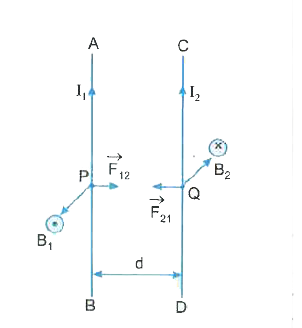 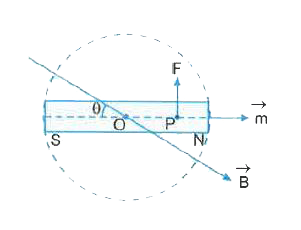
|
|