

Saved Bookmarks
| 1. |
A disc of mass m is moving with constant speed v_(0) on a smooth horizontal table. Another disc of mass M is placed on the table at rest as shown in the figure. If the collision is elastic, find the velocity of the disc after collision. Both disc lie on the same horizontal plane of the table. |
Answer» Solution :`sin THETA = (d)/(r+R)`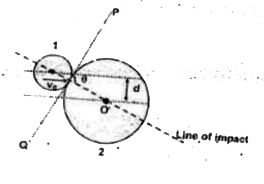 For mass m : Momentum before impact 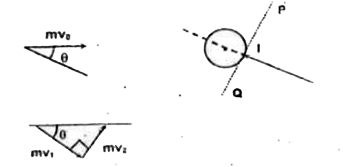 Momentum after impact 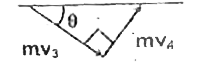 For mass M : Momentum before impact = 0 Momentum after impact 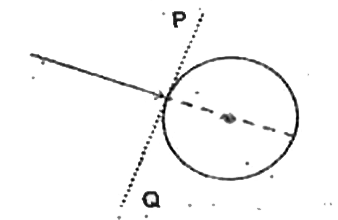 Net impulse on the system = 0 Momentum of the system is conserved. `mv_(0) COS theta + 0=mv_(1)+Mv_(3)` ....(i) `mv_(0)sin theta + 0 = mv_(2)+Mv_(4)` ....(ii) INDIVIDUALLY for mass m and M, the impulse along the tangent = 0 `therefore` For mass `m, mv_(0) sin theta = mv_(2)`....(iii) For mass M,`0 = Mv_(4)` .... (iv) As the collision is elastic `E=-(v_(3)-v_(1))/(0-v_(0)cos theta)=1`. `v_(3)-v_(1)=v_(0)cos theta` ....(v) SOLVING equations (i) through (v) `v_(2)=v_(0)sin theta,"" v_(4)=0` `v_(3)=(2mv_(0)cos theta)/(m+M), v_(1)=((m-M)/(m+M))v_(0)cos theta` It can be verified that, `(1)/(2)mv_(0)^(2)=(1)/(2)m(v_(1)^(2)+v_(2)^(2))+(1)/(2)M(v_(3)^(2)+v_(4)^(2))` `rArr`The kinetic energy is conserved in an elastic impact. Special case : If m =M `v_(1)=0, v_(0) sin theta` `v_(3)=v_(0)cos theta, v_(4)=0`. Note : The impulse along the common tangent during an impact may not be always negligible. For example, when normal reaction is impulsive and the effect of friction is to tbe considered. |
|