

Saved Bookmarks
| 1. |
(a) Draw a diagram showing the Young's arrangement for producing 'a sustained interference pattern. Hence obtain the expressionforthe width of the interference fringes obtainet in this patten. |
Answer» Solution :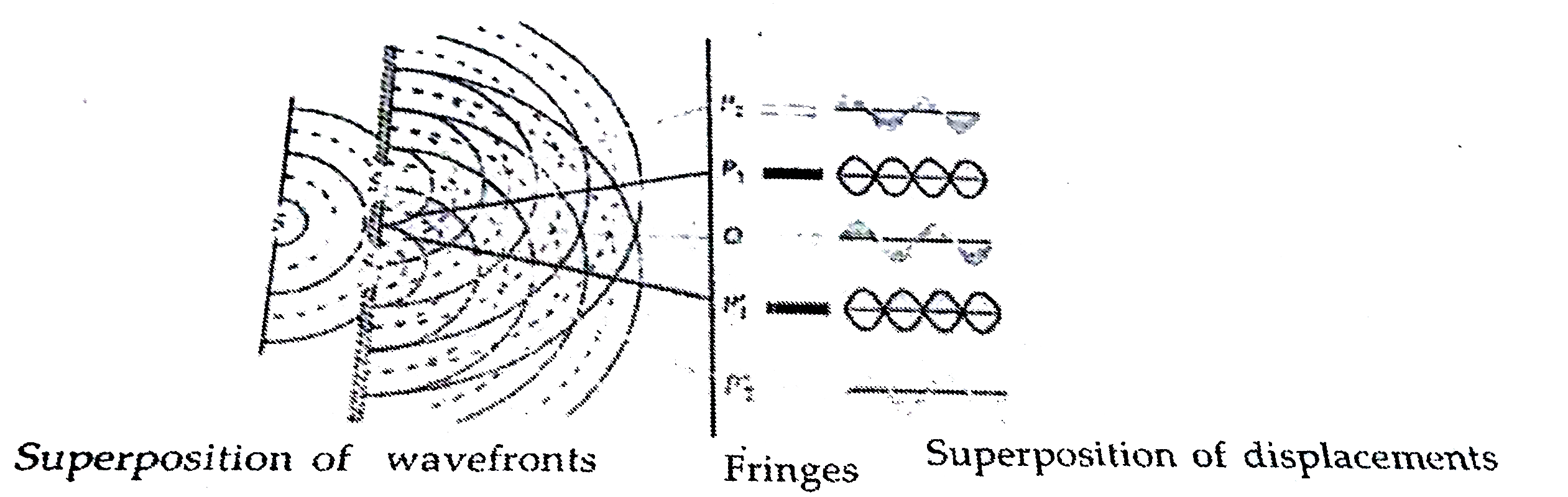 Consider a point P onthe screen at distance x from the centre O. The nature of the interference at the point P depends onpath difference. `p=S_(2)P-S_(1)P` From right-angled `DeltaS_(2)BPandDeltaS_(1)AP`, `S_(2)P^(2)-S_(1)P^(2)=[S_(2)B^(2)+PB^(2)]-[S_(1)A^(2)+PA^(2)]` `=[D^(2)+(x+(d)/(2))^(2)]-[D^(2)+(x-(d)/(2))^(2)]` or `(S_(2)P-S_(1)P)(S_(2)P+S_(1)P)=2xd` or, `S_(2)P-S_(1)P=(2xd)/(S_(2)P+S_(1)P)` In practice, the point P lies very close to O, THEREFORE `S_(1)P=S_(2)P=D`. Hence, `p=S_(2)P-S_(1)P=(2xd)/(2D)` or, `p=(xd)/(D)` For constructive interference, `p=(xd)/(D)=nlamda` or, `x=(nDlamda)/(d)"""where "n=0,1,2,3......` Clearly, the positions of various bright fringes are as follows : For, n=0, `x_(0)=0 ""Central bright fringe For, `n=1,x_(1)=(Dlamda)/(d)` ""First bright fringe `n=2,x_(2)=(2Dlamda)/(d)` ""Second bright fringe For, `n=n,x_(n)=(nDlamda)/(d)" nth bright fringe"` `p=(xd)/(D)=(2n-1)(LAMDA)/(2)` or, `x=(2n-1)(Dlamda)/(2d)` where n=1,2,3..... Clearly, the positions of various dark fringes are as follows: For, `n=1,x_(1)=(1)/(2)(Dlamda)/(d)"""First dark fringe"` For, `n=2,x_(2)=(3)/(2)(Dlamda)/(d)"""Second dark fringe"` For, `n=n,x_(n)=(2n-1)(Dlamda)/(2d)" nth dark fringe"`. Since, the central point O is equidistant from `S_(1)andS_(2)`, the path difference. P for it is ZERO. There will be a bright fringe at the centre O. But as we move from O upwards or downwards, alternate dark and bright fringes are formed. Fringe width : It is the separation between two successive bright or dard fringes,. Width of a dark fringe= Separation between two consecutive bright fringes `=x_(n)-x_(n-1)=(nDlamda)/(d)-((n-1)Dlamda)/(d)=(Dlamda)/(d)` Width of a bright fringe = Separation between two consecutive dark fringes `=x_(1)-x_(n-1)` `=(2n-1)(Dlamda)/(2d)-[2(n-1)-1](Dlamda)/(2d)=(Dlamda)/(d)`. Clearly, both the bright and dark fringes are of equal width. Hence, the expression for the fringe width in YOUNG's double slit experiment can be written as `beta=(Dlamda)/(d)`. |
|