

Saved Bookmarks
| 1. |
(a) Draw the circuit arrangement for studying the input and output characteristics of an n-p-n transistor in CE configuration . With the help of these characteristics define (i) input resistance , (ii) current amplification factor . (b) Describe briefly with the help of a circuit diagram how an n-p-n transistoris used to produce self-sustained oscillations . |
|
Answer» Solution :(a) Common emitter (CE) transistor characteristic : The transistor is most widely USED in the CE configuration . When a transistor is used in CE configuration , the input is between the base and emitter and the output is between the collector and emitter . The input and output characteristics of an n-p-n transistor in CE configuration can be studied by using the given circuit . 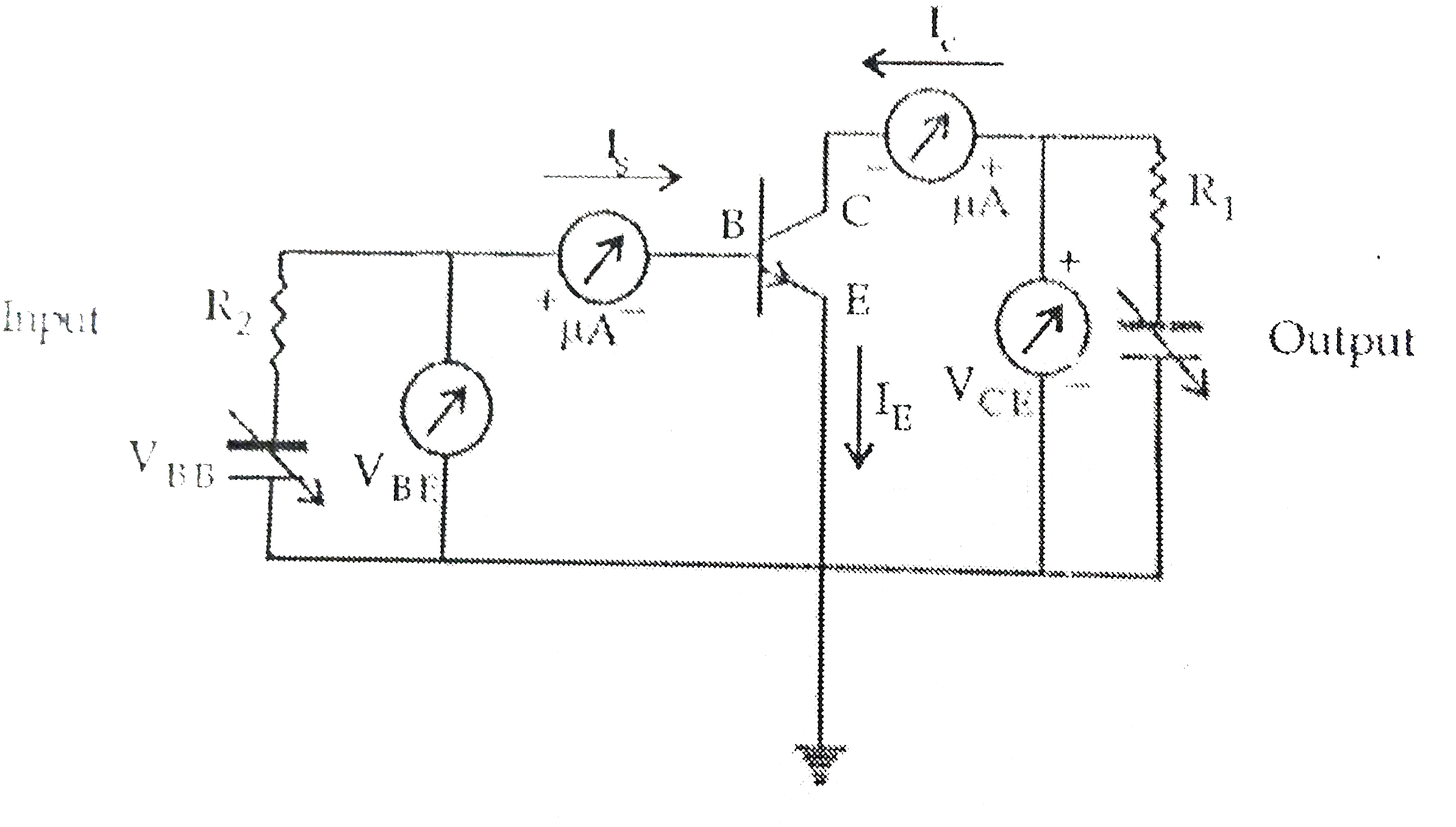 (i) Input characteristics : The variation of the base current `I_(B)` with the base emitter voltage `V_(BE)` is called the input characteristics keeping `V_(CE)` fixed . A CURVE is plotted between the base current `I_(B)` against the base emitter voltage `V_(CE)` is kept fixed . Since `V_(CE) = V_(CB) + V_(BE)` and for Silicon (Si) transistor `V_(BE)` is 0.6 to 0.7 `V , V_(CE)` must be larger than 0.7 V . The input characteristics of a transistor is shown in FIG. (a) . (ii) Output characteristics : The variations of the collector current `I_(C)` with the collector emitter voltage `V_(CE)` , keeping the base current`I_(B)` constant is called output characteristics . The plot of `I_(C)` versus `V_(CE)` for different fixed values of `I_(B)` gives one output characteristic . The different output characteristics for different values of `I_(B)` is shown in ltbegt 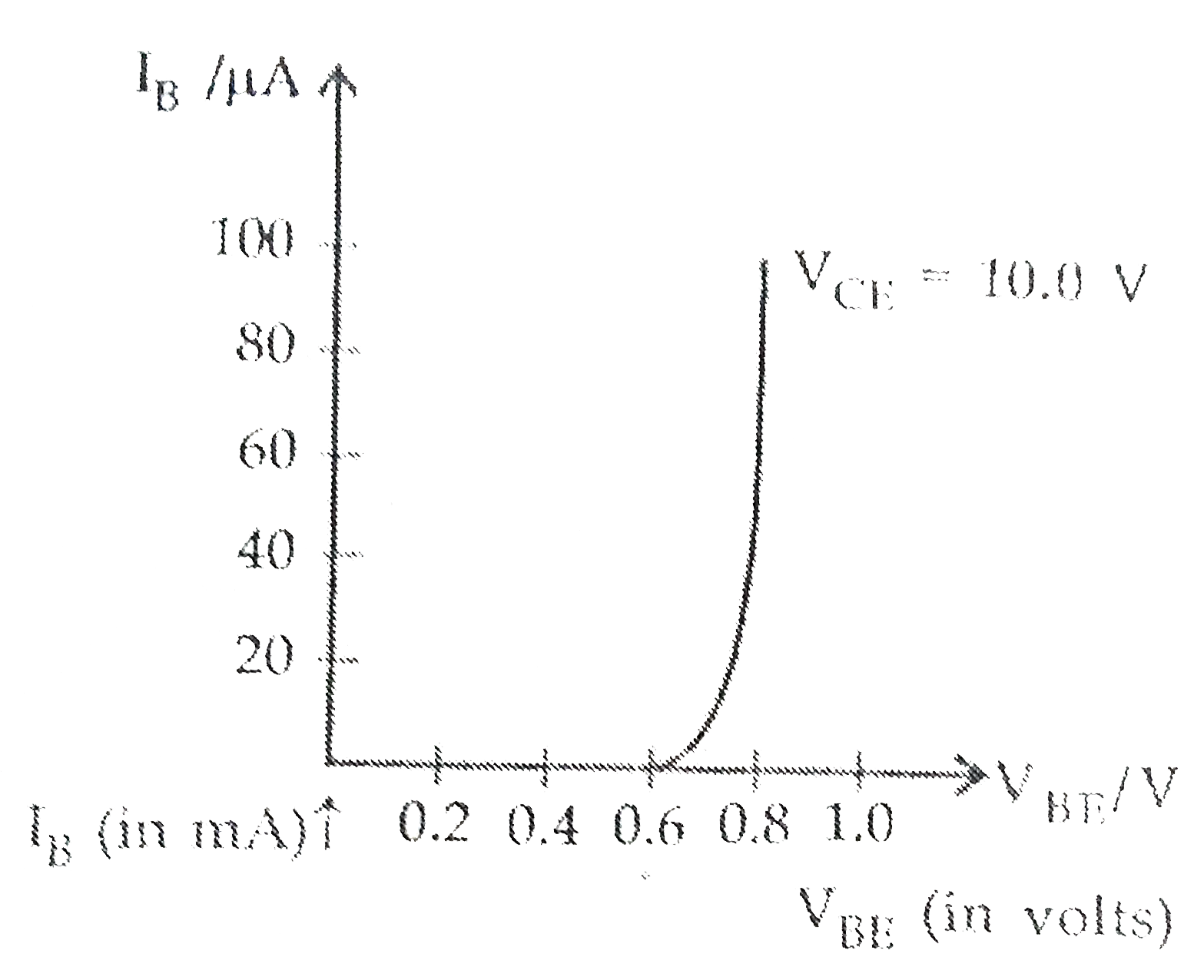 (iii) Input Resistance : This is defined as the ratio of the change in collector-emitter voltage `(DeltaV_(CE))` to the resulting change in base current `(Delta I_(B))` at constant collector-emitter voltage `(V_(CE))`. `therefore "" r_(i) = ((DeltaV_(BE))/(DeltaI_(B)))_(V_(CE))` (iv) Output Resistance : This is defined as the ratio of the change in base-emitter voltage `(Delta_(VE))` to the change in collector current `(DeltaI_(C))` at constant base current `I_(B)`. `therefore "" r_(0) = ((DeltaV_(CE))/(DeltaI_(C)))_(I_(B))` (v) Current Amplification Factor `(beta)`: This is defined as the ratio of the change in collector current `(DeltaI_(C))` to change in base current `(Delta I_(B))` at constant `V_(CB)`. `beta_(ac) = ((DeltaI_(C))/(DeltaI_(B)))_(V_(CE))` This is also known as current gain . |
|