

Saved Bookmarks
| 1. |
(a) Draw the ray diagram showing refraction of ray of light through a glass prism. Derive the expression for the refractive index n of the material of prism in terms of the angle A ray angle of minimum deviation delta_m (b) A ray of light PQ enters an isosceles right angles prism ABC of refractive index 1.5 as shown in figure . (i) Trace the path of the ray through the prism . (ii) What will be the effect on the path of the ray if refractive index of the prism is 1.4 ? |
|
Answer» Solution :(a) Refraction of light rays through a prism has been shown below . Here `anglei` is the incidence angle at first surface of prism and `anglee` is the angle of emergence from the second surface `angler_1 and angler_2` are the RESPECTIVE refraction angles at the two faces and `angledelta` is the angle of deviation. Now in `DeltaQMR, "" angler_1 + angler_2 + angleM=180^@ ""...(i)` and in quadrilateral AQMR, `"" angleA+90^@ + angleM +90^@=360^@` or `angleA + angleM = 180^@ ""...(ii) ` 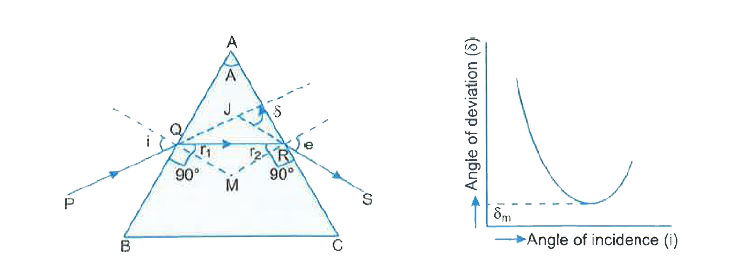 Comparing (i) and e(ii), we get `angler_(1) + angler_(2) = angleA ""...(III)` Now in `DeltaJQR angledelta=angleJQR+ angleJRQ` `=(anglei-angler_1)(anglee-angler_2)=angler+anglee-(angler_(1)+angler_(2))=anglei+anglee-angleA` `implies anglei+ anglee=angleA+angledelta""....(iv)` A graph showing variation in angle of deviation `(delta)` withvariation in angle of incidence (i)is also shown below . As minimum deviation position CORRESPONDS to only one angle of incidence, it means that for minimum deviation position `anglei=anglee` and also `angler_(1) = angler_(2) =r` (say) . So in minimum deviation position , we have `:. angleA=angler_(1) +angler_(2)=angler+angler=2angler " or "angler=(A/2)` and `angleA+angledelta_(m)=anglei+anglee=anglei+anglei=2anglei"or " anglei=((A+delta_m)/2)` `:.` Refractive of prism `n=(sini)/(sinr)=(SIN((A+delta_m)/2))/(sin(A/2))` (b) (i) Complete path of the ray through the prism has been traced. Since critical angle of prism is `i_(c) = sin^(-1)(1/(1.5))=42^@` , the light ray undergoes total internal REFLECTION two times as shown . 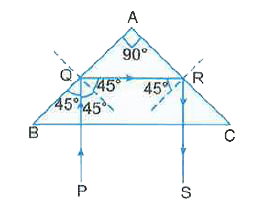 (ii) If refractive index of prism is n = 1.4 , then critical angle `i_(c)=sin^(-1)(1/(1.4)) = 45.6^@`. In that case the light ray will be refracted into air at point Q and deviates away from the normal as shown below . 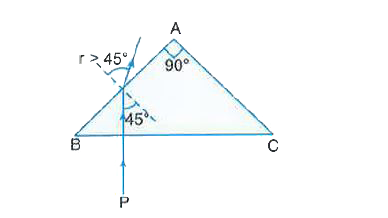
|
|