

Saved Bookmarks
| 1. |
(a) Drawa ray diagram to show the image formation by a combination of two thin convex lenses in contact . Obtain the expression for the power of this combination in terms of thefocal lengths of the lenses. (b)A ray of light passing from air through an equilateral glass prism undergoes minimum deviation when the angle of incidenceis (3)/(4)^(th) of the angle of prism . Calculate the speed ofltbRgt light in the prism. |
|
Answer» Solution :(a)Consider lenes A and B with focal length `f_(1) and f_(2)` placed in contact . Object is placed atO beyond focus of A . FIRST lens produces image at I, (its real) and SERVE as virtual object for lens B producing image I. As the lenses are lenses are thin , so optc centres of lenses are closer to each other . Let this centre point be denoted by P. Image formation by A `(1)/(v_(1)) - (1)/(u) = (1) /(f_(1)) ` and...(i) Image formation by B `(1)/(v) - (1)/(v_(1)) = (1)/(f_(2)) ` ...(ii) Adding(i) and (ii) we get , ` (1)/(v) - (1)/(u) = (1)/(f_(1)) + (1)/(f_(2))` ...(iii) 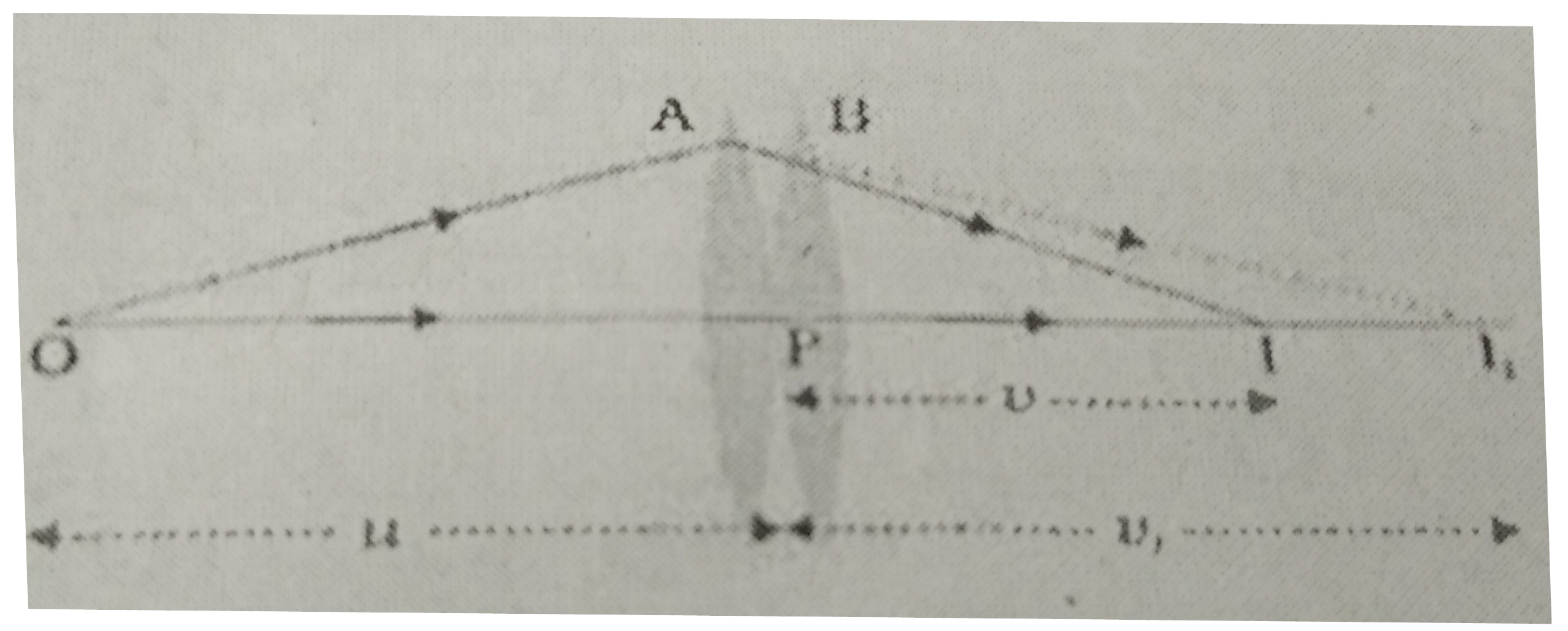 If two lenses system is taken as one lens equivalent system then, eq . (iii) can be ` (1)/(v)- (1)/(u) = (1)/(f)` where, ` (1)/(f) = (1) /(f_(1)) + (1)/(f_(2))`. Then is valid for any number of lens`f_(1) , f_(2) , f_(3)`... are the focal lengths of lenses in contact `(1)/(f) = (1)/(f_(1) ) + (1)/(f_(2)) + (1)/(f_(3)) +.....u` ` P = P _(1) + P_(2) + P _(3) + ...` (b)Given, ` i = (3)/(4) A` Also,`mu = ("SIN" [(A+ delta m)/(2)])/("sin" (A)/(2)) or, delta _(m) to `Angle of MIN . deviation . or`(C_(1))/(C_(2))= ("sin" [(A+ delta m)/(2)])/("sin" (A)/(2)) or, delta _(m) = 2i - A = 2xx (3A)/(4) - A = (A)/(2)` `delta _(m) = (60^(@))/(2) = 30^(@)` `C_(2) = (3xx10^(8))/(sqrt(2)) ms^(-1) = 1.5 sqrt(2)ms^(-1) xx10^(8)` `rArrC_(2)2.12 xx10^(8)` ms^(-1)`. |
|