

Saved Bookmarks
| 1. |
(a) Find the equivalent capacitance of the combination between Aand B in the figure If the points A and B are maintained at 15 V and 0 V respectively then (b) Find the charges on 3mu F, 4 mu F "and " 5 muFcapacitors (c ) What are the potentials of the points C and D ? |
|
Answer» Solution :The simplified form of the GIVEN combination has been SHOWN in the figure (b ) Here `(C_(1))/(C_(2))= (2muF)/(4mu F) = (1)/(2)` `(C_(3))/(C_(4))=(3muF)/(6 muF) =(1)/(2)` 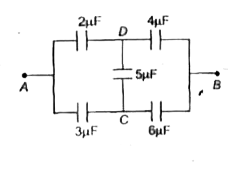 Thus `(C_(1))/(C_(2))=(C_(3))/(C_(4))` Hence (a) `C_(eq)= (C_(1)C_(2))/(C_(1)+C_(2))+(C_(3)C_(4))/(C_(3)+C_(4))` `=((2xx4)/(2+4)+(3xx6)/(3+6))muF=((4)/(3)+2)muF=(10)/(3)muF` (b ) `V_(A)-V_(B)= 15 V ` `:.` The charge on `(4)/(3)muF` capacitor is `q_(1)=((4)/(3)muF)(15V) = 20 muC ` 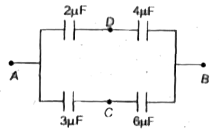 Hence the charge on `4muF` capacitor in figure ( c) is ALSO `q_(1) = 20 muC ` The charge on 2`muF` capacitor in figure (d) is `q_(2) = (2muF) (15 V) =30 muC` So the charge on the `3mu F` capacitor in figure ( c) is also `q_(2) = 30 muC` The charge on `5 muF ` capacitor is zero . Hence our answer are `30mu C ` on `3 MU F` capacitor `20 mu C` on 4 `muF` capacitor and zero on `5muF` capacitor . (c ) The potential difference across `3mu F ` capacitor of figure ( c) is 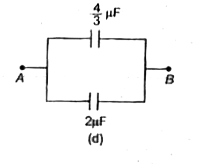 `V_(A)-V_(C) =(30muC)/(3 muF) = 10 V` or `15 V- V_(C) = 10 V ` `IMPLIES V_(C) = 5 V` |
|