

Saved Bookmarks
| 1. |
A glass sphere of radius 2R, refractive index n has a spherical cavity of radius R, concentric with it. A black spot on the inner surface of the hollow sphere is viewed from the left as well as right. Obtain the shift in position of the object. |
|
Answer» Solution :a. Viewer on the left of hollow sphere: Single refraction takes place at surface S. From the single surface refraction equation, we have `mu_(2)=1, mu_(1)=n, u=-R, and R=-2R` `(1)/(V)-(n)/((-R))=((1-n))/((-2R))` which on solving for v yields, `v=-((2R)/(n+1))` Image is on the right of refracting surface S. Shift= Real depth-Apparent depth `R-((2R)/(n+1))=((n-1))/((n+1))R` b. When the viewer is on the right, two rerfractions take place at surfaces `S_(1)` and `S_(2)`. `mu_(2)=n, mu_(1)=1, u=-2R, and R=-R` For refraction at surface `S_(1): (n)/(v_(1))-(1)/((-2R))=((n-1))/((-R))` which on solving for `v_(1)=-(2nR)/(2n-1)` . The first lies to the left of `S_(1) ` and acts as OBJECT for refraction at the second surface. We have to shift the origin of CARTESIAN COORDINATE system to the vertex of `S_(2)`. The object distance for the second surface is `u_(2)=-[(2nr)/(2n-1)+R]=-((4n-1)/(2n-1))R` Here `mu_(2)=1, mu_(1)=n, R=-2R` `rArr (1)/(v_(2))-(n)/(-[(4n-1)/(2n-1)]R)=(1-n)/(-2R)` On solving for `v_(2)` , we get `v_(2)`=`-(2(4n-1))/((3n-1))R` The minus sign shows that image is virtual and lies to the leftof `S_(2)` . Shift= Real depth-Apparent depth `=3R-(2(4n-1)R)/((3n-1))` `=((n-1))/((3n-1))R` 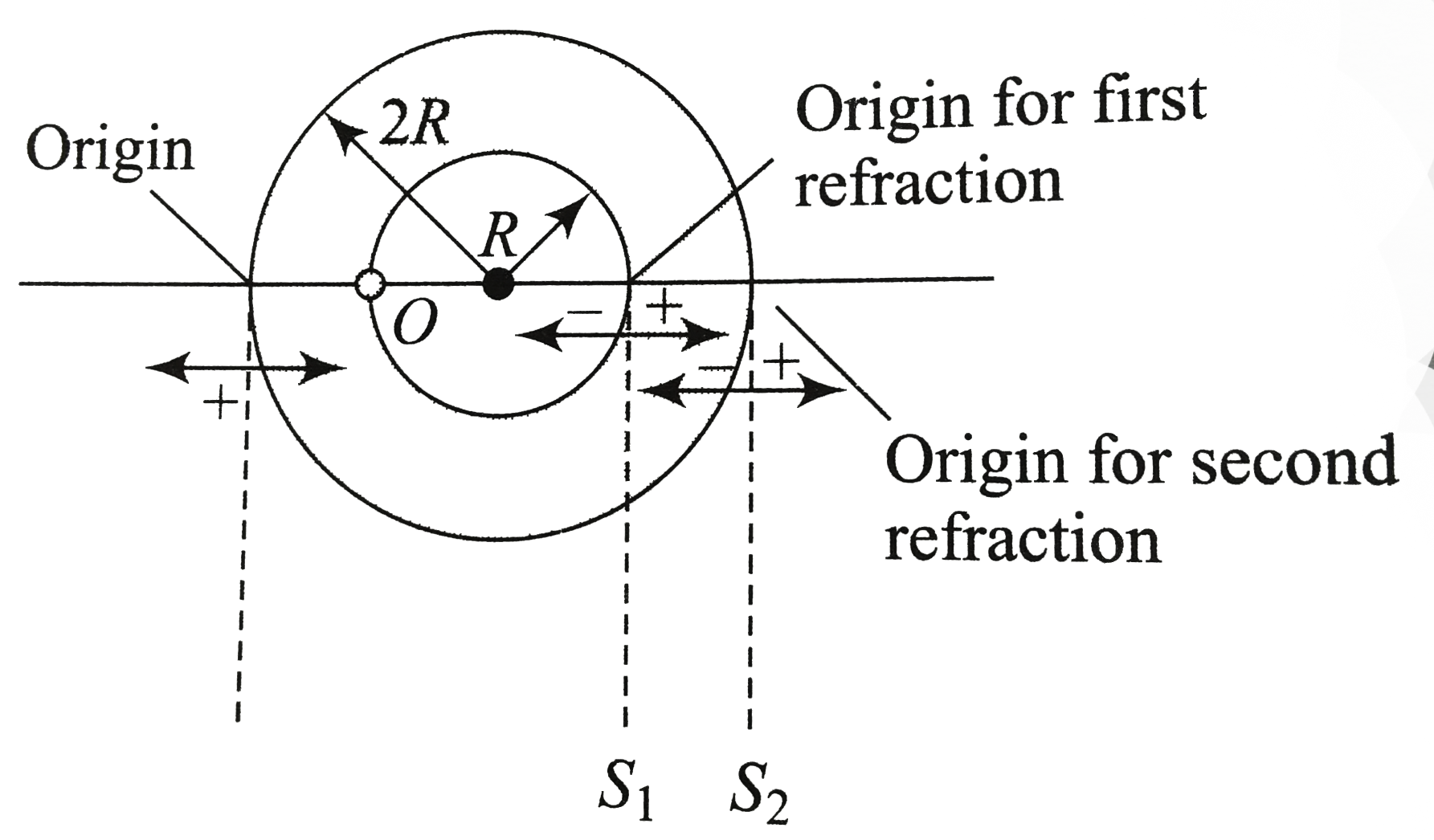
|
|