

Saved Bookmarks
| 1. |
A head maze is a maze formed by tall rows of hedge. After entering, you search for the center point and then for the exit. Shows the entrance to such a maze and the first two choice we make at the junctions we encounter in moving from point I to point c. We undergo three displacements as indicated in the overhead view of d _(1) = 6. 00 m theta _(1) = 40^(@) d _(2) = 8. 00 m theta _(2) =30^(@) d _(3) = 5. 00 m theta_(3) = 0^(@). where the last segment is parallel to the superimposed x axis. When we reach point c, what are the magnitude and angle of our net displacement vecd _(net) from point i? |
|
Answer» Solution :To evaluate we find the x and y components of each disp[lacement .Asan example, the components for the first displacement are shown We draw similar diagrams for the outer two displacements and then we apply the x part of to each displacement, using angle relative to the positive direction of the x axis ` d _(1x ) = (6.00m) cos 40^(@)=4.60m` ` d _(2x) = (8.00m) cos (-60^(@)) =4.00m` ` d_(3x) = (5.00m) cos 0^(@) =5.00m.` Equation then gives us `d _(n etx) = + 4.60m+ 4.00 m + 5.00 m` `13.60m`. Similarly, to evaluate we apply the y part of each displacement: `d _(1y) = (6.00m) SIN 40^(@)=3.86m` `d _(2Y) = (8.00 m) sin (-60^(@)) =-693m` `d _(3y) = (5.00m) sin 0^(@) =0m.` Equation then gives us `d _(nety ) =+ 3.86 m - 6.93 m + 0 m` `=- 3.07m.` Next we use these components of `vecd _(net)` to construct the vector as shown in the components are in a head-to-tail arrangement and form the legs of a right triangle, the vector forms the hypotenuse, We find the magnitude and angle of `vecd _(net)` with The magnitude is ` d _(n et)= sqrt ( d _(n etx) ^(2)+ d _(n ety) ^(2))` `= sqrt ((13.60 m)^(2)) + (3.07m) ^(2) = 13.9m.` To find the angle ( measured from the positive direction of x), we take an inverse tangent: `theta = tan ^(-1) ((d _(n ety ))/( d _(n et.y)))` `= tan ^(-1) ((-3.07m)/( 13.60))=-12.7 ^(@).` The angle is NEGATIVE because it is measured clockwise from positive x. We must always be alert when we take an inverse tangent on a calculator. The answer it displays is mathematically correct but it may not be the correct answer for the physical situation. In those cases, we have to add `180^@` to the displayed answer, to reverse the vector. To check, we always need to draw the vector and its components as we did in Fig. 3-16d. In our physical situation, the figure shows us that `theta= -12.7^@` is a reasonable answer, whereas -`12.7^@ + 180^@ = 167^@` is clearly not. We can see all this on the graph of tangent VERSUS angle in Fig. 3-12c. In our maze problem, the argument of the inverse tangent is -3.07/13.60, or -0.226. On the graph draw a horizontal line through that value on the vertical axis. The line cuts through the darker plotted branch at -12.7o and also through the lighter branch at `167^@` 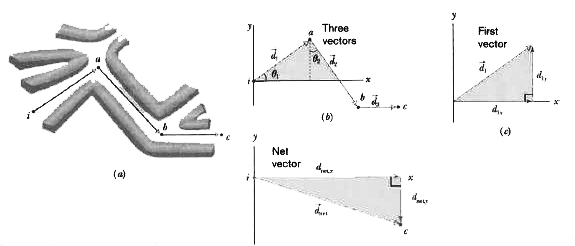 Figure (a) Three displacemnts through a hedge maze. (b) The displacement vectors. (c) The first DISPLACEMET vector and its components (d) The net displacement vectorand its components . |
|