

Saved Bookmarks
| 1. |
A hollow conducting sphere of inner radius r_1 and outer radius r_2 has a charge Q on its surface. A point charge - q is also placed at the centre of the sphere . (a) What is the surface charge density on the (i) inner and (ii) outer surface of the sphere ? (b) Use Gauss' law of electrostatics to obtain the expression for the electric field at a point lying outside the sphere. |
|
Answer» Solution :Let us have a hollow CONDUCTING sphere of inner radius `.r_1.` and outer radius `.r._2` having a charge Q on its outer surface and let a point charge - q is also place at the centre point O of the sphere . (a) (i) Surface charge density on inner surface of the sphere. `sigma_("inner")=(+q)/(4pir_1^2)"".....(i)` (ii) Surface charge density on outer surface of the sphere `sigma_(outer)=((Q-q))/(4pir_2^2)""...(ii)` (b) To obtain the expression for the electric field `vecE` at a point P situated at a DISTANCE r from centre . O of the sphere (where `r gt r_2`) let us consider a GAUSSIAN sphere of radiusa as shown here. Obviously `vecE and vec(DeltaA)` are insame direction and so TOTAL electric flux over the entire Gaussian surface. `phi_(E)=sumvecE.vec(DeltaA)=sumEDeltaA=EsumDeltaA`[Since E is having same magnitude at all points of the sphere] `impliesphi_E=E(4pir^2)""....(iii) ` As PER Gauss law, `phi_(E)=1/(in_0)(sumq_("enclosed"))=1/in_0[-q+q+(Q-q)]=(Q-q)/(in_0)""...(iv)` Comparing (iii) and (iv) , we get `E4pir^2=(Q-q)/in_0` `impliesE=((Q-q))/(4piin_0r^2)" or " vecE=((Q-q))/(4piin_0r^2)hatr` 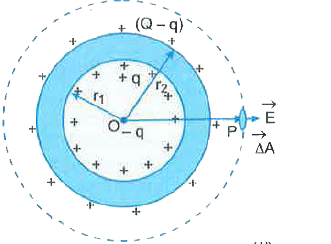
|
|