

Saved Bookmarks
| 1. |
(a) (i) CalculatepHof 10^(-7) M HCI, (ii)Definecorrosion .Giveoneexample. (b)What isadsorptionisotherm Explain aboutFreundlichadsorptionisotherm. |
|
Answer» Solution :(i) If wedo notconsider `[H_(3)O^(+)]` from theionisationof `H_(2)O` then`[H_(3) O^(+)]=[HCI]` i.e., pH=7 whichis a pHof a neutralsolution.Weknowthat HCIsolutionis acidicthiscasethe concentrationof the acidis verylow `(10^(-7) M)`. Hencethe `H_(3) O^(+)(10^(-7 M)` So in thiscasewe shouldionisation of watercannot be neglected. (ii) Theredoxprocesswhichcausesthe deteriorationof metalis calledcorrosionRustingof ironis anexampleof corrosion.It isan electrochemicalprocess. (b)i.Adsorptionisothermsrepresentthe variationof adsorptionat constanttemperatureadsorptionisothemcan bestudiedquatitatively (ii) A plotbetweenthe amountof adsorbate adn pressureor concentration of . (iii)Freundichadsorptionisotem. (IV) thisequationisapplicationfor adsorptionof gaseson solidsurfaces.TheSameequationbecomes `(x)/(m)=ke^(1//n)` whenusedforadsorptionin solutionwith Cas concentration (v )theseequationquantitivelypredictthe effectof pressure(orconcentration ) on theadsorptionof gasesat constanttemperature. (vi)Takinglogon bothsidesof equation `(x)/(m) =kP^(1//n)` `log(x )/(m)= log k+ (1)/(n )log P` 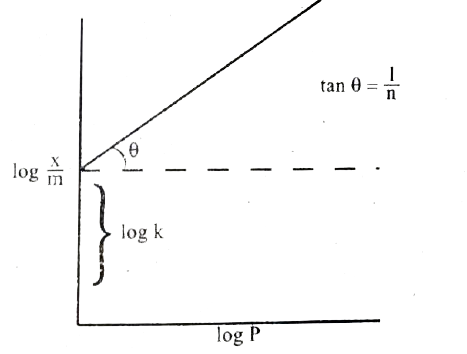 (VII) Hencetheinterceptrepresentsthe valueof logk andthe slope `(b)/(q)` gives `(1)/(n)` (vii)thisequationexplainthe increasesof `(x)/(m)` withincreasin pressure.Butexperimentalvaluesshowsthe deviationat lowpressure . `(IX) LIMITATIONS (a)Thisequationis purelyempiricalovera limitedpressurerange |
|