

Saved Bookmarks
| 1. |
A long conductor of circular cross section with radius R has current density J(r )=rho_(0)(r^(2))/(R^(2)) (for R//2 le r le R) =0 (for r lt R//2) into the plane of paper There is a point P at distance a from axis of conductor [a gt R]. Two infintely long thin conducting wires carrying current I_(0) in the same direction is placed at distance a, from O perpendicular to OP and parallel to conductor at either sides such that magnetic field at P is zero. Find current I_(0) in wires and direction of current as compared with direction of current in the conductor. (Given rho_(0)R^(2)=64//5pi) |
|
Answer» Solution :Current through conductor `I=int_(0)^(R )2pirdrJ(r )` `=int_(0)^(R//2)2pirJ(r )dr+int_(R//2)^(R )2pirJ(r )dr` `= int_(0)^(R//2)2pir*0*dr+int_(R//2)^(R )2pirp_(0)(r^(2))/(R^(2))dr` `=0+(2pip_(0))/(R^(2))int_(R//2)^(R )r^(3)dr` `=0+(2pip_(0))/(R^(2))[(r^(4))/(4)]_(R//2)^(R )=(2pip_(0))/(R^(2)4)(R^(4)-(R^(4))/(16))` `=(15pi)/(32)p_(0)R^(2)`. 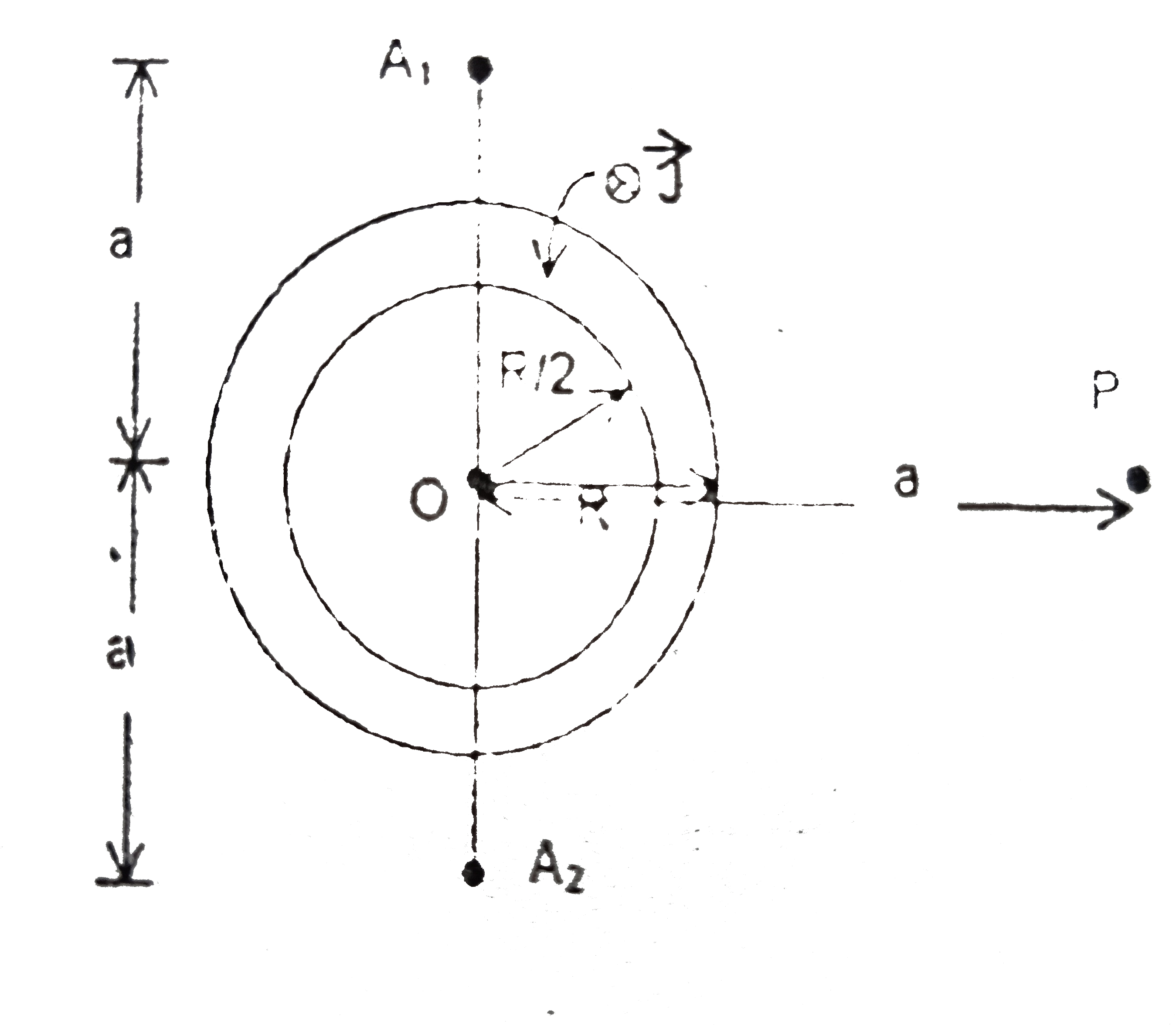 Let us CONSIDER a circle with enter `O` and radius `OP` in line `bot` to conductor, for all point on the circle due to symmetry `B` is same due to condctor. Applying Amperes law `int_(0)^(2pia)B*dl=mu_(0)I` [current inclosed] `rArr B*2pia=mu_(0)(15)/(32)pi p_(0)R^(2)` `rArr B=(15)/(64)(mu_(0)p_(0)R^(2))/(a)` As current is in to the plane `B` is downward at `P`. Now field due to wire `A_(1)` and `A_(2)` MUST cancel `B`. That is possible when current in the wires is out of the plane. Field due to `A_(1)|vecB_(1)|=(mu_(0))/(4pi)(2I)/(asqrt(2))` Due to `A_(2)|vecB_(2)|=(mu_(0))/(4pi)(2I)/(asqrt(2))` Resultant of `B_(1)` and `B_(2)` `VECB'=vecB_(1)+vecB_(2)=2(mu_(0))/(4pi)(2I_(0))/(asqrt(2))*(1)/(sqrt(2))=(2mu_(0)I_(0))/(4pia)` opposite to `vecB` Net field at `P` `vecB+vecB'=0` `=(mu_(0))/(4pi)(2I_(0))/(a)-(15)/(64)mu_(0)(p_(0)R^(2))/(a)=0` `I_(0)=(15pip_(0)R^(2))/(32)` 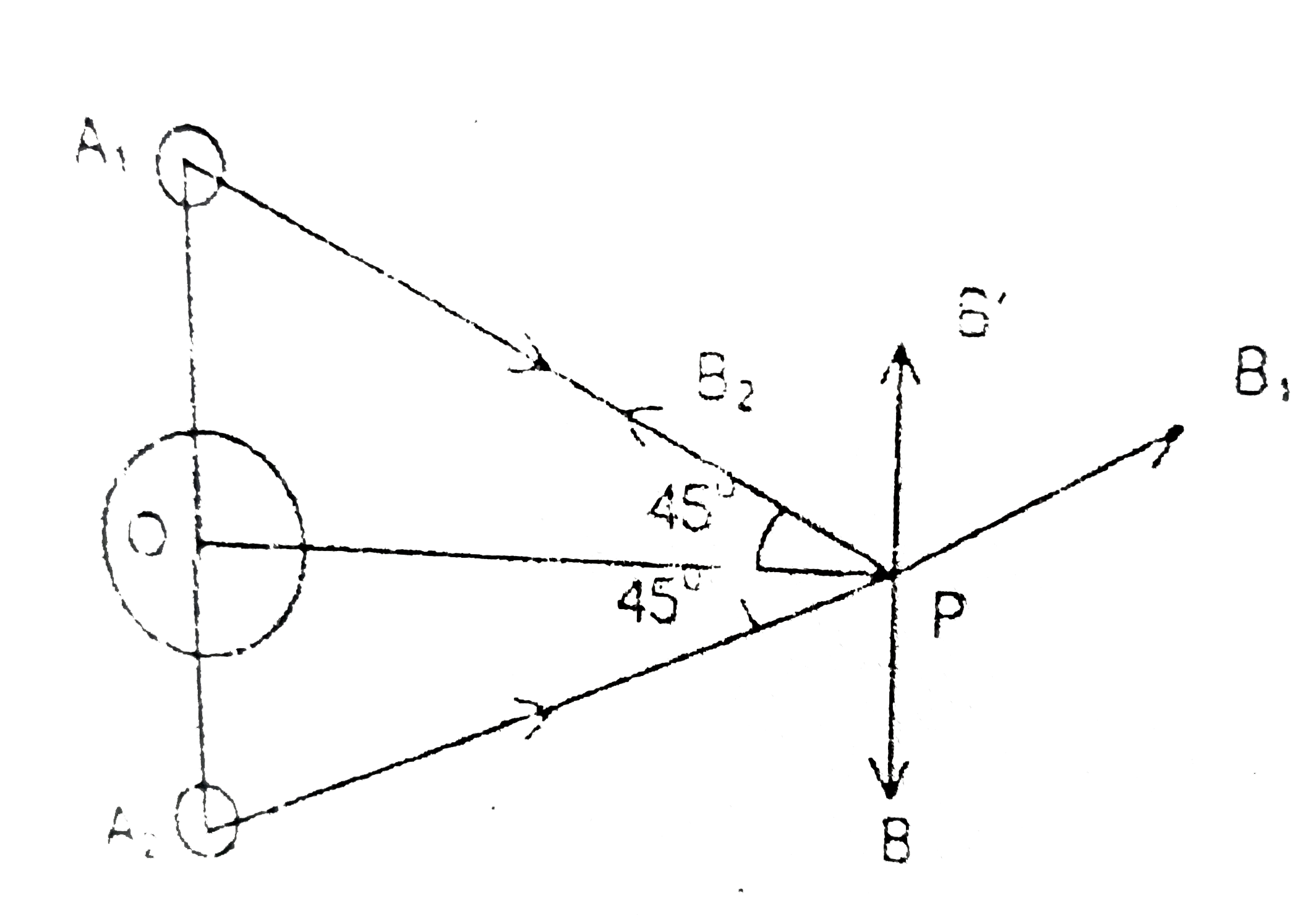
|
|