

Saved Bookmarks
| 1. |
A long straight wire of a curcular cross-section of radius 'a' carries a steady current 'l'. The current is uniformly distributed the across- section . Apply Amphere's circuital law to calculate the magnetic field at a point 'r' in the region for (i) r lt a and (ii) r gt a. |
|
Answer» Solution :Consider an infinite long thick wire of radius 'a' with axis XY. Let I be the current flowing through the wire. A mangnetic field is set up due to current through the cylinder in the FORM of circular magnetic lines of force,with their centres lying on the axis of the cylinder. (i) When the pointP lines OUTSIDE the wire : Let r be the perpendicular distance of point P form the axis of the cylinder, where `r gt a` .Let `vecB` be the magnetic field induction at P. Here `vecB and vecdl` are acting in the same direction. Applying Amphere's Circuital Law, we have, `ointvecB.vecdl=mu_0I` `oint Bdl cos 0^@=mu_0I` `B.2pir.1=mu_0I rArr B=(mu_0I)/(2pir)rArr Balpha(1)/(r)` (II) When the point P lies INSIDE the wire. Here `r le a`. We have two possibilities : (a) If the current is only along the surface of the wire, then the current through the closed path L is Zero. Using Amphre Circuital Law, we have `B=0` (b) If the current is uniformaly distributed throughout the cross-section of the conductor. THen, the current through closed path L is given by ` I'=(I)/(pia^2).pir^2=(Ir^2)/(a^2)` Applying Amphere's Circuital Law, we have, `oint vecB.vecdI=mu_0 mu _r I`' ` 2pir B=mu_0mu_r I '=mu_0mu_r (Ir^2)/(a^2)` ` rArr B=(mu_0mu_r Ir)/(2pia^2)` `therefore B alpha r`. 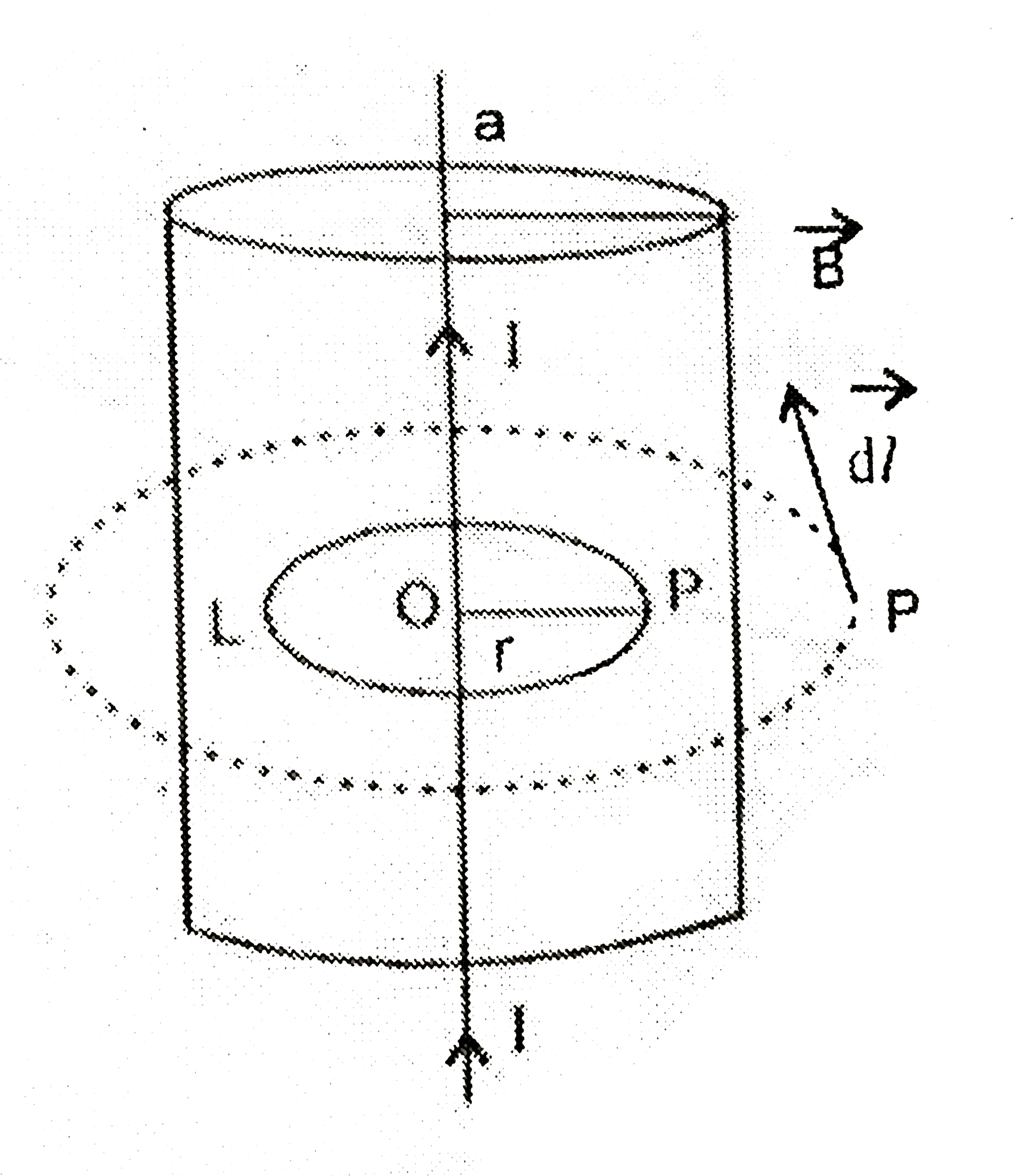
|
|