

Saved Bookmarks
| 1. |
A man of mass m climbs a rope of I length L suspended below a balloon of mass M. The balloon is stationary with respect to ground (a) if the man begins to climb up the rope at a speed vnl (relative to rope) in what direction and with what speed (relative to ground) will the balloon move ? (b) How much has the balloon descended when the man reached the balloon by climbing the rope ? |
|
Answer» Solution :(a) Given that initially the system is at rest, so initial momentum of the system is zero. In the claiming of the ROPE there is no external force. Therefore final momentum of the system should also be zero. 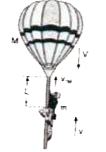 `mvecv + MvecV =0` [as (m+n) = finite] i.e., `MvecV =-mvecv`.....(1) Furthermore here it is given that `vecv_(m) = vecv - vecV`.....(2) Substituting the value ofy from Eqn. (20 in (1) we get `MvecV =-m(vecv_(m) + vecV)` or `vecV =-(mvecv_(rel))/(m+M)`.... (3) This is the desired RESULT and from this it is clear that the direction of MOTION of balloon is opposite to that of CLIMBING `(vecv_("rel"))` vertically down. |
|