

Saved Bookmarks
| 1. |
A metallic rod of 1 m length is rotated with a frequency of 50 rev/s, with one end hinged at the centre and the other end at the circumference of a circular metallic ring of radius 1 m, about an axis passing through the centre and perpendicular to the plane of the ring as per figure. A constant and uniform magnetic field of 1T parallel to the axis is present everywhere. What is the emf between the centre and the metallic ring ? |
Answer» Solution :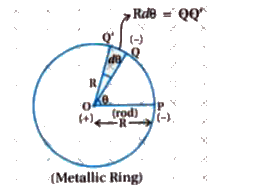 Consider uniform magnetic field `vecB(x)`, perpendicularly inside the plane of figure. Also consider a metallic ring of radius R whose plane is perpendicular to `vecB`. There is a conducting rod (OQ) of length R, with its one end hinged at O (centre of ring) and another end in contact with the ring. SUPPOSE, this rod ROTATES anticlockwise with constant angular speed `omega` . Because of this motion of rod, free ELECTRONS in it acquire velocity `vecv bot vecB`and hence they are exerted upon by magnetic force `vecF_m=e (vecBxxvecv)` in a direction from centre to outer end. Hence, free electrons in the rod start displacing away from centre, making centre positive and outer end negative. After some time when electric force `vecF_e` exerted on free electrons becomes equal and opposite to magnetic force `vecF_m`, a steady state is REACHED when Lorentz force exerted on electrons becomes zero. At this STAGE, we get maximum induced emf across the two ends of rod (or between centre and periphery of ring). Let this emf be `epsilon` whose formula can be derived as follows. Across the elemental length dr of rod chosen at distance r from centre if induced emf is `depsilon` then according to formula of motional emf we can write, `d epsilon=Bvdr` `therefore depsilon=B(romega)dr` `therefore` Total induced emf across the rod will be , `epsilon= intd epsilon` `=intB(romega)dr` `=Bomega int_0^R r dr` `therefore epsilon= Bomega{r^2/2}_0^R` `therefore epsilon=1/2BomegaR^2` Second Method : In above figure, suppose the rod rotates by extremely small angle `d theta` in time dt. Here, length of arc `Q Q. = Rd theta`. Now, area traversed (or swept) by rod in time dt would be `dA=1/2` (base)(height) `=1/2(R)(R d theta)` `dA=1/2R^2 d theta` Magnetic flux cut by the rod in time dt is , `d phi=B (dA)` `therefore d phi=B(1/2R^2 d theta)` `therefore (dphi)/(dt)=1/2BR^2 (d theta)/(dt)` `therefore (dphi)/(dt)=1/2BR^2 omega` (`because omega=(d theta)/(dt)` = constant angular speed of rod ) Now, induced emf across the rod will be , `epsilon=-(dphi)/(dt)` `therefore epsilon=-1/2 BomegaR^2` `therefore |epsilon|=1/2BomegaR^2` Third Method : At time t=0 , `epsilon_1=0 ( because v=0 rArr epsilon= Bvl=0)` At time t=t, `epsilon_2=Bvl` ( `because` Forl=R, `(v=R omega)`) `=B(R omega)R` `epsilon_2=BomegaR^2` `therefore` Average induced emf `lt epsilon gt = (epsilon_1+epsilon_2)/2=(0+BomegaR^2)/2` `therefore lt epsilon gt =1/2 B omegaR^2` Now , value of induced emf across the rod in the present situationwill be , `epsilon=1/2 B omegaR^2` `=1/2B(2pif)R^2`(`because omega = 2pif` where f=frequency of rotation) `=(1)(3.14)(50)(1)^2` `therefore epsilon`=157 V |
|