

Saved Bookmarks
| 1. |
(a) Obtain an expression for the effective focal length of a combination of two lenses placed in contact coaxially with each other. (b) By drawing a diagram, show how can a totally reflecting prism to be used to deviate a ray of light through 180^@. |
Answer» Solution :(a) Two thin lenses placed in contact. Consider an object O placed at a distance u on the principle axis of a LENS A. The ray of light starts from O and forms an image `I_1` as shown in the figure. 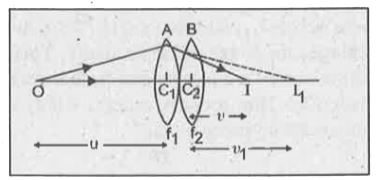 `:. 1/v_1 - 1/u = 1/(f_1)…(i)` Now place lens B in contact with A. The image `I_1`, will SERVE as virtual object and form a real image From lens formula, we have. `-1/v_1 + 1/v = 1/(f_2)...(ii)` ADDING (i) and (ii), we get `1/v - 1/u= 1/f_1 + 1/(f_2)...(iii)` But `1/v -1/u = 1/f` where f is effective focal length of the combination. So, Eq. (iii) becomes `1/f = 1/f_1 + 1/f_2` (b) We know that the critical ANGLE of glass is about `42^@`. if a prism is so designed that its angles are `45^@, 45^@,90^@`,if is said to be a totally reflecting prism. Its principal section is a RIGHT angled isosceles triangle. Since the rays are incident at angle of `45^@` i.e. greater than critical angle of glass (`42^@` nearly), the rays suffer total internal reflection and the plane surface acts as mirror. In the given figure, the face ac acts as a mirror and inverts the image without producing any deviation i.e. deviation of light through `180^@`. 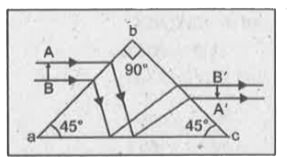
|
|