

Saved Bookmarks
| 1. |
(a) Obtain Lens Maker's formulausing the expression (n_(2))/( v) - ( n_(1))/( u ) = ((n_(2) - n_(1)))/( R ) Here the ray of light propagating from a rarer medium of refractive index ( n_(1)) to a denser medium of refractive index ( n_(2)) is incident on the convex side of spherical refracting surface of radius of curvature R. (b) Draw a ray diagram to show the image formation by a concave mirror when the object is kept between its focus and the pole. Using this diagram , derive the magnification formula for the image formed. |
Answer» Solution :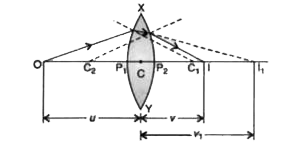 For refraction at the first SURFACE `(n_(2))/( v_(1)) - ( n_(1))/( u ) = ( n_(2) - n_(1))/( R_(1))`...(i) For the second surface, `I_(1)` acts as a virtual object ( located in the denser medium ) whose final real image is formed in the rarer medium at I. so for refraction at this surface, we have `(n_(1))/( v) - ( n_(2))/( v_(1) ) = ( n_(1) - n_(2))/( R_(1))`...(ii) From equations (i) and (ii) , `(1)/(v) - ( 1)/(u) = ((n_(2))/(n_(1))-1) ((1)/( R_(1)) - ( 1)/( R_(2)))` The point, where image of an object, located at infinity is formed, is called the focus F, of the lens and the distance f gives its focal length. so for u `= oo, , v = + f ` `rArr (1)/( f) = (( n_(2))/(n_(1) ) - 1) ((1)/( R_(1)) - ( 1)/( R_(2)))` (B) 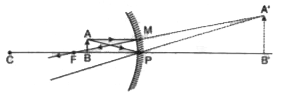 `Delta ABP` is similar to `DELA A.B.P` So `(A.B.)/( AB) = ( B.P)/( BP )` Nor `A.B. = I, AB =0, B.P= +v` and `BP = - u` So magnification `m = ( I )/( O ) = - ( v )/( u )` |
|