

Saved Bookmarks
| 1. |
A parallel plate capacitor with circular plates of radius 1 m has a capacitance of 1 nF. At t = 0, it is connected for charging in series with a resistor R = 1 M Onega across a 2V battery. Calculate the magnetic field at a point P, halfway between the centre and the periphery of the plates, after t=10^(-3)s. (The charge on the capacitor at time t is q (t) = CV [1 - exp (-t//tau)], where the time constant tau is equal to CR.) |
|
Answer» Solution :Here, during charging of a capacitor, CHARGE on its PLATE changes with time ACCORDING to formula `q=CV(1-e^(-t//RC))`. Hence surface charge density on the plate changes according to `sigma =(q)/(A)`. Hence electric field between the plates of a capacitor changes according to `E=(sigma)/(in_(0))`. Because of this electric flux, associated with area `A_(1)=pi r_(1)^(2)` between the plates changes according to `Phi_(E )=A_(1)E` which gives rise to displacement current `i_(d)=in_(0)(d Phi_(E ))/(dt)`. Because of this, we get induced magnetic field B whose magnitude can be obtained USING Ampere - MAXWELL law. During the charging of a capacitor, charge on the plate of a capacitor at time t is given by `q=q_(0)(1-e^(-t//tau))` (Where `q_(0)=CV=` maximum charge on the plate of a capacitor and `tau = RC =` time constant) `therefore q=CV(1-e^(-t//RC))` `therefore q=CV-CV e^(-t//RC)` `therefore (dq)/(dt)=0-CV e^(-t//RC)(-(1)/(RC))=(V)/(R )e^(-t//RC)`....(1) (Where R = external resistance in the circuit) At time t, displacement current enclosed by Amperean loop of radius r given by, `i_(d)=in_(0)(d Phi_(E ))/(dt)` `therefore i_(d)=in_(0)(d)/(dt){A.E}` (Where A. = area enclosed by considered circular Amperean loop `= pi r^(2)` and r = radius of this loop) `therefore i_(d)=in_(0)(d)/(dt){pi r^(2)xx(sigma)/(in_(0))}` (Where `sigma =` surface charge density on the plate of a capacitor) `therefore i_(d)=pi r^(2)(d)/(dt)(sigma)` `=pi r^(2)(d)/(dt)((q)/(pi R_(0)^(2)))` (Where `R_(0)=`radius of plate of a capacitor) `=((r )/(R_(0)))^(2)(dq)/(dt)` `therefore i_(d)=((r )/(R_(0)))^(2)(V)/(R )e^(-t//RC)` [From equ. (1)]....(2) Placing the respective values, `i_(d)=((0.5)/(1))^(2)((2)/(1xx10^(6)))(2.718)-((10^(-3))/(1xx10^(6)xx1xx10^(-9)))` `therefore i_(d)=(1)/(4)xx(2)/(10^(6)xx(2.718))` `therefore i_(d)=0.184xx10^(-6)A` 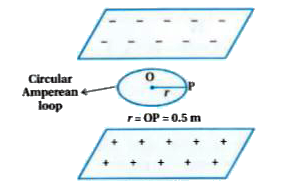 Now, as shown in the figure, because of above displacement current, magnitude of magnetic field at each point on the circumference of circular Amperean loop, considered between the plates of a capacitor, parallel to its plates will be same. If this magnitude is B then, according to Ampere - Maxwell, line integration of induced magnetic field, taken over loop will be, `oint vec(B).vec(d)l=mu_(0)(i_(c )+i_(d))` `therefore int B dl cos 0^(@)=mu_(0)(0+i_(d)) ""`(`because` In the region between the plates `i_(c )=0` and `vec(B)"||"vec(d)l`) `therefore B int dl=mu_(0)i_(d)` `therefore B(2pi r)=mu_(0)i_(d)` `therefore B=(mu_(0)i_(d))/(2pi r) ""`...(3) `=(4pi xx10^(-7)0.184xx10^(-6))/(2pi xx0.5)` `therefore B=0.736xx10^(-3)T` |
|