

Saved Bookmarks
| 1. |
A point is located at a distance 100 cm from the screen. A lens of focal length 23 cm mounted on a movable frictionless stand is kept between the object and screen. The stand is attached to massless spring of natural length 50 cm and spring constant 800(N)/(m) as shown in the figure. Mass of the stand with lens is 2 kg. Initially spring is in its natural length. Now a sharp impulse J is given to the stand. Answer the following questions. Q. Choose the correct options (s): |
|
Answer» Impulse J imparted to the stand is `8kg(m)/(sec)` 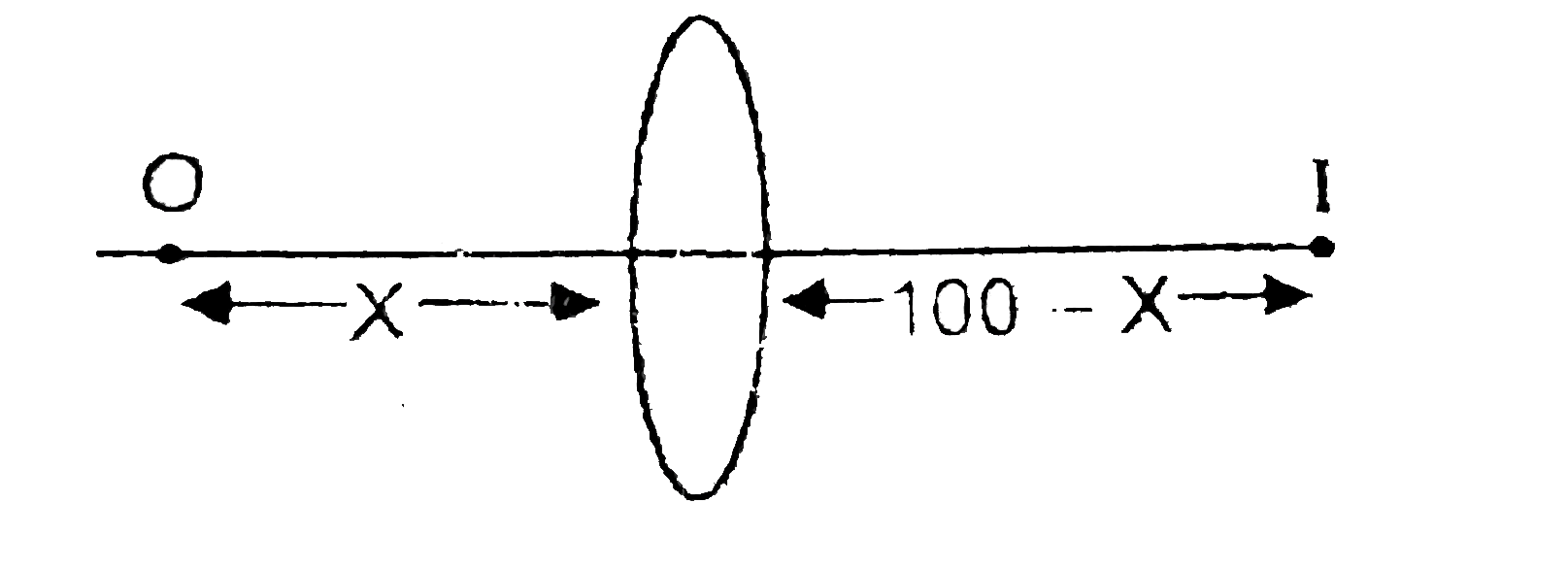 `f=+23cm` `(1)/(100-x)+(1)/(x)=(1)/(23)` `implies(100)/(100x-x^(2))=(1)/(23)` `x^(2)-100x+2300=0` `x=(100+-sqrt(10000-9200))/(2)=50+-10sqrt(2)` `x=(50-10sqrt(2))cm,(50+10sqrt(2))cm`. Mean position is `x=50` REAL images will be formed when x `=(50-10sqrt(2))cm` or `x=(50+10sqrt(2))cm`. since time difference between two consecutive real image formation on SCREEN in same and this repeats four times in an oscillation, so displacement from mean position i.e., `Deltax=10sqrt(2)=(A)/(sqrt(2))`. Here A is amplitude 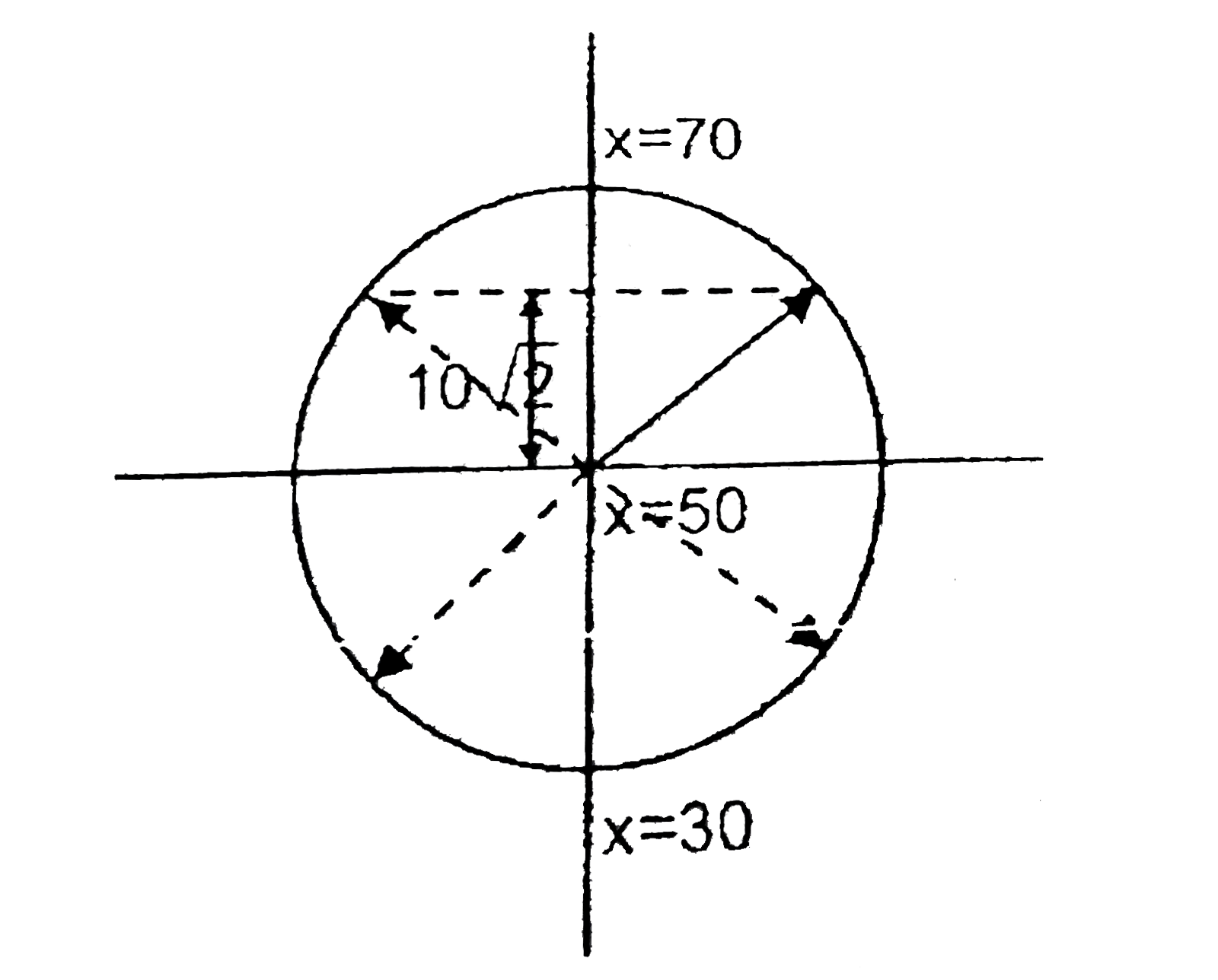 `impliesA=20cm` `t_(0)=((pi)/(2))/(omega)=(pi)/(2omega)` `omega=sqrt((k)/(m))=sqrt((800)/(2))=20` `t_(0)=(pi)/(40)sec` Impulse imparted `=J=momegaA` `=2.20(1)/(5)=8N-S` |
|