

Saved Bookmarks
| 1. |
A point source of light is placed at a depth of h below the calm surface of water. From the source, light rays can only be transmitted to air through a definite circular section. (i) Draw the circular section of the surface of water by ray diagram and mark its radius r. (ii) Determine the angle of incidence of a ray of light incident at any point on the circumference of the circular plane. ["Given : refractive index of water", mu = (4)/(3) , 48^(@)36' = sin^(-1)] (iii) Show that r = (3)/(sqrt7)h. |
|
Answer» Solution :(i)Let MN be the open SURFACE of water {Fig. 240]. O is the source of light at a depth h below the surface of water. Light rays incident on the surface of water from O at angles less than critical angle transmit in air after refraction. At the points A and B the light rays are incident at angles equal to the critical angle `(theta)`. So the refracted rays at these two point graze along the surface of separation. So light rays will transmit outside water only through the circular section of water excluding this circular section, they will be totally reflected from the surface of water and will return to water. (II) Let the angle of incidence be `theta`. `sintheta = (1)/(a^(mu)w) = (1)/(mu) = (3)/(4) = sin48^(@)36. or, theta = 48^(@)36.` (iii) From the triangle AOP, `tantheta = (AP)/(OP) = (r)/(h) or, (sintheta)/(costheta) = (r)/(h)` `or, "" ((1)/(mu))/(sqrt(1-(1)/(mu^(2)))) = (r)/(h) [therefore sintheta = (1)/(mu)]` `or, "" r = (h)/(sqrt(mu^(2) - 1)) = (h)/(sqrt(16/(9) -1)) = (3)/(sqrt(7))h` 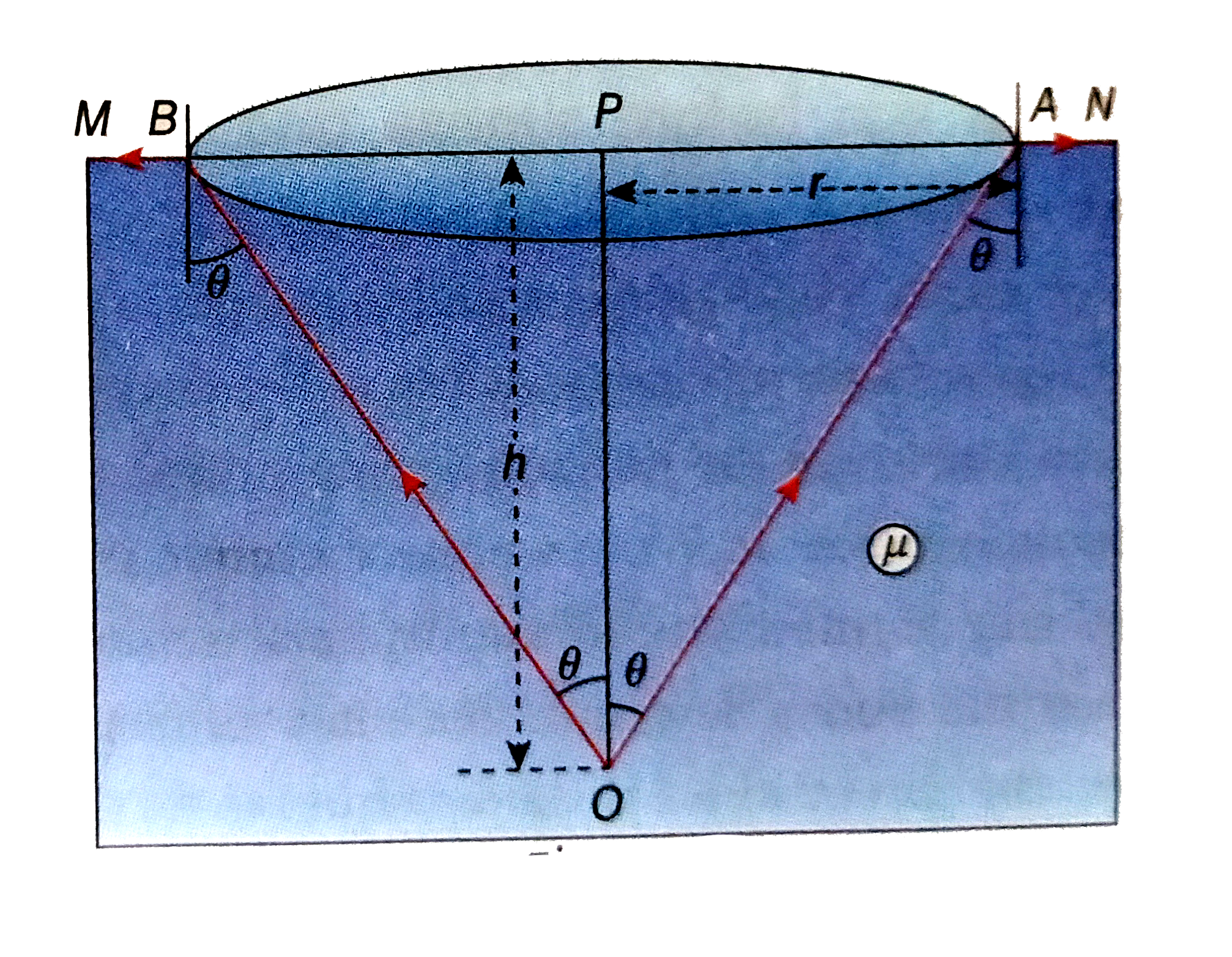
|
|