

Saved Bookmarks
| 1. |
A radio nuclide with half life T = 69.31second emits beta-particles of average kinetic energy E = 11.25eV. At an instant concentration of beta-particles at distance, r = 2m from nuclide is n = 3 xx 10^(13) per m^(3). (i) Calculate numberof nuclei in the nuclide at that instant. (ii) If a small circular plate is placed at distance r from nuclide such that beta-particles strike the plate normally and come to rest, calculate pressure experienced by the plate due to collision of beta-particle. (Mass of beta-particle = 9 xx 10^(-31)kg) (log_(e) 2 = 0.693) |
Answer» 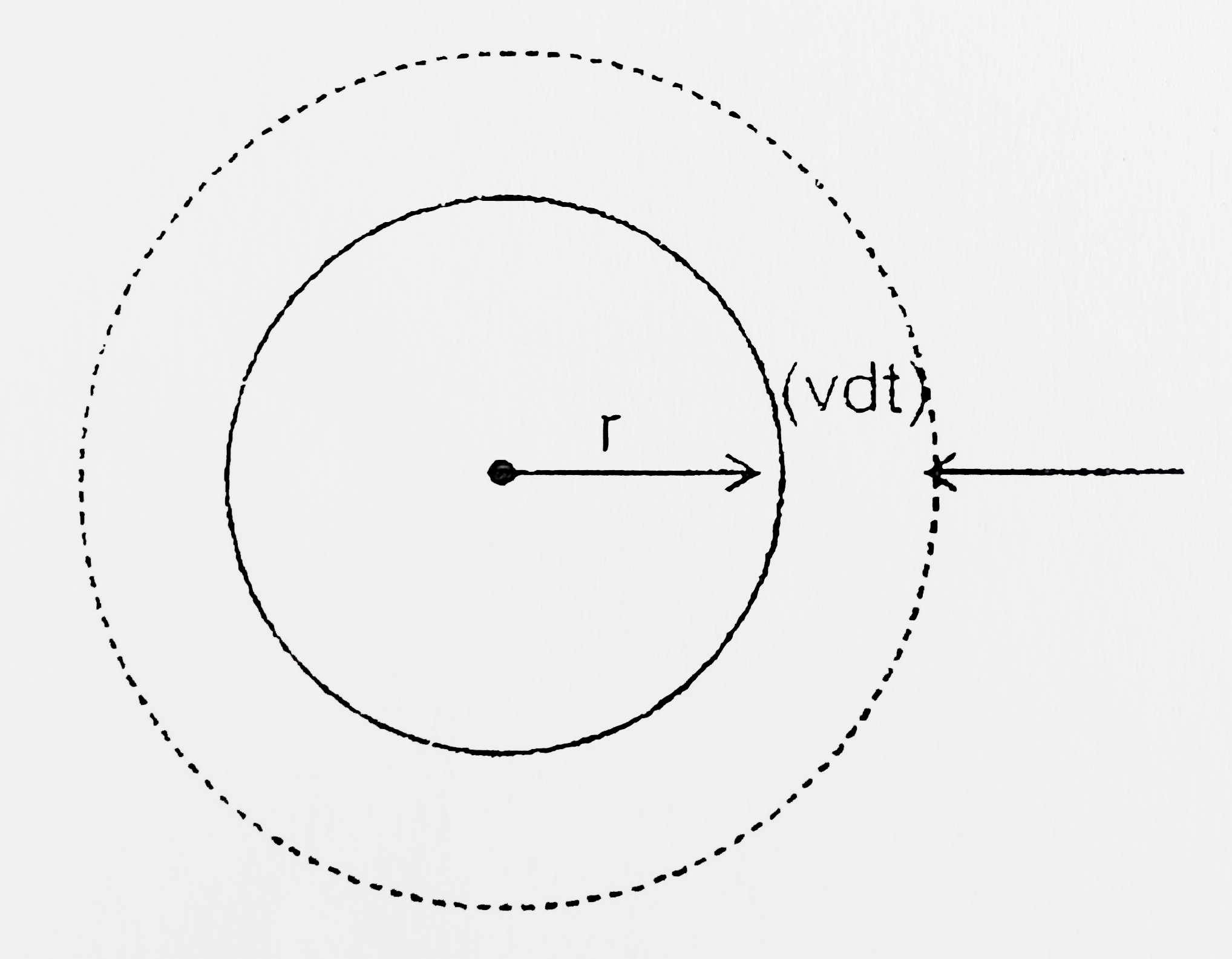 Volume of this space `=4 pi r^(2)(v dt)` `:.` Concentration of `b`-particles at distance `r` from nuclide is `n=(A dt)/(4pi^(2)(vdt))` oractivity of the nuclide, `A=4 pi r^(2)vn` But activity, `A= lambda N` where `N` is number of nuclei Hence, `N=(4pir^(2)vn)/(lambda)` butdecay constant `lambda=(log 2)/(T)` `N=(4pir^(2)vnT)/(0.6931)`........(1) Kinetic energy of `beta`-particle `E=(1)/(2)mv^(2)` `v=SQRT((2E)/(m))` substituting this VALUE in equation (1) , `N=(4pir^(2)nT)/(0.6931)sqrt((2E)/(m))=9.6 pi xx10^(22)` (ii) At distance `r` from the nuclide `(A//4 pi r^(2)) beta`-particle cross UNIT area per second. Let area of small circular plate be `S`, then number of `beta`-particle striking the plate per second `=(A)/(4pir^(2))S=(lambdaN)/(4pir^(2))S=(0.6931NS)/(4pir^(2)T)` Momentum of each particle just before collision is `mv` and after collision particles come to rest or momentum becomes Zero. `:.` Momentum transferred to plate due to collision is `Delta p= mv-0= mv` Due to transfer of momentum, the plate experiences a force which is equal to rate of transfer of momentum. `:.` Force, `F=Delta pxx"no".` of particles striking per second or `F=mvxx(0.6931NS)/(4pir^(2)T)` Pressure, P= Force per unit area `:. P=(F)/(S)=(0.6931N)/(4pir^(2)T)mv` but `v=sqrt(2E)/(m)` `:."" P=(0.6931N)/(4pir^(2)T)sqrt(2mE)=1.08xx10^(-4)Nm^(-2)` |
|