

Saved Bookmarks
| 1. |
A ray of light is refracted through a transparent sphere of refractive from mu in such a way that the ray passes through the ends of two radii inclined at an angle theta with each other. If delta is the angle of deviation of the ray while passing through the sphere then prove that, mu=("cos"(1)/(2)(theta-delta))/("cos"(theta)/(2)) |
|
Answer» Solution :Let the ray PQ incident at Q on the sphere, is refracted along QR and emerges from the sphere along RS [FIG. 2.12]. Of the triangle OQR , OQ = OR (both are radii of the sphere). `therefore "" angleOQR = angleORQ` Let angle of INCIDENCE of the ray at`Q = anglePQN = i` and angle of refraction ` = angleOQR = R` So the angle of incidence of the ray at R is r and angle of refraction i.e. angle of emergence is i. Angle of deviation of the incident ray, `delta = angleMTR = angleTQR + angleTRQ` `= (i -r) + (i -r) = 2(i - r)` From the triangle OQR we have, `r + r + theta = 180^(@)` `or, "" 2r + theta = 180^(@) or, r = 90^(@) - (theta)/(2)` From equation (1) we get, `(delta)/(2) = i - r or, i = (delta)/(2) + r = (delta)/(2) = 90^(@) + (delta)/(2) - (theta)/(2)` Considering refraction at Q, `mu = (sini)/(sinr) = (sin(90^(@) + (delta)/(2) - (theta)/(2)))/sin(90^(@) - (theta)/(2))` `sin{90^(@) - (1)/(2) (theta - delta)}/(cos(theta)/(2)) = (cos""(1)/(2)(theta - delta))/(cos(theta)/(2))` 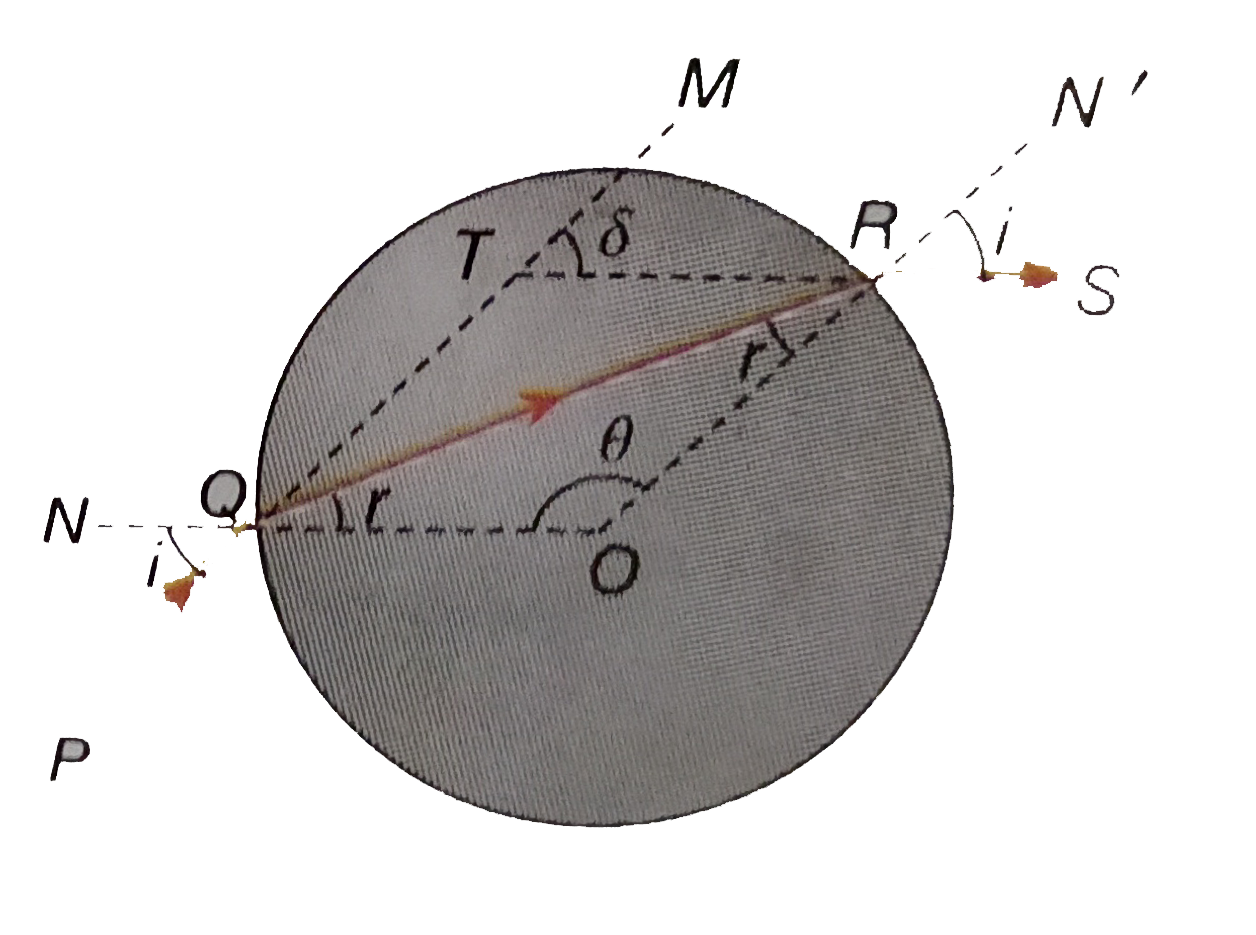
|
|