

Saved Bookmarks
| 1. |
A rod of leng th 'l' rests at a point A against a smooth vertial wall while end B is on the floor as shown in the fig. If the end Amoves uniformly downwards, what will be the velocity of the end B if x is the distance of point B from wall. |
|
Answer» `v_(B)=sqrt(l^(2)/x^(2) -1.v_(a))` `x^(2)+y^(2)=l^(2)` or `2xdx/dt+2y(dy)/(dt)=0` or `(dx)/(dt)=v=-y//x((dy)/(dt))=y//x.v_(a)` As `v_(a)` is constant magnitude of the given DOWNWARD velocity as .y. decreases with time. Then `v_(b)=y//x.v_(a)` But `y=sqrt(l^(2)-x^(2))` `:.v_(b)=sqrt((l^(2)-x^(2))/x).v_(a)` 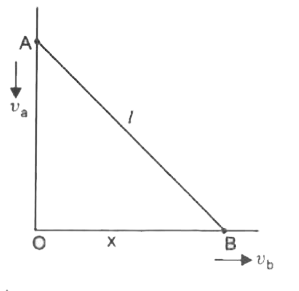
|
|